


A civil sex abuse lawsuit is a legal action a survivor files — not the government — to seek financial accountability from the person or institution that caused the harm.
A dropped, dismissed, or unfiled criminal case does not prevent a survivor from pursuing a civil claim — the two tracks operate independently.
A civil lawsuit gives survivors direct control over their own legal case, independent of what police or prosecutors decide to do.
Third Coast Lawyers offers confidential consultations for civil sex abuse survivors in Illinois and Wisconsin — no obligation, no upfront cost. Contact the firm today.
If you’re ready to get started, call us now!
Most survivors who reach this page have already experienced something that felt like a second loss. They filed a police report. They waited. Then came the call — the investigation stalled, the prosecutor declined to charge, or the case closed without action. In that moment, the legal system appears to have made its decision.
That impression is understandable. But it rests on a misunderstanding that costs survivors their options — sometimes permanently. The criminal system and the civil system operate as two entirely separate legal tracks.
One closing does not close the other. When a criminal case ends without charges, the survivor’s civil legal options remain fully intact.
A civil sex abuse lawsuit is a legal action a survivor — called the plaintiff — files against the individual or institution that caused the harm, called the defendant.
Unlike a criminal prosecution, which the state controls and aims to punish through incarceration, a civil lawsuit belongs to the survivor and seeks financial accountability: compensation for what was taken.
Civil law reaches further than most survivors realize. The direct abuser is an obvious defendant, but courts also hold accountable the institutions that enabled, concealed, or failed to prevent the abuse.
Schools, religious organizations, employers, youth sports programs, and healthcare systems — any entity that carries a duty of care and failed to meet it — can be named as a defendant in a civil sex abuse case.
In many cases, those institutions carry greater financial resources than the individual abuser, making civil recovery viable even when the abuser holds no personal assets.
| Criminal Case | Civil Lawsuit | |
| Who controls the case | The government (prosecutor) | The survivor (plaintiff) |
| Standard of proof | Beyond a reasonable doubt | Preponderance of the evidence (51%+) |
| Goal of the case | Incarceration, probation, and sex offender registration | Financial compensation is paid to the survivor |
| Who the survivor is | A witness, not a party | The plaintiff is in control of all decisions |
| Can both run simultaneously? | Yes | Yes |
In a criminal prosecution, the state controls every decision. The prosecutor decides whether to file charges, which charges to pursue, whether to negotiate a plea, and whether to take the case to trial.
The survivor is a witness — an important one, but not a party. The survivor cannot force a prosecution forward and cannot stop one.
In a civil lawsuit, the survivor is the plaintiff. The survivor, working with their attorney, decides whether to file, who to name as defendants, whether to accept a settlement offer, and whether to go to trial. Every major decision belongs to the person who was harmed.
That shift in control is not merely procedural — for many survivors, it is the first moment in the entire process when they exercise agency over what happens next.
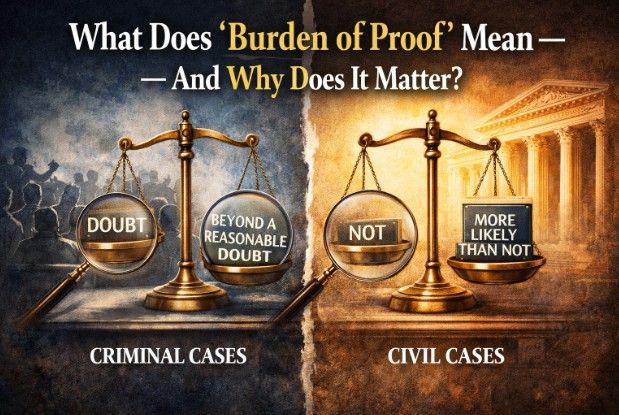
The burden of proof is the standard of evidence a party must meet to win a case. In criminal law, that standard is beyond a reasonable doubt — the highest bar in the legal system, designed to protect people from wrongful imprisonment. A jury must be firmly convinced that the defendant committed the crime.
In civil law, the standard is preponderance of the evidence. This means the evidence demonstrates it is more likely than not that the abuse occurred, often described as 51% certainty.
Conduct that a prosecutor could not prove to a criminal jury beyond a reasonable doubt can be proven in civil court under this lower standard. Under Wisconsin civil procedure standards, a civil plaintiff does not need to eliminate reasonable doubt — only to tip the scales of evidence in their favor.
Anna Gonis O’Connor, managing partner at Third Coast Lawyers, notes that the difference in burden of proof is the most misunderstood aspect of civil abuse litigation — and the most consequential for survivors evaluating whether a civil claim is viable.
This distinction explains why survivors can win in civil court even when criminal charges were never filed, or when an accused abuser received a criminal acquittal.
A criminal conviction can result in incarceration, probation, mandatory sex offender registration, and other state-imposed consequences. The government imposes these outcomes as punishment and public protection. The survivor receives no direct financial remedy from a criminal verdict.
A civil lawsuit results in monetary compensation paid directly to the survivor. That compensation covers medical costs, psychiatric care, therapy, lost income, pain and suffering, and — in cases involving especially egregious conduct — punitive damages. These outcomes are not mutually exclusive.
A criminal case and a civil lawsuit can run simultaneously, or a civil case can move forward entirely on its own — with or without a criminal investigation ever taking place.
Key takeaway: “A criminal case can send someone to prison. A civil case can provide the survivor with financial resources to rebuild.”
Yes — and this point matters more than most survivors realize. A civil lawsuit requires no criminal charge, prosecution, or conviction. The two legal systems operate independently.
The outcome of a criminal case, including an acquittal, carries no binding effect on a civil lawsuit.
The most common scenarios where survivors assume their civil options are gone — but are not:
| Scenario | Civil Lawsuit Status |
| Charges were never filed | Civil lawsuit remains fully available |
| The abuser was acquitted at trial | A civil lawsuit can still proceed and succeed |
| The criminal statute of limitations has passed | Civil SOL is separate; many states have extended windows |
| Investigation stalled or closed | No effect on civil claim viability |
Civil lawsuits carry their own statute of limitations — separate from criminal law. Following nationwide legislative reform driven by survivors’ advocacy, many states have enacted lookback windows or extended filing deadlines specifically for abuse cases.
The Childhood Sexual Abuse Statute of Limitations Project tracks current state-by-state deadline extensions and revival statutes. An attorney can review the specific circumstances, jurisdiction, and timeline to determine what options remain open.
The Wisconsin sexual abuse lawyers at Third Coast Lawyers assess statute of limitations eligibility as part of every confidential initial consultation.
Has a criminal case closed without resolution? Third Coast Lawyers helps survivors in Wisconsin and Illinois understand their civil legal options — schedule a confidential consultation.
If you’re ready to get started, call us now!
Civil damages in sex abuse cases do not reduce what happened to a number. They create financial resources the survivor needs to heal, stabilize, and rebuild — and they hold wrongdoers accountable in a way that is permanent and documented.
Categories of compensation available in a civil sex abuse lawsuit:
| Category of Damages | What It Covers |
| Medical and psychiatric care | Past and future treatment costs resulting from the abuse |
| Therapy and counseling | Ongoing mental health support related to trauma |
| Lost income | Wages lost due to the trauma’s impact on work capacity |
| Diminished earning capacity | Long-term impact on career trajectory and income potential |
| Pain and suffering | Compensation for physical and emotional harm endured |
| Loss of enjoyment of life | Damage to relationships, quality of life, and daily functioning |
| Punitive damages | Additional financial penalties were imposed where the conduct was especially egregious |
Punitive damages are not available in every case. Where a court finds that a defendant’s conduct was intentional, reckless, or involved active concealment of abuse, punitive awards can significantly exceed compensatory damages.
The American Bar Association’s civil litigation resources outline how punitive damage standards vary by jurisdiction. Courts impose punitive awards both as punishment and deterrent — and as a public record of the defendant’s conduct.
Third-party institutional liability is one of the most underutilized tools in civil sex abuse litigation. Schools, religious organizations, healthcare systems, youth sports programs, and employers can be held civilly liable when they knew — or should have known — that abuse was occurring and failed to act.
The Wisconsin sexual abuse attorneys at Third Coast Lawyers evaluate institutional negligence claims alongside individual defendant liability in every case.
Institutions matter in civil litigation for a concrete reason. Individual abusers often hold limited personal assets.
A judgment against them may be uncollectible. Institutions — churches, school districts, hospital systems, and corporations — typically carry insurance coverage, endowments, or operating budgets that make civil recovery viable.
Naming an institution as a defendant changes the financial landscape of the case entirely.
Three primary legal theories apply to institutional defendants:
Negligent hiring — The institution employed a person it should have screened out or disqualified before placing them in contact with vulnerable individuals.
Negligent supervision — The institution failed to monitor known warning signs or respond to complaints about an employee’s or member’s conduct.
Failure to report — The institution had a legal obligation to report suspected abuse under mandatory reporting laws and failed to fulfill that obligation.
The wrongful death lawyers and toxic injury attorneys at Third Coast Lawyers bring the same institutional accountability framework to all civil negligence matters.
| Term | Plain-Language Definition |
| Plaintiff | The survivor who files the civil lawsuit |
| Defendant | The person or institution being sued |
| Burden of proof | The standard of evidence required to win the case |
| Preponderance of the evidence | The civil standard — more likely than not that the harm occurred |
| Beyond a reasonable doubt | The criminal standard — a substantially higher bar |
| Statute of limitations | The legal deadline for filing a lawsuit |
| Punitive damages | Additional financial penalties for especially harmful conduct |
| Third-party liability | Legal responsibility held by an institution, not just the direct abuser |
| Settlement | A negotiated resolution reached before or during the trial |
These definitions reflect general legal principles applicable in Illinois and Wisconsin as of 2026. A qualified attorney can explain how each applies to a specific situation, jurisdiction, and set of facts.
Can I sue my abuser if they were never charged with a crime?
Yes. Criminal charges are not required to file a civil lawsuit. Civil law and criminal law operate as separate legal systems with separate standards of proof. A survivor can pursue a civil claim whether or not a prosecutor ever filed charges against the abuser.
What if the statute of limitations has already passed?
Many states have enacted lookback windows or extended filing deadlines specifically for survivors of sexual abuse. These legislative changes mean that cases once considered time-barred may now be eligible. The Wisconsin sexual abuse lawyers at Third Coast Lawyers can determine whether a civil claim remains available, even years after the abuse occurred.
Will I have to testify or face my abuser in a civil case?
Many civil sex abuse cases are resolved through settlement before any trial occurs. When cases proceed to trial, attorneys work to limit unnecessary exposure for the survivor wherever the law permits. Whether testimony is required depends on the specific facts of the case — an attorney addresses this directly during the initial consultation.
How is filing a civil lawsuit different from reporting to the police?
A civil lawsuit is filed in civil court through a private attorney, not through law enforcement. The survivor works directly with their legal team — not investigators or prosecutors — and retains decision-making control throughout the case. Filing a civil claim does not require a prior police report and does not trigger a criminal investigation.
What if the abuser has no money — can I still win?
Yes. Civil suits can target institutions — schools, religious organizations, employers, healthcare systems — that carry far greater financial resources than individual abusers. The sexual abuse attorneys at Third Coast Lawyers evaluate institutional liability as part of every case assessment. Courts can also structure judgments to allow collection over time.
Can a civil case and a criminal case happen at the same time?
Yes. Civil and criminal proceedings are legally independent and run simultaneously without either interfering with the other. The O.J. Simpson cases are the most widely known public example — a criminal acquittal was followed by a successful civil wrongful death verdict. Evidence standards, parties, and outcomes are entirely separate in each proceeding.
What does it cost to hire an attorney for a civil sex abuse case?
Most civil sex abuse attorneys, including the team at Third Coast Lawyers, work on a contingency fee basis. The survivor pays no upfront cost. Legal fees are collected only if the case produces a recovery. The contingency model exists specifically to ensure that access to civil justice does not depend on a survivor’s financial resources.
If you came here feeling like the system had already made its decision — as if a door had closed — this is the point worth holding on to: the criminal system and the civil system are not the same door. One closing does not lock the other.
Pursuing a civil lawsuit is a significant decision. It belongs entirely to you. Understanding your options is not a commitment to anything. It is information.
The attorneys at Third Coast Lawyers have represented survivors of sexual abuse in civil cases across Illinois and Wisconsin. Anna Gonis O’Connor, founding partner and managing partner, brings over 20 years of civil litigation experience and more than 50 jury trials to every case the firm handles.
Every consultation is confidential. Nothing shared creates an obligation. The only goal of that first conversation is to understand what options exist.
Third Coast Lawyers represents civil sex abuse survivors across Wisconsin and Illinois on a contingency basis — no upfront fees. Schedule your confidential consultation now.

About the Author
Managing Partner · Toxic Tort Trial Attorney · Licensed in Wisconsin, Illinois, and Missouri
Anna G. O'Connor is the founding member and managing partner of Third Coast Lawyers and a trial attorney licensed in Wisconsin, Illinois, and Missouri. She practices across the Midwest and has tried more than 50 jury trials during her 20-plus-year legal career. Anna represents workers and families in toxic tort matters, including asbestos and mesothelioma claims, in Wisconsin, Illinois, and Missouri state courts, federal courts, and multi-district litigation proceedings.
