

The deadline to file a civil sex abuse lawsuit — called the statute of limitations — varies by state, by the survivor’s age at the time of abuse, and by the nature of the claim. Many survivors who believe they have missed their window have not.
Exceptions, extensions, and lookback windows enacted across the United States since 2019 have dramatically expanded survivor rights, so survivors who assumed the door was closed are finding it open more often than not.
Anna O’Connor has spent over 20 years in Illinois civil litigation, and one question follows her into nearly every initial consultation — survivors call certain their time has run out, and the answer surprises them more often than not.
The Wisconsin sexual abuse lawyers at Third Coast Lawyers assess filing eligibility as the first step of every consultation — because everything else in a civil claim depends on whether the window is open.
Third Coast Lawyers offers free confidential consultations for survivors in Illinois and Wisconsin — including those who believe their deadline has passed. Contact the firm today.
The statute of limitations is the one legal issue that can permanently foreclose a valid civil claim. Not the strength of the evidence. Not the passage of time alone. A missed legal deadline — and nothing else — is what ends a case before it begins, so survivors who delay getting an accurate answer lose the one resource civil law cannot restore.
Many survivors carry abuse for years before they feel ready to come forward. State legislatures across the country have recognized this reality and responded — extending deadlines, creating discovery exceptions, and passing revival statutes specifically because the traditional rules failed the people they were supposed to protect.
Assumptions — “it’s been too long,” “it happened when I was a child,” “the criminal case was dropped” — are not legal analysis. They are guesses. Acting on them without speaking to an attorney is one of the most consequential decisions a survivor can make.
A statute of limitations is a legally imposed deadline by which a lawsuit must be filed — a procedural gate that closes regardless of the merits of the underlying claim. After the deadline expires, a court will generally refuse to hear the case, so the filing deadline is not a formality. It is the threshold question every civil sex abuse case must clear first.
These deadlines exist in both criminal and civil law, but the two run on entirely separate clocks. A criminal statute of limitations expiring does not affect the civil deadline. A prosecution ending — or never starting — does not start or stop the civil limitations period.
The most critical nuance in sex abuse cases: the clock does not always start on the date the abuse occurred. When the limitations period begins is often as legally significant as how long it runs.
If you’re ready to get started, call us now!

A statute of limitations in civil sex abuse cases is a state law — a deadline set by each state’s legislature independently, with no single federal rule governing all claims. Every state has established its own window, and those windows differ dramatically across jurisdictions.
Some states allow survivors one to three years from the date of abuse or discovery. Others have extended windows of a decade or more.
A growing number of states have eliminated the civil deadline for childhood sexual abuse entirely — so a survivor in one of those states faces no filing deadline at any point in their lifetime.
RAINN’s state law database tracks current filing windows by jurisdiction and updates as legislation changes.
This variation is why generic answers are dangerous. A survivor in Illinois may hold options that a survivor in another state does not.
The only reliable answer is one delivered by an attorney who knows the current law in the specific state where the claim will be filed — so survivors get an accurate picture of their options, not an approximation.
Two trigger points govern most civil sex abuse claims, and understanding the difference between them is what determines whether a claim that appears time-barred actually is.
Date of the abuse is the traditional starting point — the clock begins running on the day the abuse occurred. For adult survivors of a single incident, this rule can be straightforward.
For childhood sexual abuse survivors, it has proven profoundly unfair, requiring children to file claims they had no legal capacity or psychological readiness to pursue.
Date of discovery — governed by the discovery rule — is a legal doctrine starting the clock not when the abuse occurred, but when the survivor knew or reasonably should have known that the abuse caused their harm.
Courts developed this doctrine because trauma, repression, and the power dynamics embedded in abuse mean survivors frequently cannot connect their psychological injuries to their cause until years or decades later.
The American Law Institute’s Restatement of Torts establishes the theoretical foundation for the discovery rule across civil tort claims — so survivors who spent years in therapy before understanding the source of their harm may find the clock has not yet started.
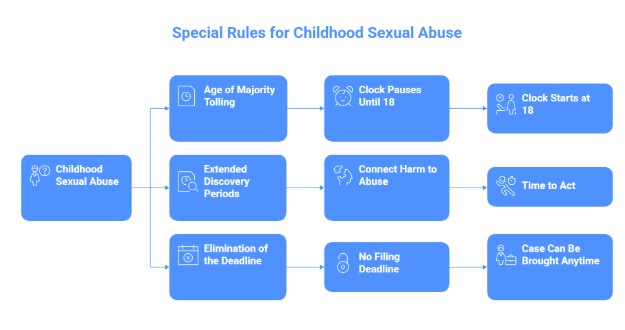
Tolling is a legal mechanism that pauses the statute of limitations clock under defined conditions. Age of majority tolling pauses the clock entirely until the survivor turns 18 — so the limitations period does not run during childhood.
An adult survivor of childhood abuse does not lose time that passed before their 18th birthday, and the clock starts — or resumes — only at legal adulthood.
Extended discovery periods add additional years after the survivor, now an adult, connects their current psychological or physical harm to the childhood abuse.
These periods recognize that the developmental impact of childhood abuse often does not become legible to the survivor until adulthood therapy, a triggering life event, or public disclosure of an institutional abuse pattern they were part of, so survivors have time to act once they understand what happened to them.
Elimination of the deadline is the most significant legislative shift of the past decade. States including California, New Jersey, and New York have removed civil statutes of limitations for childhood sexual abuse entirely for certain claim types.
A survivor in those jurisdictions faces no filing deadline — the case can be brought at any point in the survivor’s lifetime, so the passage of time alone cannot foreclose a claim.
A lookback window — also called a revival statute — is a law that temporarily or permanently reopens the statute of limitations for survivors whose deadlines had already expired, so survivors who were previously time-barred regain the right to file.
State legislatures have enacted these laws specifically in response to institutional cover-ups — particularly in clergy abuse, school abuse, and youth organization abuse cases — where survivors were silenced for decades by the same institutions that held authority over them.
Notable lookback legislation enacted in recent years includes:
New York’s Adult Survivors Act (2022) opened a one-year window for adult survivors of sexual abuse to file civil claims regardless of when the abuse occurred. That specific window has closed. New York’s broader childhood sexual abuse lookback under the Child Victims Act remains in effect.
New Jersey’s statute of limitations reforms extended the civil filing window for childhood sexual abuse to age 55, with a two-year lookback for previously expired claims — so New Jersey survivors whose deadlines had passed gained a direct path back into civil court.
California’s AB 218 eliminated the civil statute of limitations for childhood sexual abuse and opened a three-year lookback window. The lookback window has closed. The elimination of the deadline for future claims remains in effect.
The status of these windows changes as legislation is enacted, extended, and expires. The Child USA legislative tracker monitors active and closed lookback windows by state and serves as the most current public resource on this topic.
The Wisconsin sexual abuse attorneys at Third Coast Lawyers have direct experience with revival statute claims and assess whether any applicable window — current or pending — applies to a survivor’s specific circumstances.
Not sure whether a lookback window applies to your case? Third Coast Lawyers reviews eligibility for the statute of limitations in every consultation. Schedule yours here.
If you’re ready to get started, call us now!
Delayed discovery is a legal doctrine recognizing that survivors — particularly those with trauma-induced memory repression — may not connect their harm to its cause until years after the abuse occurred, so the statute of limitations clock does not start at the date of abuse but at the point of recovery and connection.
In states that apply this doctrine to repressed memory cases, the limitations period does not begin until the survivor recovers the memory and understands its relationship to the harm they have experienced.
Courts developed the delayed discovery doctrine because standard limitations rules assume a plaintiff knows they were harmed.
Childhood sexual abuse survivors who repressed memories had no knowledge — not because they failed to act, but because the neurological response to severe trauma interrupted the formation or retrieval of those memories.
The American Psychological Association’s resources on trauma and memory document the clinical basis for delayed memory recovery in abuse survivors.
This doctrine is contested legal terrain. Not every state applies it. States that recognize it apply it inconsistently across fact patterns. Defendants routinely challenge repressed memory claims, and courts evaluate the specific circumstances carefully.
The application of delayed discovery to any individual case is highly fact-dependent — so a general answer from any written source, including this article, cannot substitute for an attorney’s direct assessment of the facts.
What the doctrine means in practice: a survivor who recovered memories of childhood abuse in 2023 or 2024 may be in a more viable legal position than they believe — if they are in a state that recognizes delayed discovery and if the specific facts support its application.
A civil claim against a deceased abuser’s estate is a legal action filed against the assets the abuser left behind — redirecting the claim toward probate proceedings rather than the individual.
An abuser’s death does not automatically extinguish a survivor’s civil rights. The estate and its assets remain subject to civil judgment.
Institutional claims — against schools, religious organizations, employers, or youth programs that enabled or concealed the abuse — are generally unaffected by the abuser’s death entirely.
The institution’s liability is independent of the abuser’s survival. A school district that negligently supervised an abusive employee remains civilly liable whether or not that employee is living, so survivors whose abuser has died retain a viable path to accountability through institutional defendants.
The wrongful death attorneys at Third Coast Lawyers handle cases where institutional negligence compounds individual harm, including situations where the direct abuser is deceased.
Physical evidence deteriorates. Institutional records get destroyed, lost, or deliberately purged. Medical documentation becomes harder to reconstruct. Every year that passes narrows the evidentiary foundation a civil claim can stand on — so survivors who wait lose ground that cannot be recovered.
Former employees, classmates, administrators, and co-survivors who can corroborate a claim move, lose contact, or die.
Witness identification and cooperation become less reliable with each passing year — and a civil case that needed one witness in 2024 may have no witness available in 2027.
A revival statute that is open today may not be open in six months. These are legislative deadlines with fixed endpoints. They do not extend because a survivor is not yet ready, so the window a survivor is counting on may close before they act.
Whatever the actual deadline is — and only an attorney can determine that with precision — it runs whether or not the survivor is tracking it.
A consultation costs nothing and closes no doors. Delay costs time. And time is the one resource civil law does not give back.
| Term | Plain-Language Definition |
| Statute of limitations | The legal deadline by which a lawsuit must be filed |
| Tolling | A legal pause on the limitations clock — stopping it from running under certain conditions |
| Discovery rule | A doctrine that starts the clock when the survivor knew or should have known about the harm |
| Age of majority | The age (typically 18) at which tolling often ends for childhood abuse survivors |
| Lookback window | A law that temporarily or permanently reopens the right to sue for survivors whose deadline had already passed |
| Revival statute | Another term for lookback window legislation |
| Delayed discovery | A doctrine recognizing that survivors with repressed memories may not connect harm to its cause until years later |
| Equitable tolling | A court’s discretionary power to pause the limitations clock when strict enforcement would produce a fundamentally unjust result |
These definitions reflect general legal principles applicable in Illinois and Wisconsin as of March 2026. A licensed attorney can explain how each doctrine applies to a specific set of facts and jurisdiction.
How long do I have to file a civil lawsuit for sexual abuse?
The filing window varies by state, ranging from one year to no deadline at all, depending on the jurisdiction and the survivor’s age at the time of abuse. No general answer applies reliably, so the Wisconsin sexual abuse lawyers at Third Coast Lawyers provide state-specific assessments in every initial consultation.
What if the abuse happened when I was a child — is it too late to sue?
Most states have extended or eliminated civil filing deadlines for childhood sexual abuse survivors, so many adults abused as children retain the right to file decades after the abuse occurred. An attorney familiar with your state’s current law can determine whether your specific claim remains viable.
What is a lookback window law, and does my state have one?
A lookback window is a law that reopens the civil filing deadline for survivors whose time had already expired. Several states enacted lookback windows between 2019 and 2024 — Child USA’s legislative tracker monitors current windows by jurisdiction, because status changes as legislation is enacted or expires.
Can I still file a lawsuit if the abuse happened decades ago?
Whether a decades-old claim remains viable depends on state law, the survivor’s age at the time, applicable exceptions, and whether any lookback window applies — and the answer is frequently yes in ways that surprise survivors. A direct consultation with a civil abuse attorney is the only reliable path to an accurate answer.
Does it matter that I didn’t report the abuse when it happened?
A police report is not required to file a civil sex abuse lawsuit, and failure to report — for any reason — does not eliminate or reduce a survivor’s civil legal rights. Courts and legislatures have consistently recognized the many reasons survivors do not report, so civil law does not penalize them for not doing so.
What if I repressed the memory and only recently remembered the abuse?
Some states apply the delayed discovery doctrine to repressed memory cases, meaning the limitations clock starts when the memory is recovered and connected to the harm, rather than on the date of abuse. Whether this doctrine applies depends on the state and specific facts, so an attorney’s direct assessment is the only reliable way to determine viability.
Does the statute of limitations change if I want to sue an institution rather than just the abuser?
Institutional claims may carry their own rules, and some lookback windows specifically target institutional defendants — schools, religious organizations, and employers — so the window to sue an institution can remain open even when the window to sue the direct abuser has closed. A legal consultation clarifies how the deadline applies to each defendant separately.
You have been carrying this. Maybe for years. Maybe you assumed the time had run out — that the law had already made its decision, the way every other institution seemed to.
The law has changed. In state after state since 2019, legislatures have extended deadlines, created new exceptions, and opened revival windows — specifically because survivors who could not come forward sooner deserved the chance to do so at all. Most survivors have not heard about these changes because no one told them.
Anna Gonis O’Connor and the team at Third Coast Lawyers have had this conversation with many survivors who were certain it was too late. Often, it was not.
One conversation — confidential, no obligation, no pressure — can give you an accurate answer about where you actually stand. That is the only goal: not to sign you up for anything, but to make sure you know what your options actually are.
Learn more about Wisconsin sexual abuse claims, wrongful death litigation, and institutional negligence cases across Illinois and Wisconsin.
Third Coast Lawyers represents civil sex abuse survivors across Wisconsin and Illinois — no upfront fees, contingency basis. Schedule your confidential consultation today.

About the Author
Managing Partner · Toxic Tort Trial Attorney · Licensed in Wisconsin, Illinois, and Missouri
Anna G. O'Connor is the founding member and managing partner of Third Coast Lawyers and a trial attorney licensed in Wisconsin, Illinois, and Missouri. She practices across the Midwest and has tried more than 50 jury trials during her 20-plus-year legal career. Anna represents workers and families in toxic tort matters, including asbestos and mesothelioma claims, in Wisconsin, Illinois, and Missouri state courts, federal courts, and multi-district litigation proceedings.
