

Illinois asbestos deadlines have two separate parts. The statutory period is two years under 735 ILCS 5/13-202. Separately, Illinois case law fixes when that period starts: a claim accrues when the claimant knows or reasonably should know both of an injury and that it was wrongfully caused.
Exposure alone does not start it. For toxic injury claims, determining the accrual date is ordinarily a question of fact rather than a calendar calculation.
Illinois runs a year shorter than Wisconsin and starts counting on facts, not dates. Third Coast Lawyers reviews diagnosis and employment records during a free consultation.
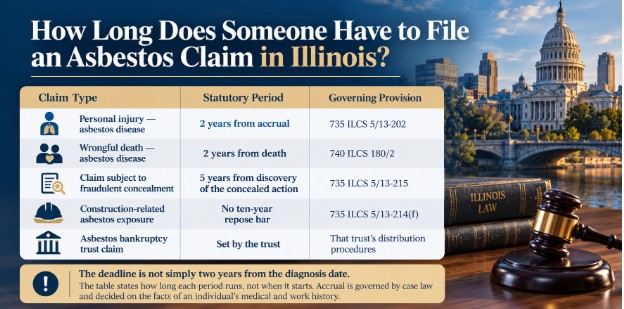
Two years covers most Illinois asbestos claims. 735 ILCS 5/13-202 sets the period for personal injury actions, measured from accrual.
| Claim Type | Statutory Period | Governing Provision |
| Personal injury — asbestos disease | 2 years from accrual | 735 ILCS 5/13-202 |
| Wrongful death — asbestos disease | 2 years from death | 740 ILCS 180/2 |
| Claim subject to fraudulent concealment | 5 years from discovery of the concealed action | 735 ILCS 5/13-215 |
| Construction-related asbestos exposure | No ten-year repose bar | 735 ILCS 5/13-214(f) |
| Asbestos bankruptcy trust claim | Set by the trust | That trust’s distribution procedures |
The deadline is not simply two years from the diagnosis date. The table states how long each period runs, not when it starts. Accrual is governed by case law and decided on the facts of an individual’s medical and work history.
Illinois also leaves less room for error than Wisconsin, whose comparable period under Wisconsin’s asbestos deadline rules runs three years.
A claim accrues when the claimant knows or reasonably should know of an injury and also knows or reasonably should know that it was wrongfully caused. The Illinois Supreme Court adopted that standard for asbestos disease in Nolan v. Johns-Manville Asbestos, 85 Ill. 2d 161 (1981), and restated it in Knox College v. Celotex Corp., 88 Ill. 2d 407, 415 (1981).
Two features matter in practice. First, the timing question is ordinarily one of fact for the trier of fact, resolved as a matter of law only where the facts are undisputed and permit a single conclusion.
Nolan knew he had lung problems in 1957 and pulmonary fibrosis in 1965, yet whether he should reasonably have connected that condition to workplace asbestos before 1973 remained a jury question.
Second, Knox College frames the trigger as the point at which a person holds enough information about an injury and its cause to put a reasonable person on inquiry as to whether actionable conduct is involved.
From that point, the period runs, and the claimant carries an obligation to investigate. Waiting for certainty is not the same as lacking knowledge.
A diagnosis identifying an asbestos-related disease and linking it to asbestos supplies both elements at once, which is why diagnosis so often marks the practical starting point. The legal test remains knowledge of injury and wrongful cause, not the date on a pathology report.
Illinois deadlines are decided on facts a claimant may not have gathered yet. Third Coast Lawyers reconstructs Illinois work histories — request a case review.
If you’re ready to get started, call us now!
No. Illinois accrual does not wait until a claimant can name the manufacturer whose product caused the exposure.
Knox College is explicit that “wrongfully caused” is a general or generic term rather than a term of art, and that it connotes neither knowledge of negligent conduct nor knowledge that a cause of action exists.
Nolan made the same point directly: the rule announced is not one under which a cause of action accrues only when a person knows of both the injury and the defendants’ negligent conduct.
Illinois appellate courts have since restated the principle as knowledge that an injury was wrongfully caused, meaning no knowledge of a specific defendant’s negligent conduct, in Castello v. Kalis, 352 Ill. App. 3d 736, 744 (2004).
The practical effect compresses an already short window. A claimant may need employment records, product identification, and a defendant list assembled inside the same two years that began running at diagnosis. That is why proving an asbestos exposure history starts immediately rather than after a defendant is identified, particularly where exposure spans several Illinois industrial sites.
Illinois removed the ten-year construction repose bar for asbestos claims. Governor Pat Quinn signed Public Act 098-1131 on 19 December 2014, effective 1 June 2015, adding subsection (f) to 735 ILCS 5/13-214.
Subsection (f) provides that the ten-year repose in subsection (b) does not apply to an action based on personal injury, disability, disease, or death resulting from the discharge into the environment of asbestos.
Before that amendment, a defendant in construction could argue no claim survived ten years after the work, regardless of when the disease appeared—a bar that defeated latent-disease claims by design.
The amendment removed the outer bar, not the filing window. Construction-exposure claims still run on the two-year period in section 13-202 and still accrue under Nolan and Knox College.
The Illinois Wrongful Death Act allows a personal representative two years from the date of death to bring a claim on behalf of the surviving spouse and next of kin.
That period runs separately from the decedent’s own, but the two are connected. In Wyness v. Armstrong World Industries, Inc., 131 Ill. 2d 403 (1989) — itself an asbestos case — the Illinois Supreme Court explained that although a wrongful death action is independent and does not arise until death, it is derivative of the injury to the decedent and rests on the same wrongful act.
A wrongful death action lies where the deceased held a claim that was not time-barred on or before death.
The converse follows, and Lambert v. Village of Summit, 104 Ill. App. 3d 1034 (1982), states it: where the personal injury period had already expired before death, the decedent had no right to sue at that moment, and the administrator cannot maintain a wrongful death action. Death does not reset a period that has already run.
This falls hardest on families who waited. Where a diagnosis came years before death, and no action was filed, the wrongful death claim inherits that problem rather than curing it. Families weighing an asbestos wrongful death claim should have both periods assessed together.
Illinois imposes no cap on compensatory damages in these actions. The General Assembly’s $500,000 cap on noneconomic damages was held unconstitutional in Best v. Taylor Machine Works, 179 Ill. 2d 367 (1997), as special legislation and a violation of separation of powers.
Yes, in narrow circumstances. Section 13-215 allows an action within five years after the claimant discovers a fraudulently concealed cause of action.
The provision demands more than a defendant staying quiet. Illinois courts require concealment consisting of affirmative acts or representations calculated to lull or induce a claimant into delaying a filing, or to prevent discovery of the claim; mere silence by a defendant, together with a claimant’s failure to learn of the action, does not suffice, as stated in Smith v. Cook County Hospital, 164 Ill. App. 3d 857, 862 (1987).
Two qualifications matter. Silence can be enough where a fiduciary relationship carries a duty to disclose facts bearing on the existence of a claim.
And where a claimant discovers the concealment with reasonable time still remaining in the ordinary limitations period, section 13-215 does not extend the deadline.
Claimants should treat this as an exception argued on evidence rather than a routine extension of the two-year period.
Senate Bill 328 became Public Act 104-0352 on 15 August 2025, permitting Illinois courts to exercise general jurisdiction over foreign corporations deemed to have consented, in qualifying toxic-exposure actions. It changes jurisdiction, not timing — the two-year period is unaffected.
The statute is narrower than general descriptions suggest. Two predicates must both be met, and consent timing varies by registration status.
| Element | Requirement Under PA 104-0352 |
| Subject matter | The action alleges injury or illness from exposure to a substance defined as toxic under the Uniform Hazardous Substances Act of Illinois |
| Co-defendant | At least one named co-defendant is otherwise subject to Illinois jurisdiction under 735 ILCS 5/2-209(a) |
| Newly registering corporations | Consent attaches on registration after 15 August 2025 |
| Already-registered corporations | Consent attaches on the next annual report due date after that date |
| Unregistered corporations transacting business | Consent attaches on each qualifying act and continues 180 days afterward |
| Termination | Consent ends on formal withdrawal from the state |
Illinois became the second state, after Pennsylvania, to adopt consent-by-registration jurisdiction following the United States Supreme Court’s decision in Mallory.
A challenge to the statute’s passage failed on the enrolled bill doctrine, and the Illinois Appellate Court affirmed dismissal in McCombie v. Welch, 2026 IL App (4th) 250971, released 11 August 2026.
That decision addressed only the legislative process, expressly making no finding on whether the three-readings rule was violated and none on the substantive validity of the jurisdiction provisions, which remain open to challenge.
The effect is to widen the field of reachable defendants in Madison and Cook County filings without lengthening the time available to file.
How long does someone have to file an asbestos lawsuit in Illinois?
Illinois sets two years under 735 ILCS 5/13-202, measured from accrual rather than from exposure. Accrual follows the discovery rule, so the starting date depends on when the claimant knew or should have known of the injury and its wrongful cause.
When exactly does the Illinois clock start running?
When the claimant knows or reasonably should know of an injury and that it was wrongfully caused, under Nolan v. Johns-Manville Asbestos and Knox College v. Celotex Corp., Illinois treats that timing as a question of fact unless undisputed facts permit one conclusion.
Must a claimant identify the responsible manufacturer before filing?
No. Knox College holds that “wrongfully caused” requires neither knowledge of a defendant’s negligence nor knowledge that a cause of action exists. The period runs once a reasonable person would be put on inquiry about actionable conduct.
Did the 2015 law extend the Illinois filing deadline?
No. Public Act 098-1131 added 735 ILCS 5/13-214(f), removing the ten-year construction repose bar for asbestos claims. The two-year filing period under section 13-202 was unchanged, and accrual still follows the discovery rule.
Can a family file after the personal injury deadline already expired?
Generally no. Wyness v. Armstrong World Industries and Lambert v. Village of Summit establish that a wrongful death action lies only where the decedent could still have sued at death. A claim does not revive upon the decedent’s death.
What does fraudulent concealment require in Illinois?
Affirmative acts or representations calculated to delay a filing or prevent discovery of the claim, under Smith v. Cook County Hospital. Silence alone generally does not qualify, though a fiduciary’s failure to disclose material facts can suffice in some circumstances.
Did Senate Bill 328 change Illinois filing deadlines?
No. Public Act 104-0352 addresses jurisdiction over foreign corporations in qualifying toxic-exposure actions, effective 15 August 2025. It can widen the pool of reachable defendants but leaves the two-year period and its accrual rules untouched.
Does Illinois cap damages in asbestos cases?
Illinois does not cap compensatory damages. The legislature’s $500,000 noneconomic cap was struck down in Best v. Taylor Machine Works, 179 Ill. 2d 367 (1997), as unconstitutional special legislation violating separation of powers.
Illinois gives claimants twelve months, less than Wisconsin. Third Coast Lawyers confirms which period governs a specific history — free case review.

About the Author
Managing Partner · Toxic Tort Trial Attorney · Licensed in Wisconsin, Illinois, and Missouri
Anna G. O'Connor is the founding member and managing partner of Third Coast Lawyers and a trial attorney licensed in Wisconsin, Illinois, and Missouri. She practices across the Midwest and has tried more than 50 jury trials during her 20-plus-year legal career. Anna represents workers and families in toxic tort matters, including asbestos and mesothelioma claims, in Wisconsin, Illinois, and Missouri state courts, federal courts, and multi-district litigation proceedings.
