

Approximately 95% of personal injury cases in the United States settle before trial, and mediation produces the majority of those resolutions.
Settlement data reported by Plaintiff Magazine places 2026 medical malpractice and general injury outcomes into three tiers: $15,000–$35,000 for minor injuries, $75,000–$200,000 for moderate injuries, and $500,000 or more for severe or catastrophic outcomes.
Represented claimants settle roughly 40% higher according to Insurance Research Council research, and mediation value depends on documented losses, liability strength, and the preparation a personal injury attorney brings to the session.
Unsure what your Illinois injury claim is worth at mediation? Third Coast Lawyers offers free consultations — call (847) 922-1178 today.
The vast majority of personal injury cases settle without a jury verdict. Research published by the Bureau of Justice Statistics shows that only 4–5% of filed personal injury claims proceed to trial, while approximately 95% resolve through negotiated settlement. Mediation is the most common resolution mechanism in contested Illinois personal injury claims.
The 95% settlement rate does not mean cases resolve easily. Claims routinely cycle through months of discovery, expert depositions, and failed demand-response exchanges before parties agree to mediate.
Illinois circuit courts operating under the Illinois Uniform Mediation Act (710 ILCS 35) authorize mediation at any stage of litigation, and judges in Cook County, DuPage County, and Lake County routinely refer personal injury actions to mediation before setting trial dates.
Cook County’s Major Case Court-Annexed Civil Mediation Program under Local Circuit Rule 20.02(A) specifically covers personal injury litigation, product liability actions, and medical malpractice claims seeking damages above $30,000.
Settlement timelines vary by case complexity. A straightforward car accident claim involving clear liability and a closed treatment plan may be resolved within 6–9 months.
A medical malpractice case requiring expert standard-of-care testimony and multi-party discovery routinely takes more than 18 months before mediation produces a resolution.
Trial carries risk for both sides. Plaintiffs risk a defense verdict or a reduced award. Defendants risk a jury awarding general damages well above the last settlement offer.
Insurance carriers track verdict exposure — the range of potential jury awards in a given Illinois county — and adjust mediation authority based on trial probability. When both parties recognize that trial-outcome uncertainty exceeds the cost of settlement, mediation produces an agreement.
Settlement means the parties sign a binding agreement specifying payment terms, a release of claims, and — in many cases — confidentiality provisions. The claimant receives a negotiated sum minus attorney fees and case costs, and the court dismisses the case with prejudice. No appeal, no retrial, and no waiting on a jury’s timeline.
If you’re ready to get started, call us now!
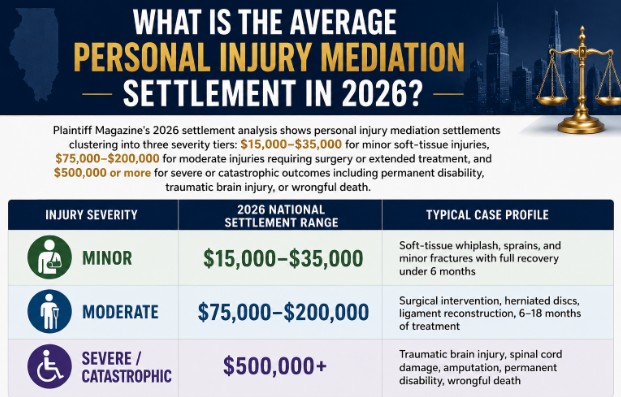
Plaintiff Magazine’s 2026 settlement analysis shows personal injury mediation settlements clustering into three severity tiers: $15,000–$35,000 for minor soft-tissue injuries, $75,000–$200,000 for moderate injuries requiring surgery or extended treatment, and $500,000 or more for severe or catastrophic outcomes including permanent disability, traumatic brain injury, or wrongful death.
| Injury Severity | 2026 National Settlement Range | Typical Case Profile |
| Minor | $15,000–$35,000 | Soft-tissue whiplash, sprains, and minor fractures with full recovery under 6 months |
| Moderate | $75,000–$200,000 | Surgical intervention, herniated discs, ligament reconstruction, 6–18 months of treatment |
| Severe / Catastrophic | $500,000+ | Traumatic brain injury, spinal cord damage, amputation, permanent disability, wrongful death |
These ranges reflect national medians. Actual Illinois settlements swing based on available insurance coverage, documented medical costs, lost wages, and the quality of liability evidence presented at mediation.
A broken arm that heals in 8 weeks with $12,000 in medical expenses and no lost income produces a different settlement than a broken arm requiring two surgeries, 14 months of physical therapy, and $85,000 in cumulative bills.
The injury diagnosis matters less than the documented financial impact and the residual limitation the claimant carries forward.
Illinois’s modified comparative negligence rule under 735 ILCS 5/2-1116 also plays a direct role. If the claimant bears 20% fault, the settlement value adjusts downward by 20%.
If fault attribution exceeds 50%, the claimant recovers nothing. A plaintiff attorney’s ability to document and argue liability percentage at mediation directly shifts the final number.
Claimants represented by a personal injury attorney recover approximately 40% more at mediation than unrepresented individuals, according to Insurance Research Council research on attorney representation and settlement outcomes.
The gap reflects differences in documentation quality, damages valuation, and negotiation preparation — not just the presence of legal counsel at the table.
Insurance adjusters evaluate claims using software-driven damage calculators that score medical documentation, liability evidence, and treatment consistency.
Unrepresented claimants typically submit incomplete records, miss future medical cost projections, and accept initial offers without counter-demand analysis. An attorney builds the file that the adjuster’s scoring model rewards.
An attorney presents a structured demand package that includes itemized past medical expenses, future medical cost projections from a life-care planner or treating physician, documented lost wages and diminished earning capacity, and a pain-and-suffering multiplier anchored to case-specific evidence.
The mediator and defense counsel receive a package that frames the settlement discussion around documented value — not the insurer’s opening offer.
Unrepresented claimants often settle for the insurance company’s first or second offer because they lack a benchmark for case value.
They cannot identify when an offer undervalues future medical costs, when a policy-limits demand is appropriate, or when the insurer is delaying because its adjuster lacks settlement authority. Attorney representation closes every one of those gaps.
Serious Illinois injuries demand experienced mediation preparation. Third Coast Lawyers handles toxic exposure, medical malpractice, and complex injury claims on contingency — call (847) 922-1178.
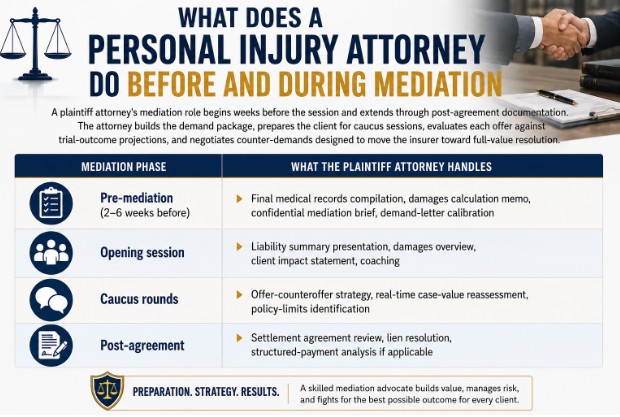
A plaintiff attorney’s mediation role begins weeks before the session and extends through post-agreement documentation. The attorney builds the demand package, prepares the client for caucus sessions, evaluates each offer against trial-outcome projections, and negotiates counter-demands designed to move the insurer toward full-value resolution.
| Mediation Phase | What the Plaintiff Attorney Handles |
| Pre-mediation (2–6 weeks before) | Final medical records compilation, damages calculation memo, confidential mediation brief, demand-letter calibration |
| Opening session | Liability summary presentation, damages overview, client impact statement, coaching |
| Caucus rounds | Offer-counteroffer strategy, real-time case-value reassessment, policy-limits identification |
| Post-agreement | Settlement agreement review, lien resolution, structured-payment analysis if applicable |
The mediation brief — a confidential document sent to the mediator before the session — frames the liability narrative, quantifies damages, and identifies the defense’s weak points.
A well-prepared brief tells the mediator exactly where the settlement should land and gives the mediator leverage to push the defense side during a private caucus.
At Third Coast Lawyers, pre-mediation preparation includes verifying all medical records against billing statements, coordinating with treating physicians to obtain updated prognosis letters, and — in medical malpractice and toxic injury cases — preparing expert causation summaries that link the defendant’s breach of care or exposure timeline to the confirmed diagnosis.
Anna O’Connor, founding partner and accredited Cook County arbitrator, brings over 50 years of jury-trial litigation experience to mediation preparation across personal injury, medical malpractice, and toxic tort matters.
Mediation alternates between joint sessions and private caucuses, during which the plaintiff’s attorney communicates trial readiness, presents verdict research from comparable Illinois jury awards, and recalibrates counter-demands based on the mediator’s reading of the defense authority.
If you’re ready to get started, call us now!
Personal injury mediations most often stall due to three common friction points: absent decision-makers on the insurance side, disputed medical causation, and gaps in the claimant’s treatment documentation.
Rising medical costs in 2026 have added a fourth pressure — disagreement over the present value of future treatment needs.
In cases involving commercial policies, excess carriers, or multi-defendant structures, the adjuster at the table often needs authorization from a supervisor or reinsurer to exceed a preset number. When that authorization chain requires real-time phone calls during caucus, mediation grinds to a halt.
Experienced plaintiff attorneys anticipate this by confirming settlement authority before the session and — when necessary — requesting the mediator to intervene on the authority question during pre-mediation calls.
Defense counsel in medical malpractice and toxic exposure cases routinely contests whether the defendant’s conduct caused the injury. In medical malpractice mediations, the defense challenges standard-of-care opinions, disputes proximate causation between the provider’s act or omission and the patient’s outcome, and introduces alternative-cause theories.
If the plaintiff’s medical expert report is incomplete or the causation chain has documentary gaps, the defense uses that weakness to justify a lower offer. The fix happens before mediation: complete the expert work before the session, not during it.
Insurance adjusters flag treatment gaps — periods where the claimant stopped seeing a doctor, missed therapy appointments, or switched providers without a referral — as evidence that the injury resolved.
A 3-month gap in physical therapy records can materially reduce a moderate-injury claim’s value at mediation. Plaintiff attorneys who track treatment compliance and address gaps with supplemental physician letters before mediation eliminate this deduction entirely.
Medical documentation is the single largest variable in personal injury mediation outcomes. The difference between a $40,000 settlement and a $175,000 settlement for the same underlying injury often comes down to whether the claimant’s attorney presented organized, narrative medical records rather than a stack of disjointed billing statements.
Insurance scoring models weigh four medical-evidence categories: consistency of treatment, severity of diagnosis, permanency of injury, and the treating physician’s prognosis. Each category requires documentation — not just a records dump, but a curated narrative that builds the damages case.
Strong evidence includes the emergency department records from the date of injury, all follow-up treatment records with clinical notes, imaging reports with radiology reads, a treating physician’s permanency letter, and — for claims involving future medical costs — a life-care plan or a projected treatment cost summary.
In medical malpractice claims, the evidence package also includes the complete medical chart from the treating facility, an independent standard-of-care expert opinion, and a causation report linking the provider’s deviation to the patient’s documented harm.
In construction accident and railroad injury claims, the medical evidence package also includes industrial hygiene reports and occupational exposure assessments.
Medical cost inflation in 2026 has driven average treatment expenses higher across surgical, rehabilitation, and diagnostic categories. For the claimant, higher treatment costs increase documented economic damages in the mediation demand package.
For the insurer, higher treatment costs raise the verdict-exposure calculation. Higher documented damages and increased insurer verdict exposure push settlement values upward — provided the attorney documents costs in real time rather than reconstructing them after treatment ends.
Accepting or rejecting a mediation offer depends on three variables: whether the offer covers documented economic losses, how the offer compares to projected trial outcomes in your Illinois county, and whether the risk and timeline of trial justify holding out. Your attorney runs this analysis at the mediation table, not after you get home.
No competent personal injury attorney advises a client to accept or reject an offer based on instinct. The evaluation is mathematical. The attorney calculates total economic damages — medical bills, lost wages, future medical expenses, diminished earning capacity — adds a general-damages multiplier consistent with Illinois jury-award patterns, and compares the result to the offer on the table, minus the cost and risk of trial.
The trial-risk discount changes the math. Trial introduces uncertainty. An Illinois jury applying comparative negligence under 735 ILCS 5/2-1116 may assign the plaintiff 30% fault, reducing a $300,000 verdict to $210,000 before attorney fees.
A mediation offer of $190,000 — superficially lower — may net the client more after fees and risk adjustment. The attorney’s job is to show the client both numbers side by side so the decision is informed.
Rejection is the right call when the gap is too wide. If the insurer’s highest mediation offer is well below the conservatively projected trial value and the client’s evidence package is strong, rejecting it and continuing trial preparation may yield a better result.
Insurers frequently raise authority after a failed mediation once the plaintiff moves toward a firm trial date.
Third Coast Lawyers evaluates every mediation offer against trial projections specific to the Illinois county where the case would be tried — Cook County jury patterns differ materially from those in downstate Illinois counties.
What percentage of personal injury cases go to trial in Illinois?
Approximately 4–5% of filed personal injury cases reach trial in 2026, and Illinois tracks closely with that national figure. The remaining 95% settle through negotiated resolution, with mediation serving as the primary settlement mechanism for contested claims in Illinois circuit courts.
How long does a personal injury mediation session typically last?
Most personal injury mediation sessions last between 4 and 8 hours in a single day. Complex multi-party mediations — especially those involving medical malpractice or multiple insurance layers — may require a second session scheduled two to four weeks after the first round concludes.
Can I attend mediation without a lawyer in Illinois?
Illinois law does not require attorney representation at mediation, but data from the Insurance Research Council show that unrepresented claimants settle for approximately 40% less than those with counsel. The insurer sends trained adjusters and defense attorneys to every session, creating a structural disadvantage for unrepresented claimants.
What is the average personal injury settlement in Illinois in 2026?
Illinois personal injury settlements follow national severity tiers in 2026: $15,000–$35,000 for minor injuries, $75,000–$200,000 for moderate injuries requiring surgery, and $500,000 or more for severe or catastrophic outcomes. Illinois’s modified comparative negligence threshold under 735 ILCS 5/2-1116 adjusts these figures based on the allocation of fault, barring recovery entirely when the claimant is more than 50% at fault.
Does the insurance company have to send a decision-maker to mediation?
Cook County’s Major Case Court-Annexed Civil Mediation Program requires that trial counsel and a representative with full settlement authority attend the session. In practice, insurance carriers sometimes send adjusters with limited authority who must call a supervisor for approval when they exceed a preset cap during caucus rounds.
What happens if mediation fails in a personal injury case?
If mediation does not produce an agreement, the case returns to the litigation track. Discovery, depositions, and trial preparation continue on schedule. Illinois cases frequently settle in the weeks following a failed mediation as the insurer reassesses verdict exposure with a trial date approaching.
How much does a personal injury mediation cost the claimant?
In most contingency-fee arrangements, the plaintiff’s law firm advances all mediation costs — including the mediator’s hourly fee and administrative expenses — and recoups those costs from the settlement. Clients at Third Coast Lawyers pay no fees or costs unless the case resolves in their favor.
Is a mediation settlement agreement legally binding in Illinois?
A signed mediation settlement agreement is an enforceable contract under Illinois law. Once both parties execute the agreement, the circuit court enters a stipulated dismissal order, and the insurer issues payment in accordance with the agreed terms and timeline specified in the document. The Illinois Uniform Mediation Act (710 ILCS 35) governs confidentiality protections for communications made during the mediation process.
What is the statute of limitations for personal injury claims in Illinois?
Illinois’s statute of limitations for personal injury claims is two years from the date of injury under 735 ILCS 5/13-202. Medical malpractice claims follow a separate timeline under 735 ILCS 5/13-212: two years from the date the patient discovered or should have discovered the injury, subject to an absolute four-year statute of repose from the date of the negligent act.
Can I reject a mediation settlement and still go to trial?
You retain full authority to accept or reject any settlement offer at mediation in Illinois. If you reject, the case continues toward trial. Your attorney evaluates whether the offer falls below trial-projected value and provides a risk analysis before you decide.
Should I bring documents to my personal injury mediation session?
Your attorney handles all documentation before and during the session. The mediation brief, medical records, damages calculations, and demand package are prepared and submitted to the mediator in advance. You may prepare a personal impact statement describing how the injury affected your daily life.
Does mediation delay my personal injury case in Illinois?
Mediation typically accelerates resolution rather than delaying it. A case that might take 18–24 months to reach trial often settles at mediation within 9–14 months of filing. Illinois circuit courts increasingly require mediation before granting trial dates, so the process runs parallel to litigation preparation.
Underprepared mediation costs claimants real money. Third Coast Lawyers builds the evidence and fights for full settlement value — call (847) 922-1178.

About the Author
Managing Partner · Toxic Tort Trial Attorney · Licensed in Wisconsin, Illinois, and Missouri
Anna G. O'Connor is the founding member and managing partner of Third Coast Lawyers and a trial attorney licensed in Wisconsin, Illinois, and Missouri. She practices across the Midwest and has tried more than 50 jury trials during her 20-plus-year legal career. Anna represents workers and families in toxic tort matters, including asbestos and mesothelioma claims, in Wisconsin, Illinois, and Missouri state courts, federal courts, and multi-district litigation proceedings.
