
Originally published: November 2025 | Updated: December 2025
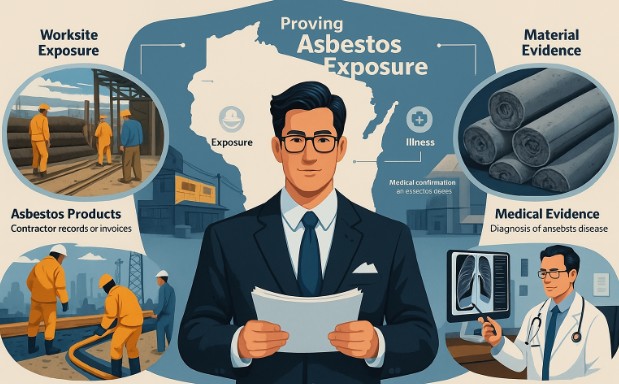
To succeed in a Wisconsin asbestos claim, you must produce three rock-solid pillars of proof — a confirmed medical diagnosis, a precise work-history timeline tying you to asbestos-containing jobsites, and product-identification evidence that links exposure to specific materials or manufacturers.
Immediately preserve medical records and employer documents; missing evidence or missed deadlines are the No. 1 reasons meritorious claims fail.
Combine these with Wisconsin’s filing rules and submit a complete evidentiary package to strengthen your claim.
The toughest task is retrieving decades-old records — and that’s why immediate preservation, targeted records requests, and fast legal intake are critical: the sooner you act, the better your chance of reconstructing a winning exposure record.
Employment records and work histories are instrumental in demonstrating asbestos exposure.
Many Wisconsin workers were exposed in construction, manufacturing, shipyards, and other risky jobs. If you don’t have the right paperwork, even a real claim can get stuck or tossed out.
Wisconsin law sets deadlines and has its own rules for filing these cases. Knowing what evidence to collect—and how to keep it organized—can make or break your case in court.

Wisconsin judges require three independent, documented proofs — diagnosis, exposure history, and product linkage — each supported by contemporaneous records or admissible expert opinion.
Every strong asbestos case in Wisconsin stands on three foundations. Each one has to be solid and backed up by documents.
Medical Evidence is the first pillar. You’ll need medical records showing an asbestos-related diagnosis like mesothelioma or lung cancer. Your doctor should confirm that asbestos—not something else—caused the disease.
Exposure History is next. This means detailed work records, job sites, and the time periods during which you were exposed. You have to tie your exposure to specific companies’ products.
Product Identification completes the trio. You’ll need proof of which asbestos materials you came into contact with. Tracking down brand names, product types, and materials containing asbestos helps your case.
Wisconsin courts demand both quality and specificity: repeated, proximate exposure documented by dates, tasks, and corroborating records.
Isolated or minimal contact rarely proves legal causation; successful claims show repeated exposure events, contemporaneous employment evidence, and credible expert interpretation linking exposure intensity to disease.
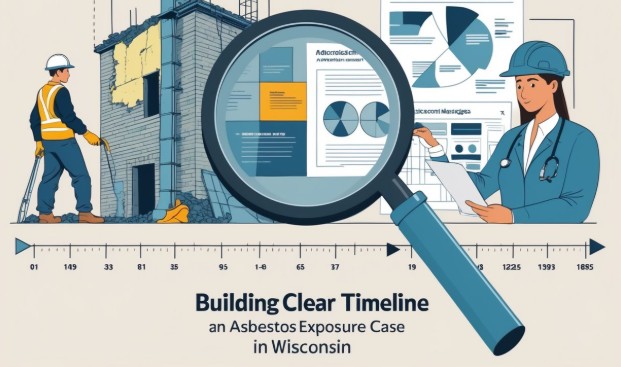
Creating a detailed work-and-home timeline is the backbone of any good asbestos case. Attorneys dig into employment records, union files, and even military service documents to determine where the exposure likely occurred.
| Employer | Job Title | Years Worked | Jobsite Address | Tasks Performed | Possible Asbestos Sources |
| Example: ACME Plant | Pipefitter | 1978–1984 | Milwaukee, WI | Installed/removed insulation | Pipe insulation, gaskets, and boilers |
To sharpen exposure searches, focus on industries and site types with a history of asbestos use, such as paper mills, power plants, shipyards, chemical plants, foundries, railroad shops, and construction/renovation sites.
Why this matters: Knowing these local industries narrows record requests and helps identify likely product types (insulation, gaskets, boiler wrap, roofing, floor tile).
When reconstructing a claim, always list the industry and site type for each job entry — it helps match exposure to products and defendants.
If you’re ready to get started, call us now!
Employment records are the primary evidence of work-related exposure. Pay stubs from different jobs help pin down exact dates and locations.
For veterans, service records are gold. Military files often spell out duties and work sites.
Union logs can back up work assignments and projects. They sometimes list materials used, too.
Essential documents include:
Most people can’t remember every date or job site from decades ago. Coworkers who did the same work can give witness statements about shared asbestos exposure.
Witness testimonies fill in the blanks. Former colleagues often remember which products you used or which jobs involved asbestos.
To verify your work history, you may need to contact former employers or their insurance companies. Company files may include safety reports or purchase orders that indicate asbestos was present.
Key reconstruction methods:
Social Security records can also help confirm work dates when other paperwork is missing.
Product identification is the liability engine — it ties exposure to manufacturers and creates actionable defendant lists.
Strong records (invoices, blueprints, MSDS, submittals) or lab-tested samples let you name responsible parties and file trust claims; where documentary proof is weak, industrial hygienists and material analysts supply the missing link.
The best product ID evidence? Brand names, model numbers, and exact product types. Researching what was used in your industry or home, down to the brand and material, is key.
Documentation Sources:
In shipyard cases, you need to name insulation brands used on certain ships. Construction workers should try to identify specific roofing, tile, or pipe insulation brands they handled.
Former coworkers can help confirm which products were at job sites. They can describe how you and others worked with them.
Old product packaging, ads, and company catalogs from that era can also tie certain manufacturers to the asbestos products you encountered.
| Evidence Type | Where to Obtain | Strength Level |
| Invoices / Purchase Orders | Former employer, contractors, suppliers | ⭐⭐⭐⭐⭐ Strongest |
| Building Plans / Blueprints | City building department, site owner | ⭐⭐⭐⭐ |
| MSDS / Product Catalogs | Manufacturer archives, online MSDS libraries | ⭐⭐⭐⭐ |
| Photographs / Material Samples | Taken onsite or collected historically | ⭐⭐⭐ |
| Maintenance Logs / Work Orders | Facility management, archives | ⭐⭐⭐ |
| Prior Litigation Records | Public case databases | ⭐⭐ |
Use these short scenario bullets to speed investigation — they tell you which documents to seek.
Sometimes you need an expert—especially if product identification gets complicated. Industrial hygienists can examine workplace conditions and identify likely asbestos sources based on industry standards in effect at the time.
Expert testimony helps with:
In tricky shipbuilding or construction cases, experts can review blueprints to determine which asbestos products were standard. They can also explain how workers would’ve been exposed during normal work.
Product identification witnesses can be a great source of information regarding alternative exposures. But if witnesses disagree or can’t remember, experts can provide a more objective take on product use and makeup.
Experts are beneficial if you need to show that exposure didn’t come from products made by companies that aren’t being sued, or to prove when certain products were used at a site.
You’ll need medical records showing an asbestos-related disease and proof that asbestos exposure caused it. Your doctor should write a letter connecting the diagnosis to your job or product exposure.
| Medical Document | What It Proves | Prepared By |
| Pathology / Biopsy Report | Confirms an asbestos-related disease | Pathologist |
| CT Scan / X-ray Report | Shows extent & location of disease | Radiologist |
| Pulmonary Function Test | Shows lung impairment/damage | Pulmonologist |
| Treatment Notes | Document symptoms, progression, and care | Treating physicians |
| Doctor Causation Letter | Links disease to asbestos exposure | Specialist / medical expert |
Proving asbestos exposure in mesothelioma cases means you need thorough medical files. Gather records from every doctor who treated you.
Key diagnostic records include:
Pathology reports are the strongest proof—they specify cell types and confirm asbestos disease. Biopsies might even reveal asbestos fibers in tissue.
CT scans usually show pleural thickening or fluid. X-rays document lung changes over time. These tests help create a timeline of the disease’s development.
Make sure your medical records cover the entire treatment period. Missing paperwork can really weaken your case.
Your doctor needs to write a letter linking your illness to asbestos exposure. Usually, your treating physician handles this.
The letter should clearly say asbestos exposure caused your mesothelioma or lung cancer. Doctors base this on your medical records and exposure history.
What causation letters need:
Sometimes, you’ll need other medical experts. These specialists review all your records and give an independent opinion on causation. Their input makes a difference in complicated cases with multiple exposures.
The causation letter should rule out other possible causes. This opinion is key evidence in Wisconsin courts.
Understanding your exposure history is crucial, and our team at Third Coast Lawyers is ready to guide you through every step. Take the next step—schedule an appointment now.
If you’re ready to get started, call us now!
Wisconsin sets strict time limits for asbestos claims. Victims can seek compensation through workers’ comp or third-party lawsuits. The Wisconsin statute of limitations depends on the claim type and the date the symptoms first appeared.
Wisconsin uses a discovery rule for asbestos exposure claims. Victims get 3 years from when they knew or should’ve known about their asbestos-related disease to file a lawsuit.
The clock starts when a doctor diagnoses mesothelioma or another asbestos disease. It doesn’t start from the date of exposure, which might have happened decades ago.
For mesothelioma claims, the medical malpractice statute of limitations in Wisconsin is between 1 and 3 years. But asbestos lawsuits follow different rules than medical malpractice cases.
Key timeframes:
If you miss these deadlines, you could lose the right to file an asbestos claim for good. Wisconsin’s statute of limitations has only a few exceptions for extending time limits.
Wisconsin workers hurt by asbestos exposure have two main legal options. They can file workers’ compensation claims or sue manufacturers in third-party asbestos lawsuits.
Workers’ compensation covers medical bills and lost wages, no matter who’s at fault. As long as you file within the required timeframe after diagnosis, there’s no statute of limitations. Benefits are guaranteed, but they’re limited.
Third-party asbestos lawsuits target companies that manufactured or sold asbestos products. These cases can pay out more for pain and suffering, and sometimes for punitive damages. Victims can also file asbestos trust fund claims against companies that went bankrupt.
Many Wisconsin workers go after both options at once. Workers’ comp pays out quickly while third-party cases take shape. Asbestos trust fund claims can provide additional compensation from companies that have set aside money for future victims.
The best choice depends on work history, product identification, and who’s available to sue. Some cases qualify for multiple asbestos trust funds, which can boost total compensation.
Organizing evidence well can make or break a claim. A solid file system and the avoidance of common paperwork mistakes help mesothelioma lawyers build a stronger case.
A mesothelioma attorney needs all three types of evidence in one place. Medical records should have pathology reports, imaging scans, and treatment documents.
Work history evidence includes employment records, job descriptions, and statements from coworkers.
Product identification evidence should list specific asbestos products used at each job site. Photos of job sites and equipment strengthen this part.
Essential file sections include:
Personal injury lawyers usually organize documents by workplace and date. This helps attorneys prove asbestos exposure more easily in court.
Digital copies can save you from losing paperwork. Mesothelioma lawyers can pull up files fast when building a case.
Missing employment records cause the biggest headaches in asbestos cases. Companies tend to destroy old personnel files after a few years. Clients should try to gather these documents as soon as they’re diagnosed.
Incomplete medical records slow things down, too. Mesothelioma attorneys need the original pathology report that confirms the cancer. If test results are missing, lawyers have to spend extra time chasing down medical documentation.
Common delay factors:
Waiting too long to contact a mesothelioma lawyer just creates more problems. Time is crucial for building a strong case, as witnesses may disappear. Mesothelioma lawyers work more quickly when clients arrive with organized evidence from the start.
| Evidence Type | Status (Y/N) | Notes |
| Pathology / Biopsy Report | ||
| Imaging (CT, X-ray) | ||
| Doctor Causation Letter | ||
| Work-History Timeline | ||
| Social Security Earnings | ||
| Pay Stubs / W-2s | ||
| Union or Trade Records | ||
| Invoices / Purchase Orders | ||
| MSDS / Product Manuals | ||
| Photos / Site Evidence | ||
| Witness / Coworker Statements |
A Wisconsin asbestos case usually follows a fairly set path, from the initial diagnosis to the final resolution. Timeline factors vary depending on how complicated things get and what kind of evidence people dig up.
| Date | Event | Related Evidence |
| 1976–1982 | Worked at ACME Industrial Plant | Union card, pay stubs, site photos |
| March 2024 | First symptoms recorded | Clinic visit notes |
| June 2024 | CT scan + biopsy confirming mesothelioma | Imaging + pathology |
| October 2024 | File asbestos trust claims | Completed evidence packet |
| November 2024 | File a Wisconsin lawsuit | Complaint, exhibits |
Cases in Wisconsin can move faster if there are strong employment records from big places like shipyards or paper mills.
Case investigations may include phone interviews and reviews of medical records tied to Wisconsin’s healthcare systems. Sometimes, it’s surprising how quickly things move when the paperwork’s all there.
An asbestos diagnosis changes everything. We become your legal partner from day one — protecting records, preserving evidence, and launching targeted investigations while you concentrate on treatment.
In the first 48 hours, we:
We then assemble a single case file — medical, work history, product ID, witness lists — and map every possible recovery source (workers’ comp, trust funds, third-party defendants).
If you’re facing an asbestos diagnosis, Third Coast Lawyers can help you gather the right records and move forward confidently. Protect your rights and secure your future. Contact us today.
What evidence do I need to prove an asbestos case in Wisconsin?
You need three core types of evidence: (1) Medical proof showing a diagnosed asbestos-related disease; (2) a work-history timeline connecting you to job sites or tasks where asbestos exposure occurred; and (3) product-identification proof demonstrating specific asbestos-containing materials or products you encountered.
How long do I have to file an asbestos lawsuit in Wisconsin?
In Wisconsin, you typically have 3 years from the date of diagnosis of an asbestos-related disease (or from the date of death in wrongful-death cases) to file a lawsuit. If you miss this deadline, you may lose your right to claim.
What counts as valid work-history evidence for an asbestos claim?
Valid work-history evidence includes documentation such as pay stubs, W-2s, union records, Social Security earnings statements, and jobsite logs or coworker statements that show your employment periods, job titles, locations, and tasks, which help link you to asbestos exposure.
How is product identification proven in an asbestos case?
Product identification may be shown through invoices, purchase orders, building/architectural plans, manufacturer manuals, MSDS sheets, and laboratory analysis of material samples. These show which asbestos-containing products you were exposed to and help assign liability.
Do I need a medical expert’s statement to link my disease to asbestos exposure?
Yes — a medical specialist’s causation letter or expert testimony is critical. It should state that it is “more likely than not” that your diagnosed disease was caused by your asbestos exposure, and reference your medical records, imaging, pathology findings, and exposure history.
Can I still file a claim if I don’t remember the exact job site where I was exposed?
Yes — you can still file a claim even if you don’t recall the exact location. Your attorney can use supporting records (employment history, union logs, coworker testimonies, industry usage patterns) to reconstruct your exposure timeline and site-link evidence.
What happens if the company responsible for the asbestos exposure has gone bankrupt?
If a company has gone bankrupt, many cases still have options via asbestos trust funds. These trusts were set up to pay claims when original defendants are no longer solvent, provided you can meet the evidence criteria.
How much compensation can I expect in a Wisconsin asbestos case?
Compensation varies widely and depends on the diagnosis (mesothelioma typically yields higher awards), degree of impairment, lost earnings, medical bills, and the defendant’s culpability. Settlements and verdicts are case-specific; however, a thorough evidentiary package (strong medical proof, clear work history, and product ID) is the single biggest factor in maximizing recovery.
