


Comparative negligence is the rule that decides how much an injured person recovers when they share blame for their own injury.
Wisconsin uses a modified system under Wis. Stat. § 895.045: a claimant whose negligence exceeds that of the party they are suing recovers nothing, and a claimant below that line recovers damages reduced by their own percentage.
The threshold is commonly described as 51%, and in a single-defendant negligence case that shorthand holds.
Across toxic injury claims, multi-defendant cases, and strict product liability, the comparison works differently.
A few percentage points of fault can decide whether a claim pays or pays nothing. Third Coast Lawyers reviews how fault is likely to be allocated — free consultation.
An injured person who shares blame can still recover, provided their share does not exceed that of the party they are suing. Recovery is then reduced in proportion to their own negligence.
The arithmetic is straightforward once the percentages are set:
Total damages × (100% − claimant’s fault percentage) = award
In a single-defendant negligence case, a claimant with $100,000 in damages found 30% at fault recovers $70,000. The same claimant with the same injuries, found 51% at fault, recovers nothing.
That cliff edge is why fault allocation drives settlement negotiations as heavily as the damages themselves, and why insurers argue for the highest percentage the evidence will bear.
Wisconsin’s rule replaced the older contributory negligence doctrine, under which any fault at all on the claimant’s part barred recovery entirely.
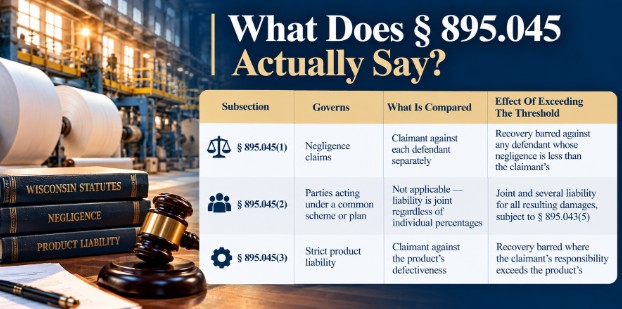
Wis. Stat. § 895.045 is titled “Contributory negligence,” though it establishes a comparative system across three subsections that operate differently from one another. Identifying which one governs is the first question in any allocation analysis.
| Subsection | Governs | What Is Compared | Effect Of Exceeding The Threshold |
| § 895.045(1) | Negligence claims | Claimant against each defendant separately | Recovery barred against any defendant whose negligence is less than the claimant’s |
| § 895.045(2) | Parties acting under a common scheme or plan | Not applicable — liability is joint regardless of individual percentages | Joint and several liability for all resulting damages, subject to § 895.043(5) |
| § 895.045(3) | Strict product liability | Claimant against the product’s defectiveness | Recovery barred where the claimant’s responsibility exceeds the product’s |
Subsection (1) provides that contributory negligence does not bar recovery in an action to recover damages for negligence resulting in death or in injury to person or property, if that negligence was not greater than the negligence of the person against whom recovery is sought.
Two elements of that sentence do the work. The bar applies where the claimant’s negligence is greater than the defendant’s—equal shares do not bar recovery, which is why 50% is recoverable, and 51% is not.
And the comparison is against “the person against whom recovery is sought,” singular, which is what makes multi-defendant cases behave differently from the 51% shorthand.
Subsection (1) also limits joint and several liability to defendants found 51% or more causally negligent, a change the legislature made in 1995.
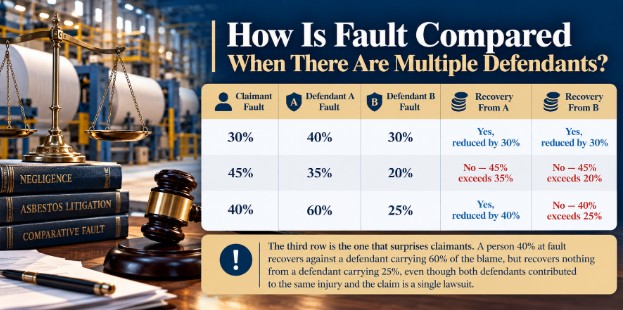
In negligence claims, courts compare each defendant against the claimant separately. Courts do not aggregate the defendants’ negligence and compare the claimant against the combined total, which means a single claimant can recover from one defendant and be barred against another in the same case.
| Claimant Fault | Defendant A Fault | Defendant B Fault | Recovery From A | Recovery From B |
| 30% | 40% | 30% | Yes, reduced by 30% | Yes, reduced by 30% |
| 45% | 35% | 20% | No — 45% exceeds 35% | No — 45% exceeds 20% |
| 40% | 60% | 25% | Yes, reduced by 40% | No — 40% exceeds 25% |
The third row is the one that surprises claimants. A person 40% at fault recovers against a defendant carrying 60% of the blame, but recovers nothing from a defendant carrying 25%, even though both defendants contributed to the same injury and the claim is a single lawsuit.
That structure bears on which defendants are worth naming in a negligence claim. Where a defendant’s likely share falls below the claimant’s own percentage, the claim against that defendant may return nothing while still costing the claimant to litigate — one consideration among several, alongside insurance coverage, solvency, and the evidence each defendant can be expected to produce.
As the product liability section explains, subsection (3) reverses the position entirely.
Whether a defendant is worth naming turns on the fault split, not the theory alone; Third Coast Lawyers models that before filing — case review.
A defendant found 51% or more causally negligent may be held jointly and severally liable for the full judgment, including the shares of defendants who cannot pay. A defendant below 51% pays only its own proportional share.
With three defendants at 60%, 25%, and 15%, a claimant may collect the entire judgment from the 60% defendant. The other two are liable only for their own portions, and a defendant who pays more than its share may seek contribution from the others.
Joint and several liability also attaches regardless of percentage where parties act in accordance with a common scheme or plan. Section 895.045(2) provides that such parties are jointly and severally liable for all damages resulting from that action, subject to the punitive damages provision in § 895.043(5).
Wisconsin courts look for an agreement or understanding between defendants and for mutual assistance or encouragement in the wrongful conduct. The agreement need not be formal or written.
Parallel conduct alone does not satisfy the standard. Companies that independently made similar products, used similar warnings, or responded similarly to regulation have not thereby acted under a common scheme.
The claimant must show actual communication, planning, or assistance — coordination rather than coincidence.
Asbestos claims put the statute under unusual pressure because they routinely involve many defendants, exposures spread across decades, and a disease no single exposure can be shown to have caused on its own.
A typical mesothelioma case may name product manufacturers, premises owners, and general contractors. Which subsection governs depends on the theory pleaded: negligence claims run under subsection (1), strict product liability claims under subsection (3).
One structural point shapes every allocation. Under Wis. Stat. § 102.03(2), where the conditions for workers’ compensation liability exist, that compensation is the exclusive remedy against the employer.
An injured worker’s own employer generally does not appear in the tort verdict alongside manufacturers.
Third-party claims remain available. Product manufacturers, equipment suppliers, and premises owners who are not the claimant’s employer can be named.
Premises-owner liability under Wisconsin’s safe-place statute is a live route following Estate of Lorbiecki v. Pabst Brewing Co., 2026 WI 12, where the Wisconsin Supreme Court held that a brewery owner owed a non-delegable duty under Wis. Stat. § 101.11 to frequenters on its premises, a category including employees of independent contractors.
The table below illustrates allocation in a negligence claim with $2,000,000 in total damages and exposure at several job sites over 30 years. Every defendant named is a third party rather than the claimant’s employer.
| Party | Fault | Effect |
| Asbestos Manufacturer A | 35% | Pays $700,000 — failure to warn |
| General Contractor B | 25% | Pays $500,000 — site safety practices |
| Premises Owner C | 20% | Pays $400,000 — unsafe condition on controlled premises |
| Equipment Supplier D | 15% | Pays $300,000 — defective safety equipment |
| Claimant | 5% | Recovery reduced by $100,000 |
The claimant recovers $1,900,000 rather than the full $2,000,000. Each defendant below 51% pays only its own share, so if Contractor B becomes insolvent, Manufacturer A does not absorb B’s portion.
If you’re ready to get started, call us now!
Three features recur. Insolvency is the first: many asbestos manufacturers have entered bankruptcy, which removes them from the pool of paying defendants and raises the stakes of the 51% threshold for those who remain.
Asbestos bankruptcy trusts exist precisely to address that gap and operate on their own terms.
Indivisible harm is the second. Where medical evidence cannot attribute the disease to any single exposure, expert testimony addresses cumulative dose rather than a single causal source.
The claimant’s own conduct is the third. Defendants commonly raise failure to use respiratory protection, disregard of warnings, and smoking history.
The medical distinction matters here: the National Cancer Institute reports that asbestos exposure causes mesothelioma, that smoking combined with asbestos exposure substantially increases lung cancer risk, and that smoking combined with asbestos does not appear to increase the risk of mesothelioma.
Rebutting lifestyle-based fault arguments in lung cancer claims generally requires expert medical testimony on cumulative asbestos dose.
Multiple companies, decades of exposure, and one disease. Third Coast Lawyers maps which defendants a claim can reach—schedule a consultation.
Yes, but through subsection (3) rather than subsection (1), and the comparison works differently. The law here moved in three stages.
1995 — the amendment to subsection (1). The legislature limited joint and several liability to defendants 51% or more causally negligent, raising the question of how that framework applied to strict product liability.
2001 — Fuchsgruber. In Fuchsgruber v. Custom Accessories, Inc., 2001 WI 81, 244 Wis. 2d 758, the Wisconsin Supreme Court held the 1995 amendment to § 895.045(1) did not apply to strict product liability actions. Strict liability for injuries caused by defective and unreasonably dangerous products is liability in tort rather than liability for negligence, so there is no defendant negligence to compare against the claimant’s.
2011 — Wisconsin Act 2. The legislature created § 895.045(3), which governs product liability directly and applies to actions commenced on or after 1 February 2011. It also enacted §§ 895.046 and 895.047.
Under subsection (3), the fact finder first determines whether the claimant may recover.
If the claimant’s percentage of total causal responsibility exceeds the percentage resulting from the product’s defective condition, recovery from the manufacturer, distributor, seller, or other person in the stream of commerce is barred.
If the claimant’s share is equal to or less than the product’s, recovery proceeds, reduced by the claimant’s percentage.
One provision reverses the intuition built by subsection (1). Where the claimant is not barred, the fact that the claimant’s causal responsibility exceeds an individual product defendant’s responsibility does not bar recovery from that defendant.
A marginal product defendant therefore remains reachable in a way a marginal negligence defendant does not. Responsibility below 51% is still limited to that defendant’s own percentage.
Subsection (3) does not apply to actions based on negligence or breach of warranty, which is why the theory pleaded determines the framework. Where a claim pleads both, the allocation questions differ between them.
Wisconsin sets three years for personal injury claims under Wis. Stat. § 893.54(1m)(a), including claims arising from motor vehicle accidents. A wrongful death claim runs for three years under § 893.54(1m)(b), except that a death arising from a motor vehicle accident runs for two years under § 893.54(2m).
The period runs from accrual, not automatically from the date of the incident. A claim accrues when the injury is discovered, or with reasonable diligence should have been discovered, whichever comes first.
In most crash cases, the injury and its cause are apparent immediately, and the two dates coincide. In latent-disease cases, they can be decades apart, which is why Wisconsin’s asbestos filing deadline rules turn on the discovery analysis rather than the exposure date.
Claims against a governmental body or officer carry separate procedural requirements under Wis. Stat. § 893.80. Two distinct steps apply rather than one.
Written notice of the circumstances of the claim must be served within 120 days of the event, and a claim containing the address of the claimant and an itemized statement of relief sought must be presented to and disallowed by the governmental body before an action may be brought.
The statute also contains a savings provision: failure to give the required notice does not bar an action where the governmental body had actual notice, and the claimant shows the delay caused no prejudice.
Those requirements run alongside the limitation period rather than replacing it, and the shorter of the applicable deadlines controls what must happen first. Separate tolling provisions apply to claimants who were minors when the claim accrued, under Wis. Stat. § 893.16.
What does Wisconsin’s 51% comparative negligence rule mean?
A claimant whose negligence exceeds that of the party being sued recovers nothing. Below that line, damages are reduced by the claimant’s own percentage. Against a single defendant in negligence, the practical threshold falls between 50% and 51%.
How does the comparison work with several defendants?
In negligence claims, each defendant is compared separately rather than as a combined group. A claimant can recover from a defendant carrying a larger share while being barred against a defendant carrying a smaller one.
When is a defendant liable for the entire judgment?
When found 51% or more causally negligent, that defendant may be held jointly and severally liable for the full amount, including shares owed by defendants who cannot pay. Below 51%, each pays only its own proportion.
Can a defendant under 51% still face full liability?
Yes. Section 895.045(2) makes parties acting under a common scheme or plan jointly and severally liable regardless of individual percentages. Parallel conduct alone does not qualify; the claimant must show actual coordination, not similar independent decisions.
Does § 895.045 apply to strict product liability claims?
Yes, through subsection (3), added in 2011. The claimant’s responsibility is compared against the product’s defectiveness rather than against each seller. Fuchsgruber held the earlier subsection (1) framework did not apply.
Can a claimant sue their own employer in an asbestos case?
Generally no. Under Wis. Stat. § 102.03(2), workers’ compensation is the exclusive remedy against an employer where its conditions are met. Third-party claims against manufacturers, suppliers, and premises owners remain available.
Does smoking reduce an asbestos claimant’s recovery?
Smoking is a factor a jury may weigh in lung cancer claims rather than an automatic bar. The National Cancer Institute reports that smoking combined with asbestos does not appear to increase mesothelioma risk, though it substantially increases lung cancer risk.
How long is the deadline to file?
Three years for personal injury under Wis. Stat. § 893.54(1m)(a), measured from accrual rather than automatically from the incident date. Claims against governmental bodies carry separate notice and claim-presentation requirements under § 893.80.
Why do a few percentage points matter so much?
Because the bar is absolute, not graduated, a claimant at 50% against a sole negligence defendant recovers half of proven damages; the same claimant at 51% recovers nothing, on identical injuries and identical medical bills.
Fault percentages are built from evidence long before a jury sees them. Third Coast Lawyers assembles that record — free case review.

About the Author
Managing Partner · Toxic Tort Trial Attorney · Licensed in Wisconsin, Illinois, and Missouri
Anna G. O'Connor is the founding member and managing partner of Third Coast Lawyers and a trial attorney licensed in Wisconsin, Illinois, and Missouri. She practices across the Midwest and has tried more than 50 jury trials during her 20-plus-year legal career. Anna represents workers and families in toxic tort matters, including asbestos and mesothelioma claims, in Wisconsin, Illinois, and Missouri state courts, federal courts, and multi-district litigation proceedings.
