

Wisconsin’s Great Lakes shipyards rank among the most asbestos-intensive workplaces in state history. Manitowoc Shipbuilding Company, Bay Shipbuilding in Sturgeon Bay, and Fraser Shipyards in Superior used asbestos in pipe insulation, boiler lagging, gaskets, fireproofing, and valve packing from the early 1900s through the 1980s.
Workers in below-deck compartments inhaled fiber concentrations approximately two-fold higher than workers in comparable non-shipyard settings (Garabrant & Pastula, 2007).
Wisconsin allows three years from diagnosis to file under Wis. Stat. § 893.54(1m), and more than 60 asbestos trust funds hold over $30 billion for eligible claimants.
Shipyard records, co-worker contacts, and product identification evidence degrade with each passing year. Schedule a free consultation with Third Coast Lawyers before time-sensitive documentation is lost.
Three Wisconsin shipyards have confirmed asbestos exposure records tied to vessel construction, repair, and overhaul operations spanning most of the 20th century.
| Shipyard | Location | Active Period | Peak Employment | Key Operations | Current Status |
| Manitowoc Shipbuilding Company | Manitowoc | 1902–1968 | ~7,000 (WWII) | 28 submarines, tank landing craft, fuel barges | Closed 1968; operations moved to Sturgeon Bay |
| Bay Shipbuilding Company | Sturgeon Bay, Door County | 1968–present (predecessors from the early 1900s) | ~5,000 (WWII era) | Subchasers, frigates, commercial vessels, double-hull barges | Operating as Fincantieri Marine Group |
| Fraser Shipyards | Superior | 1889–present | Varies | Great Lakes vessel repair, dry dock conversions, steam-to-diesel retrofits | Operating; OSHA-cited for asbestos issues (2000) |
Manitowoc Shipbuilding operated from 1902 to 1968 in Manitowoc, Wisconsin, on the Lake Michigan shoreline. The yard built 28 submarines during World War II, as well as tank landing craft and self-propelled fuel barges. Employment peaked at approximately 7,000 workers during the war years.
Asbestos was used extensively in submarine engine rooms, boiler insulation, pipe covering, and fireproofing — all of which were applied in enclosed compartments with minimal ventilation.
Bay Shipbuilding in Sturgeon Bay traces its lineage through Sturgeon Bay Shipbuilding, Leathem D. Smith Shipbuilding Company, and Christy Corporation. The Manitowoc Company purchased the yard in 1968 and consolidated operations there.
During WWII, the predecessor yards built subchasers, frigates, net-laying ships, and water tankers with a workforce of approximately 5,000.
Fincantieri Marine Group acquired the facility in 2009. Asbestos-containing materials were standard in vessel construction and repair through the 1980s.
Fraser Shipyards in Superior, Wisconsin, began operations in 1889 as the American Steel Barge Company, founded by Alexander McDougall. The yard built the first and largest dry dock on the Great Lakes.
Fraser Shipyards performed vessel construction for World War I and transitioned to commercial repair and conversion work — including steam-to-diesel and coal-to-oil retrofits — operations that required stripping and replacing asbestos insulation throughout engine and boiler systems. OSHA cited the facility for asbestos-related violations in 2000.
A fourth Wisconsin yard — Marinette Marine Corporation in Marinette (now also Fincantieri) — has documented asbestos exposure tied to WWII-era and Cold War naval construction, including recent defense contracts with Lockheed Martin.
If you’re ready to get started, call us now!
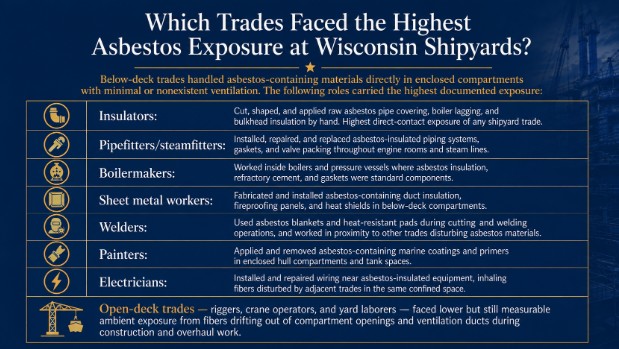
Below-deck trades handled asbestos-containing materials directly in enclosed compartments with minimal or nonexistent ventilation. The following roles carried the highest documented exposure:
Open-deck trades — riggers, crane operators, and yard laborers — faced lower but still measurable ambient exposure from fibers drifting out of compartment openings and ventilation ducts during construction and overhaul work.
The trade-specific exposure profile determines which asbestos products, which manufacturers, and which trust funds are relevant to a Wisconsin shipyard worker’s claim.
Workers in below-deck compartments at Wisconsin shipyards encountered asbestos in unventilated spaces, where fiber counts were highest. A peer-reviewed analysis of historical exposure data found that shipyard insulators experienced fiber concentrations approximately twofold greater than those of insulators performing comparable tasks in non-shipyard settings — a difference attributed directly to inadequate ventilation and confined work environments (Garabrant & Pastula, Journal of Occupational and Environmental Medicine, 2007).
Three factors drove the disparity:
Open-deck workers inhaled lower concentrations because wind and open air diluted fiber density. Below-deck workers received the full, undiluted dose — often for entire shifts during major overhaul or construction cycles.
Enclosed-compartment exposure is a critical factor in proving causation in a Wisconsin shipyard asbestos claim because it establishes the intensity and duration of fiber inhalation required to connect the exposure to a confirmed diagnosis.
If you’re ready to get started, call us now!
Heat and Frost Insulators union members performed the highest-exposure work at Wisconsin shipyards — cutting, fitting, and applying raw asbestos insulation to pipes, boilers, bulkheads, and engine components in enclosed compartments.
Heat and Frost Insulators union locals across Wisconsin dispatched members to shipyard and industrial jobsites throughout the state, covering southern, northeastern, central, and western Wisconsin — including the Door County and Fox Valley corridors where Bay Shipbuilding and multiple paper mills operated, and the Superior area where Fraser Shipyards operates.
Union dispatch records, membership files, and jobsite assignment logs are among the strongest evidence available for Wisconsin shipyard asbestos claims. These records establish which member worked at which yard, in which role, during which time period — the three elements required to connect a claimant to specific asbestos products and specific trust funds.
Many Wisconsin insulator locals maintained records that survive decades after the original jobsite assignment. A worker who cannot locate personal employment records from a closed or restructured shipyard may still have a documented work history through the union local.
The union’s original name — International Association of Heat and Frost Insulators and Asbestos Workers — reflects the direct connection between the trade and asbestos-containing materials that defined shipyard insulation work throughout the 20th century.
Great Lakes commercial shipyard workers and Navy yard veterans both qualify for asbestos trust fund claims, but the legal pathways and supplemental compensation options differ significantly.
| Factor | Great Lakes Commercial Shipyard Worker | Navy Veteran / Navy Yard Worker |
| Primary legal path | State tort claim against product manufacturers under Wis. Stat. § 893.54(1m) | Cannot sue the U.S. government (Feres doctrine); files against product manufacturers |
| Trust fund eligibility | Eligible for 60+ trusts based on product identification at the specific yard | Same trust eligibility — same manufacturers supplied both commercial and Navy yards |
| VA disability benefits | Not available (civilian worker) | Available — mesothelioma qualifies for 100% VA disability rating |
| Documentation for claims | W-2s, Social Security earnings, union dispatch records, employer files | DD-214, NARA muster rolls, deck logs, vessel assignment records |
| Comparative negligence | Wisconsin’s modified comparative negligence applies (barred at 51%+ fault) | Not applicable to trust fund claims; may apply in third-party litigation |
| Statute of limitations | 3 years from diagnosis (discovery rule) | Trust funds: no statute; VA claims: no time limit; third-party suits: state-specific |
The critical overlap: both commercial and Navy shipyard workers file trust fund claims against the same manufacturers — Johns Manville, Owens Corning, Combustion Engineering, and others — because identical asbestos products were installed on commercial Great Lakes vessels and Navy ships alike.
A pipefitter who insulated steam lines at Bay Shipbuilding in Sturgeon Bay handled the same Johns Manville pipe covering used aboard Navy destroyers at coastal yards.
The difference that matters most for Wisconsin workers: commercial shipyard employees retain full access to Wisconsin state tort law, including the right to file a personal injury lawsuit against the product manufacturer — an option Navy veterans pursuing claims solely against the government do not have.
Yes. Wisconsin shipyard workers can often file asbestos claims even when their exposure occurred in multiple Great Lakes states. Working at shipyards in Wisconsin, Michigan, Minnesota, or other regional locations during the same career does not automatically prevent compensation, and multi-state exposure may actually create additional legal options depending on the worker’s employment history and exposure record.
This is common among union shipyard workers who were dispatched to different facilities throughout the Great Lakes region.
A worker may have spent years at Bay Shipbuilding in Sturgeon Bay before taking assignments in Michigan, while workers from Fraser Shipyard in Superior frequently worked throughout the Twin Ports area, including shipyards in Duluth, Minnesota.
Because asbestos exposure often occurred across multiple job sites and employers, claims are typically evaluated based on the full work history rather than a single location.
Multi-state exposure does not prevent a Wisconsin claim. Key principles:
Wisconsin’s three-year statute of limitations under Wis. Stat. § 893.54(1m) applies from the date of diagnosis, regardless of whether the exposure occurred entirely within Wisconsin or across multiple states. Third Coast Lawyers evaluates multi-state exposure histories to determine which jurisdiction and which filing strategy produces the strongest outcome.
Anna Gonis O’Connor, founding member and managing partner at Third Coast Lawyers, has litigated more than 50 jury trials across state, federal, and multidistrict proceedings — including toxic tort matters where product identification and proof of medical causation determine the outcome.
The firm handles Wisconsin shipyard asbestos claims through a disciplined, evidence-first process:
Every client works directly with Anna O’Connor from intake through resolution — no handoff to a paralegal or case manager. The firm works on a contingency fee basis: no upfront costs and no attorney fees unless there is a recovery.
What is the statute of limitations for a Wisconsin shipyard asbestos claim?
Wisconsin allows three years from the date of diagnosis to file a personal injury claim under Wis. Stat. § 893.54(1m). The discovery rule starts the clock when the claimant discovers or reasonably should have discovered the asbestos-related disease, not when the shipyard exposure originally occurred.
Can I file a claim if the shipyard where I worked has closed?
Asbestos claims target the manufacturers of the products that caused exposure, not the shipyard operator. Manitowoc Shipbuilding closed in 1968, but trust funds established by Johns Manville, Owens Corning, and other manufacturers that supplied the yard continue to accept claims from former workers.
Which Wisconsin shipyard trades had the highest asbestos exposure?
Insulators, pipefitters, boilermakers, and sheet metal workers who performed below-deck work in engine rooms, boiler compartments, and pipe chases faced the highest exposure. Confined spaces with no ventilation, concentrated airborne asbestos fibers far above safe limits established by OSHA.
How do I prove which asbestos products were used at my Wisconsin shipyard?
Union dispatch records, co-worker statements, vessel construction logs, and product distribution databases help identify specific manufacturers. Heat and Frost Insulators union locals across Wisconsin maintained jobsite assignment records that may document which products members handled at specific yards throughout the state.
What asbestos trust funds cover products used at Wisconsin shipyards?
More than 60 asbestos trust funds hold over $30 billion in combined assets as of 2026. The Johns Manville Trust, Owens Corning/Fibreboard Trust, and Combustion Engineering Trust cover products found at Great Lakes shipyards, including pipe insulation and boiler lagging.
Can Navy veterans who served at Wisconsin shipyards file trust fund claims?
Navy veterans cannot sue the federal government for shipyard asbestos exposure under the Feres doctrine, but they can file trust fund claims against the product manufacturers who supplied asbestos-containing materials. Veterans may also qualify for VA disability benefits simultaneously — mesothelioma qualifies for the maximum rating.
What is the difference between below-deck and open-deck asbestos exposure?
Below-deck workers in engine rooms and boiler compartments inhaled fiber concentrations approximately twofold higher than those of workers in comparable non-shipyard settings, according to a peer-reviewed exposure analysis. Open-deck workers faced lower ambient exposure because wind and open air diluted fiber density.
Can my family file a claim if I brought asbestos fibers home from the shipyard?
Wisconsin law recognizes secondary exposure claims. A spouse or family member who developed mesothelioma or another asbestos-related disease from contact with contaminated work clothing may hold a valid personal injury claim under the same three-year statute of limitations that applies to direct occupational shipyard exposure.
What records should a Wisconsin shipyard worker gather before consulting an attorney?
Gather a written diagnosis from a treating physician, employment records (W-2s, Social Security earnings, union membership files), co-worker contact information, and any photographs or documentation of shipyard work conditions. Union dispatch records from Heat and Frost Insulators locals across Wisconsin are particularly valuable for identifying specific jobsite assignments.
What does it cost to hire Third Coast Lawyers for a shipyard asbestos claim?
Third Coast Lawyers works on a contingency fee basis. There are no upfront costs and no attorney fees unless the firm recovers compensation on the claimant’s behalf. The contingency percentage and any associated case costs are explained in full detail at the start of every engagement.
Wisconsin shipyard workers and their families are still receiving asbestos-related diagnoses decades after the last shift. Schedule a free consultation with Third Coast Lawyers at (847) 922-1178 before records are discarded and evidence windows close.

About the Author
Managing Partner · Toxic Tort Trial Attorney · Licensed in Wisconsin, Illinois, and Missouri
Anna G. O'Connor is the founding member and managing partner of Third Coast Lawyers and a trial attorney licensed in Wisconsin, Illinois, and Missouri. She practices across the Midwest and has tried more than 50 jury trials during her 20-plus-year legal career. Anna represents workers and families in toxic tort matters, including asbestos and mesothelioma claims, in Wisconsin, Illinois, and Missouri state courts, federal courts, and multi-district litigation proceedings.
