

Illinois mesothelioma and asbestos claims must generally be filed within 2 years of diagnosis under the state’s discovery rule, and Illinois law permits victims to pursue asbestos bankruptcy trust fund claims.
Wrongful death claims must be filed within two years of the date of death, and, following 2025’s Senate Bill 328, victims can sue out-of-state corporations in Illinois courts.
These overlapping deadlines and venue rules make it critical to work with toxic injury attorneys who can move quickly to preserve a family’s right to recovery.
Third Coast Lawyers helps Illinois families identify every avenue for compensation after a mesothelioma diagnosis — request a free case review before critical filing deadlines pass.
Illinois law gives mesothelioma patients two years from the date they knew or reasonably should have known they had an asbestos-related disease to file a personal injury claim.
Illinois follows a discovery rule for asbestos cases under 735 ILCS 5/13-202, meaning the two-year clock does not start on the date of exposure but on the date of diagnosis. Illinois courts established this standard because mesothelioma symptoms often do not appear until decades after the asbestos exposure that caused them, and a plaintiff cannot reasonably be expected to sue over a disease no doctor has yet identified.
This discovery rule distinguishes asbestos claims from many other Illinois personal injury matters, where the clock starts at the moment of the injury itself.
Because the deadline is short relative to the complexity of proving asbestos exposure that may have occurred at multiple job sites over a career, families should begin the employment-history and product-identification work as soon as possible after diagnosis.
Waiting even a few months to gather military records, union employment files, or product invoices can reduce the time available to compile a complete list of defendants before the filing deadline.
Illinois courts do not require a plaintiff to identify the specific defendant or product responsible for the exposure before the statute of limitations begins running.
The clock starts once the patient knows, or should reasonably know, both that they have an asbestos-related disease and that asbestos exposure caused it — not once they know which company’s product was responsible.
If you’re ready to get started, call us now!
Illinois surviving family members have two years from the date of a loved one’s death to file a wrongful death claim tied to mesothelioma or another asbestos-related disease.
The Illinois Wrongful Death Act, codified at 740 ILCS 180/2, allows a personal representative of the deceased’s estate to bring a claim on behalf of the surviving spouse and next of kin.
This deadline runs separately from the deceased’s own personal injury deadline, so a wrongful death claim can sometimes proceed even if the patient passed away before filing a personal injury lawsuit, provided the estate files within two years of the date of death.
Families pursuing an asbestos-related wrongful death claim can seek damages for medical expenses, funeral costs, lost income, and loss of companionship.
An estate representative typically works alongside the personal injury investigation already underway, since the same work-history documentation that supports a mesothelioma claim also supports the family’s wrongful death case.
Illinois Senate Bill 328 became law as Public Act 104-0352 on August 15, 2025, and made Illinois a general-jurisdiction state for toxic-tort claims, allowing plaintiffs to sue out-of-state corporations in Illinois courts even when the underlying asbestos exposure occurred outside Illinois.
The law amends the Illinois Code of Civil Procedure and the Business Corporation Act of 1983 so that a foreign corporation registered to do business in Illinois is deemed to have consented to the state’s general jurisdiction, so long as the claim involves a toxic substance and at least one co-defendant is properly subject to Illinois jurisdiction.
This jurisdictional change gives Illinois plaintiffs a jurisdictional tool that most other states do not offer, and it means a manufacturer that relocated its operations out of Illinois decades ago can still face suit in Illinois courts today if it remains registered to do business in the state.
| Change Under SB 328 (PA 104-0352) | Effect on an Illinois Asbestos Claim |
|---|---|
| Registration to do business in Illinois | Treated as consent to general jurisdiction |
| Claim involves a “toxic substance” | Covers asbestos, benzene, and similar exposures |
| At least one proper co-defendant in Illinois | Jurisdictional hook extends to out-of-state co-defendants |
| Effective date | August 15, 2025, applied immediately |
If you’re ready to get started, call us now!
Madison County, St. Clair County, and Cook County are among the busiest asbestos litigation venues in the United States, with dedicated asbestos dockets in the Illinois circuit court system, judges, and decades of case history that shape how claims are evaluated and resolved.
Illinois carries one of the heaviest asbestos exposure burdens in the country, consistently ranking among the top ten states nationally for mesothelioma deaths in CDC mortality data.
Illinois’s industrial history at shipyards, steel mills, and manufacturing sites across the state created concentrated exposure pathways that continue to generate litigation.
The Johns-Manville Corp. Superfund site in Waukegan alone processed roughly 3 million cubic yards of asbestos-contaminated waste before the U.S. Environmental Protection Agency added it to the National Priorities List in 1983.
Venue selection can affect how quickly a case moves and which procedural rules apply, so an attorney familiar with Illinois’s toxic tort practice areas can help a family choose the county best suited to their case facts.
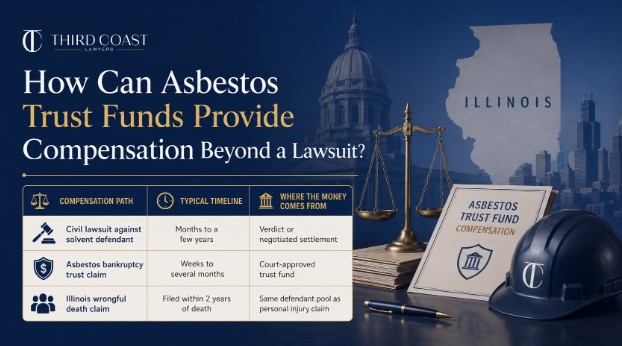
Illinois asbestos victims can file claims against active bankruptcy trust funds established by manufacturers that filed for Chapter 11 protection, separately from — or in addition to — a civil lawsuit against solvent companies.
These trusts hold funds set aside specifically to compensate people injured by the companies’ asbestos-containing products, and a single Illinois worker’s employment history often qualifies them to file claims against more than one trust at once if they worked with asbestos-containing products at multiple job sites.
An attorney experienced in asbestos trust fund claims cross-references a client’s work and product history against each trust’s claim criteria to identify every eligible fund, since missing even one trust can mean leaving compensation unclaimed.
| Compensation Path | Typical Timeline | Where the Money Comes From |
|---|---|---|
| Civil lawsuit against solvent defendant | Months to a few years | Verdict or negotiated settlement |
| Asbestos bankruptcy trust claim | Weeks to several months | Court-approved trust fund |
| Illinois wrongful death claim | Filed within 2 years of death | Same defendant pool as personal injury claim |
Illinois mesothelioma cases often involve both a lawsuit and multiple trust fund claims running simultaneously — talk with Third Coast Lawyers about which options apply to your work history.
Illinois families affected by mesothelioma can seek financial recovery covering treatment costs, lost wages, and physical and emotional suffering. When a loved one has died from the disease, survivors may also be entitled to damages for burial expenses and the loss of their relationship with the deceased.
Illinois does not cap compensatory damages in asbestos personal injury or wrongful death cases, which distinguishes the state from jurisdictions that limit non-economic damages in personal injury matters.
The value of a claim depends on the severity of the diagnosis, the number of identifiable defendants, and whether the case resolves through settlement or trial. Third Coast Lawyers’ toxic tort team works on a contingency-fee basis, so families pay nothing upfront and owe fees only if the case results in a recovery.
Starting an Illinois mesothelioma or asbestos claim begins with a medical diagnosis, followed by documenting the patient’s work and residential history to identify every location and product associated with the exposure.
Anna Gonis O’Connor, Esq., Managing Partner and Cook County arbitrator at Third Coast Lawyers, has litigated more than 50 jury trials and focuses part of her practice on toxic tort matters.
An attorney gathers military service records, union employment files, product invoices, and co-worker testimony to build a defendant list, then determines which Illinois county offers the most favorable venue and which asbestos bankruptcy trusts apply.
Because Illinois’s two-year deadline runs from diagnosis rather than exposure, families should begin this process immediately after a diagnosis to avoid losing time needed to build a complete case.
A mesothelioma diagnosis starts a two-year clock in Illinois — schedule a free consultation with Third Coast Lawyers to begin building your case today.
How long do I have to file a mesothelioma lawsuit in Illinois?
Illinois gives mesothelioma patients two years from the date of diagnosis to file a personal injury lawsuit under the state’s discovery rule. This differs from a straight exposure-date deadline because mesothelioma symptoms often surface decades after the asbestos exposure that caused them.
Can I file an Illinois asbestos claim if I no longer live in Illinois?
Yes, if the asbestos exposure occurred in Illinois, venue rules generally allow you to file in the county where the exposure happened regardless of your current residence. Senate Bill 328 further expanded which corporate defendants can be sued in Illinois courts.
What did Senate Bill 328 change for Illinois asbestos cases?
Senate Bill 328, effective August 15, 2025, made Illinois a general-jurisdiction state for toxic-tort claims. Out-of-state corporations registered to do business in Illinois can now be sued in Illinois courts even for exposures that occurred outside the state.
Does Illinois cap damages in mesothelioma lawsuits?
Illinois law does not impose a cap on compensatory damages in asbestos personal injury or wrongful death claims. Recoverable damages can include medical expenses, lost income, pain and suffering, and, in wrongful death cases, funeral costs and loss of companionship.
How does the Illinois discovery rule work for asbestos disease?
Under the discovery rule, the two-year filing clock starts when a patient knew or reasonably should have known they had an asbestos-related disease caused by asbestos exposure — not on the date exposure occurred. This accounts for mesothelioma’s long latency period.
What is the deadline for an Illinois asbestos wrongful death claim?
Illinois surviving family members have two years from the date of death to file a wrongful death claim under the Illinois Wrongful Death Act. This deadline runs separately from any personal injury deadline the deceased may have had under Illinois law.
Can I file both a lawsuit and an asbestos trust fund claim in Illinois?
Yes, Illinois asbestos victims can pursue a civil lawsuit against solvent companies while separately filing claims against asbestos bankruptcy trust funds. Some workers qualify for more than one trust claim based on the number of products and job sites in their exposure history.
Why do so many asbestos cases get filed in Madison County, Illinois?
Madison County has a dedicated asbestos docket, experienced judges, and decades of case history handling mesothelioma litigation, making it one of the most active asbestos venues nationally. St. Clair and Cook Counties are also frequently used for Illinois asbestos filings.
Do I need to know which company’s product exposed me to asbestos to file a claim?
No, Illinois’s discovery rule does not require identifying the specific defendant or product before the statute of limitations begins running. An attorney typically identifies responsible companies during the investigation phase after the claim is filed, using the employment and product history already gathered.
How much does it cost to hire an Illinois mesothelioma lawyer?
Reputable Illinois mesothelioma firms, including Third Coast Lawyers, work on a contingency-fee basis, meaning families pay nothing upfront and owe no legal fees. The firm only collects a fee if your case results in a settlement or verdict.

About the Author
Managing Partner · Toxic Tort Trial Attorney · Licensed in Wisconsin, Illinois, and Missouri
Anna G. O'Connor is the founding member and managing partner of Third Coast Lawyers and a trial attorney licensed in Wisconsin, Illinois, and Missouri. She practices across the Midwest and has tried more than 50 jury trials during her 20-plus-year legal career. Anna represents workers and families in toxic tort matters, including asbestos and mesothelioma claims, in Wisconsin, Illinois, and Missouri state courts, federal courts, and multi-district litigation proceedings.
