

Illinois steel mills, oil refineries, and power plants used asbestos insulation, gaskets, and refractory cement in high-heat equipment throughout the 20th century.
Documented sites include U.S. Steel South Works in Chicago, the Mobil refinery in Joliet, and the Powerton and Zion power plants across Illinois.
Workers and their families who spent time near these facilities may qualify for compensation from toxic injury attorneys through lawsuits or asbestos trust fund claims.
Third Coast Lawyers helps Illinois industrial workers and their families identify every source of compensation after an asbestos diagnosis — request a case review today.
Steel fabrication, petroleum refining, and power generation rank among Illinois’s highest-documented asbestos exposure industries because all three relied on asbestos to withstand extreme heat in furnaces, pipes, and boilers.
Steel mills concentrated in the Chicago Southeast Side and Will County used asbestos for furnace insulation, pipe covering, and fireproofing. Oil refineries in the Joliet and Lemont corridor used asbestos-insulated pipes, reactors, and valves to handle high-temperature petroleum processing.
Power plants across the state, from Cook County to downstate Illinois, used asbestos in boiler wrap, turbine insulation, and miles of steam piping.
This IL guide to filing deadlines explains how the two-year discovery rule applies when a diagnosis is linked to one of these industrial exposures.
Illinois steel mills in the Chicago Southeast Side and Will County industrial corridors have documented decades of asbestos use in blast furnaces, rolling mills, and maintenance shops.
U.S. Steel South Works operated on a 567-acre site on Chicago’s south side from 1882 until 1992, according to Illinois EPA site records. The mill used asbestos insulation throughout its blast furnaces, open hearth furnaces, and rolling mill equipment.
Republic Steel, later LTV Steel, operated a nearby Southeast Side facility and dumped slag waste at a site the EPA added to the Superfund National Priorities List in 2019.
| Steel Mill | Location | Active Period | Current Status |
| U.S. Steel South Works | Chicago (Southeast Side) | 1882–1992 | Site under redevelopment |
| Republic Steel / LTV Steel | Chicago (Southeast Side) | Active through 1990s | Former dump site on EPA Superfund list |
| Joliet Iron Works and Steel Company | Joliet, Will County | Late 1800s–2001 | Closed |
| Laclede Steel | Alton | Multiple decades | Closed |
Pipefitters, boilermakers, and maintenance workers who handled insulation and refractory materials at any of these mills may have grounds for a claim regardless of how long ago the mill closed, since proving exposure relies on employment records and product identification rather than the mill’s current operating status.
If you’re ready to get started, call us now!
Illinois oil refineries in the Joliet and Lemont corridor have documented asbestos use in pipe insulation, reactor linings, and valve packing dating back to the early 20th century.
The refinery in Joliet operated under the Mobil name before becoming ExxonMobil, and the refinery in Lemont operated under Union Oil before later operating as CITGO. Both facilities used asbestos-insulated pipes and high-temperature equipment to process crude oil into refined products.
Refinery mechanics, pipefitters, and insulation workers handled these materials directly during routine maintenance and turnaround work, when pipes and vessels were opened for repair.
Illinois power plants used asbestos extensively in boiler insulation, turbine wrap, and steam piping because the material resisted the extreme heat these systems generated.
Documented Illinois power plant sites include the Powerton Generating Station, the Dresden Generating Station, the Quad Cities Generating Station, and the Zion Nuclear Power Station. Zion operated two reactors from 1973 until 1997, and Nuclear Regulatory Commission records confirm the site’s decommissioning was completed through a dedicated federal oversight process.
Coal and nuclear plants alike used asbestos in boiler rooms, turbine halls, and the miles of insulated steam piping connecting them.
| Facility Type | Name | Location | Notes |
| Oil refinery | Mobil / ExxonMobil Refinery | Joliet | Asbestos-insulated pipes and reactors |
| Oil refinery | Union Oil / CITGO Refinery | Lemont | Asbestos-insulated pipes and valves |
| Power plant | Powerton Generating Station | Illinois | Boiler and turbine insulation |
| Power plant | Zion Nuclear Power Station | Zion | Decommissioned 1998–2023 |
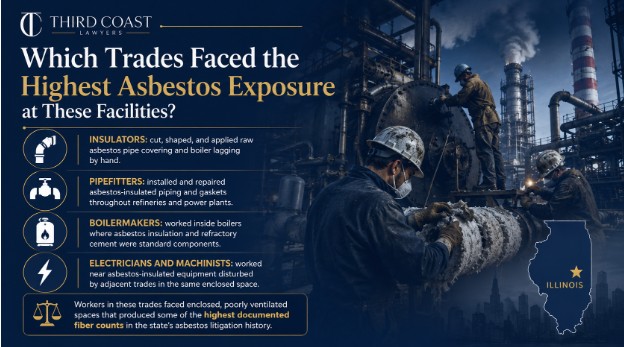
Insulators, pipefitters, boilermakers, and refractory bricklayers faced the highest asbestos exposure at Illinois steel mills, refineries, and power plants because their work required direct contact with asbestos-containing materials.
Workers in these trades faced enclosed, poorly ventilated spaces that produced some of the highest documented fiber counts in the state’s asbestos litigation history.
Anna Gonis O’Connor, Esq., Managing Partner at Third Coast Lawyers and a trial attorney with more than 50 jury trials, has represented Illinois industrial workers in these claims.
If you’re ready to get started, call us now!
Family members who developed an asbestos-related disease from fibers carried home on a worker’s clothing may have a claim under Illinois law, though the outcome depends on case-specific facts about foreseeability.
The Illinois Supreme Court addressed this question in Simpkins v. CSX Transportation, Inc., 2012 IL 110662, holding that a company’s duty to a worker’s family member turns on whether the company could have reasonably foreseen the risk of take-home exposure.
Illinois appellate courts have applied this foreseeability test differently across cases, so the strength of a secondary exposure claim depends on when the underlying workplace exposure occurred and what the employer knew at the time.
A spouse or child who laundered a steelworker’s or refinery worker’s clothing may still have valid grounds for a claim, so wrongful death options remain available even after the worker has passed away.
Secondary exposure claims require the same evidence-gathering urgency as direct exposure claims — talk with Third Coast Lawyers about your family member’s work history.
Filing an Illinois claim for industrial asbestos exposure begins with a medical diagnosis, followed by documenting which mill, refinery, or power plant the exposure occurred at and during what years.
Employment records, union files, and co-worker statements establish the timeline needed to identify responsible manufacturers and pursue trust fund claims alongside any lawsuit against solvent companies.
Illinois’s two-year statute of limitations under 735 ILCS 5/13-202 runs from the date of diagnosis, so families should begin gathering employment and product records as soon as possible after a diagnosis is confirmed.
Steel mill, refinery, and power plant asbestos claims often involve multiple defendants and trust funds — schedule a consultation to start building your case.
Which Illinois steel mills had documented asbestos exposure?
U.S. Steel South Works in Chicago, Republic Steel (later LTV Steel), Joliet Iron Works and Steel Company, and Laclede Steel in Alton all have documented asbestos use in furnace insulation, pipe covering, and refractory materials spanning decades of industrial operations in Illinois.
Did Illinois oil refineries use asbestos?
Yes, refineries in the Joliet and Lemont corridor, including the facilities that later became ExxonMobil and CITGO, used asbestos-insulated pipes, reactors, and valves throughout crude oil processing operations for much of the 20th century, and refinery mechanics and pipefitters handled these materials during routine maintenance.
What power plants in Illinois used asbestos?
Documented Illinois power plant sites include the Powerton, Dresden, and Quad Cities generating stations, as well as the Zion Nuclear Power Station. These facilities used asbestos in boiler insulation, turbine wrap, and steam piping systems because the material resisted the extreme heat these systems generated.
Can I file a claim if the steel mill or refinery where I worked has closed?
Yes, asbestos claims target the manufacturers of the products that caused exposure, not the facility operator. A closed mill or refinery does not preclude a claim against the companies whose asbestos-containing products were used on-site, regardless of how long ago the facility closed.
What trades had the highest asbestos exposure at Illinois industrial sites?
Insulators, pipefitters, boilermakers, and refractory bricklayers faced the highest exposure because their work required direct, repeated contact with asbestos insulation, gaskets, and boiler linings in enclosed industrial spaces, where insulators cut and applied raw asbestos pipe covering by hand throughout Illinois refineries and power plants.
Can my family file a claim if I brought asbestos fibers home from a steel mill or refinery?
Possibly. Illinois courts apply a foreseeability-based duty analysis from the Illinois Supreme Court’s decision in Simpkins v. CSX Transportation to secondary exposure claims, so the outcome depends on when the exposure occurred and what the employer knew about the risk at that time.
How long do I have to file an Illinois industrial asbestos claim?
Illinois generally gives mesothelioma and asbestos disease patients two years from the date of diagnosis to file a personal injury claim under the state’s discovery rule, regardless of whether the exposure occurred at a steel mill, refinery, or power plant.
Do I need to remember the exact product I worked with to file a claim?
No, an attorney typically identifies the asbestos-containing products and manufacturers during the investigation phase, using employment records, union files, and co-worker statements gathered after the claim is filed. These records establish the timeline needed to identify responsible manufacturers at the mill, refinery, or power plant.
Are asbestos trust funds available for Illinois industrial workers?
Yes, workers exposed at steel mills, refineries, or power plants can file claims against active bankruptcy trust funds established by asbestos product manufacturers, separately from or alongside a lawsuit against solvent companies, provided the claim meets Illinois’s current filing deadline.
What does it cost to hire Third Coast Lawyers for an industrial asbestos claim?
Third Coast Lawyers works on a contingency-fee basis, meaning families pay nothing upfront and owe no legal fees in advance. The firm only collects a fee if the steel mill, refinery, or power plant case results in a settlement or verdict.

About the Author
Managing Partner · Toxic Tort Trial Attorney · Licensed in Wisconsin, Illinois, and Missouri
Anna G. O'Connor is the founding member and managing partner of Third Coast Lawyers and a trial attorney licensed in Wisconsin, Illinois, and Missouri. She practices across the Midwest and has tried more than 50 jury trials during her 20-plus-year legal career. Anna represents workers and families in toxic tort matters, including asbestos and mesothelioma claims, in Wisconsin, Illinois, and Missouri state courts, federal courts, and multi-district litigation proceedings.
