

A Wisconsin mesothelioma lawyer builds a causation case linking a confirmed mesothelioma diagnosis to specific asbestos products, employers, and job sites, then files before the applicable deadline.
Wisconsin generally allows 3 years under Wis. Stat. § 893.54(1m), measured from when the injury and its cause were discovered or reasonably discoverable.
Third Coast Lawyers, licensed in Wisconsin, Illinois, and Missouri, handles toxic injury claims involving mill, foundry, shipyard, and industrial plant workers through its toxic injury practice.
A mesothelioma diagnosis can start a three-year filing clock. Third Coast Lawyers offers a free consultation. No fee unless there is a recovery.
A Wisconsin mesothelioma lawyer handles the legal case that runs alongside the medical one. That means tracing the cancer to specific asbestos products, proving causation, and filing against solvent manufacturers and bankruptcy trusts on time. Oncologists direct treatment.
The lawyer turns a diagnosis into admissible proof.
Mesothelioma is a cancer of the mesothelium, the thin membrane lining the chest and abdomen.
The National Cancer Institute identifies it as the most common cancer associated with asbestos. O’Connor previously served as national coordinating counsel for manufacturers defending asbestos claims and has tried more than 50 jury trials. That background gives the firm direct knowledge of how defendants challenge causation.
The legal work breaks into five tasks:
Workers diagnosed with asbestosis or pleural disease rather than cancer can still bring asbestos exposure claims, though the damages proof differs.
Mesothelioma is linked to a Wisconsin workplace through product identification: evidence that a named manufacturer’s asbestos product was present at the claimant’s jobsite while the claimant worked there.
Science settles that asbestos causes the disease. The case has to prove which product reached which worker.
The International Agency for Research on Cancer lists mesothelioma among the cancers asbestos causes, so the dispute usually shifts to the product itself.
Defense lawyers commonly argue that their client’s product never reached the site, held no asbestos, or mattered less than another company’s product.
Two kinds of records answer those arguments:
No single record carries the case. In the firm’s experience, a gap in the dated exposure timeline is the most common reason a claim fails at the causation stage, so the timeline comes first. These records support proving exposure even when the employer closed decades ago.
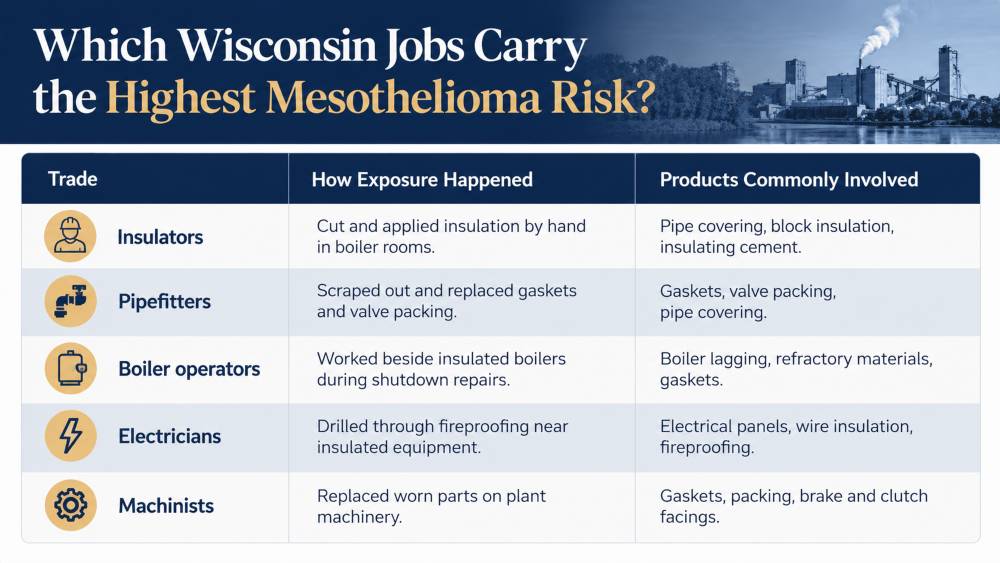
Insulators, pipefitters, boiler operators, electricians, and machinists are among the Wisconsin trades with the most direct asbestos contact. Their work meant cutting, removing, or working beside asbestos insulation, gaskets, and packing.
That contact centered on paper mills, foundries, shipyards, breweries, and machinery plants.
| Trade | How Exposure Happened | Products Commonly Involved |
| Insulators | Cut and applied insulation by hand in boiler rooms | Pipe covering, block insulation, insulating cement |
| Pipefitters | Scraped out and replaced gaskets and valve packing | Gaskets, valve packing, pipe covering |
| Boiler operators | Worked beside insulated boilers during shutdown repairs | Boiler lagging, refractory materials, gaskets |
| Electricians | Drilled through fireproofing near insulated equipment | Electrical panels, wire insulation, fireproofing |
| Machinists | Replaced worn parts on plant machinery | Gaskets, packing, brake and clutch facings |
Great Lakes shipyards in Manitowoc, Sturgeon Bay, Superior, and Marinette concentrated exposure differently.
Shipyard asbestos exposure occurred in tight compartments lined with insulated piping, where every trade aboard shared the same air.
Along the Fox River, paper mills in Brown, Winnebago, and Outagamie counties ran steam systems year-round.
Those systems kept insulators and pipefitters replacing insulation and gaskets at every shutdown. Milwaukee foundries and machinery plants added furnace insulation, refractory cement, and gaskets that maintenance crews replaced by hand.
Exposure also followed workers home. Spouses and children who washed dusty work clothes face secondary asbestos exposure risk, and those household members may have claims of their own.
If you’re ready to get started, call us now!
A mesothelioma claim usually relies on two kinds of medical proof. The first is a pathology-confirmed diagnosis, typically from a biopsy tested with immunohistochemistry.
The second is expert testimony connecting the exposure to the disease. Wisconsin juries apply a substantial factor test: whether exposure to a defendant’s product was a substantial factor in causing the cancer.
| Record | What It Proves | Usual Source |
| Pathology report with immunohistochemistry | Diagnosis: the tumor is mesothelioma, not lung adenocarcinoma | Hospital pathology department |
| CT, PET, and chest X-ray studies | Timeline: when pleural or peritoneal disease appeared | Radiology department |
| Treating physician notes | Timeline: diagnosis date and recorded exposure history | Oncologist or pulmonologist |
| Expert causation report | Causation: the defendant’s product contributed to the disease | Retained pathologist or occupational medicine physician |
Experts address two separate questions. General causation asks whether asbestos causes mesothelioma, which IARC has answered.
Specific causation asks whether this worker’s exposure to this product contributed to this cancer. Defendants may argue that a tumor is lung cancer caused by smoking, so a clear pathology diagnosis matters before filing.
Pathology slides and tissue blocks are worth preserving early, because an expert may want to examine the original material rather than rely on a summary report. Older chest films from employer physicals or prior clinics belong in the same records request.
Closed mills and shipyards leave fewer records each year. Third Coast Lawyers rebuild Wisconsin work histories before evidence disappears. No fee unless there is a recovery.
The Wisconsin filing clock generally starts when a claimant discovers, or with reasonable diligence should discover, both the injury and its probable cause. For many mesothelioma claimants, that point is the diagnosis, and Wis. Stat. § 893.54(1m)(a) then allows 3 years to sue.
The Wisconsin Supreme Court adopted the discovery rule in Hansen v. A.H. Robins Co., 113 Wis. 2d 550 (1983).
In Borello v. U.S. Oil Co., 130 Wis. 2d 397 (1986), a plaintiff’s early lay belief about the cause did not start the clock because examining physicians contradicted it until a later diagnosis confirmed it.
Diagnosis is not an automatic trigger, though. Earlier medical findings tied to asbestos can support an argument that the clock started sooner.
A wrongful death action carries its own 3-year limit under § 893.54(1m)(b). The 2-year limit in § 893.54(2m) covers only deaths arising from motor vehicle accidents.
Exposure in Illinois or another state can trigger a shorter limit under Wis. Stat. § 893.07, so the mesothelioma filing deadline is checked against every state on the work record.
Wisconsin mesothelioma families recover through two routes that often run together: lawsuits against manufacturers still in business, and claims against bankruptcy trusts created by manufacturers that reorganized. The damages available depend on who brings the claim.
Separate subsections govern each part of a wrongful death claim. Under § 895.04(1), the personal representative or a person entitled to the recovery brings the action.
Section 895.04(2) sets out who receives the money, starting with the spouse and minor children. Section 895.04(4) limits loss of society damages to the spouse, children, parents, and siblings who were minors at the death.
Trust claims carry a disclosure rule. Under Wis. Stat. § 802.025, the plaintiff must take three steps:
The same statute makes those materials admissible in evidence and lets defendants seek discovery from the trusts.
Workers’ compensation does not shield manufacturers. Wis. Stat. § 102.03(2) makes compensation the exclusive remedy against an employer, but companies that made or sold asbestos products sit outside that bar.
Each trust runs its own review, and complete documentation keeps that review moving. Coordinating asbestos trust claims with the court case keeps both on one consistent exposure record.
A first consultation with Third Coast Lawyers includes a free review of the diagnosis, work history, and applicable deadline. Clients work directly with O’Connor and the firm’s team from intake through resolution, and home and hospital appointments are available.
Families can bring whatever records they already have. The most useful are:
After the meeting, the firm sets the exposure timeline, identifies responsible parties, and maps the remaining records needed. Those steps also shape how the firm values mesothelioma compensation in a specific case.
O’Connor is admitted in Wisconsin and before the U.S. District Court for the Western District of Wisconsin, so Wisconsin claims are handled directly from the Lake Forest office. The firm works on a contingency fee basis with no upfront costs.
Asbestos causes most mesothelioma. The International Agency for Research on Cancer classifies all six asbestos minerals as known human carcinogens that cause the disease. Inhaled or swallowed fibers lodge in the lining of the chest or abdomen, usually decades before diagnosis.
Wisconsin generally allows 3 years under Wis. Stat. § 893.54(1m), counted from when the injury and its asbestos cause were known or reasonably knowable. That date is often the diagnosis, but earlier medical findings or exposure in another state can change it.
The National Cancer Institute has not established a safe level of asbestos exposure. A Wisconsin claim does not depend on years of contact. The claim depends on proof that exposure to a defendant’s product was a substantial factor in causing the mesothelioma.
Request the pathology report, all imaging, and a Social Security earnings statement; write down every employer and jobsite with dates; and list coworkers who can confirm the products used. Then schedule a legal review quickly, because the filing deadline may already be running.
Timelines vary widely and depend on the number of defendants, the court, whether the case settles, and the claimant’s health. Trust claims follow each trust’s own review schedule. Attorneys often record the claimant’s video testimony early to preserve it.
Yes. The estate’s personal representative or a family member entitled to the recovery can bring a wrongful death action, generally within 3 years under Wis. Stat. § 893.54(1m)(b). The estate can also pursue the worker’s own injury claim under Wisconsin’s survival statute.
No, not against manufacturers. Wis. Stat. § 102.03(2) makes workers’ compensation the exclusive remedy against the employer, but that bar does not reach the companies that made or sold the asbestos products. Most Wisconsin mesothelioma lawsuits name product manufacturers, not employers.
Yes. Mesothelioma claims usually target the manufacturers and suppliers of asbestos products, not the employer. When a manufacturer went bankrupt, its asbestos trust may still accept claims, and Social Security and pension records can rebuild the work history from a closed site.
A Wisconsin mesothelioma claim rests on three things: a confirmed diagnosis, proof that a named manufacturer’s product reached the claimant’s jobsite, and a timely filing under Wis. Stat. § 893.54(1m).
Families who lose a worker can bring both a wrongful death action and the worker’s surviving injury claim.
Trust claims and lawsuits can run together, and Wis. Stat. § 802.025 opens every trust filing to the defense.
Evidence disappears. Deadlines are real. Third Coast Lawyers handles Wisconsin mesothelioma claims from intake to resolution. No fee unless there is a recovery.

About the Author
Managing Partner · Toxic Tort Trial Attorney · Licensed in Wisconsin, Illinois, and Missouri
Anna G. O'Connor is the founding member and managing partner of Third Coast Lawyers and a trial attorney licensed in Wisconsin, Illinois, and Missouri. She practices across the Midwest and has tried more than 50 jury trials during her 20-plus-year legal career. Anna represents workers and families in toxic tort matters, including asbestos and mesothelioma claims, in Wisconsin, Illinois, and Missouri state courts, federal courts, and multi-district litigation proceedings.
