

Wisconsin’s asbestos filing deadline has two separate parts that are easy to confuse. The statutory period is three years under Wis. Stat. § 893.54(1m)(a).
Separately, Wisconsin case law sets when that period starts: the claim accrues when the injury is discovered, or when it should have been discovered with reasonable diligence, whichever comes first. Exposure never starts it.
For toxic injury claims involving asbestos, that accrual date commonly falls at the confirming diagnosis, but it is determined by the facts, not the calendar.
Mesothelioma diagnoses raise a timing question that turns on individual facts. Third Coast Lawyers identifies the governing deadline during a free consultation.
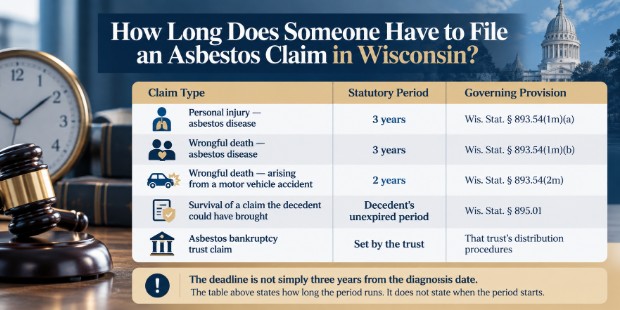
Three years covers most asbestos claims. Wis. Stat. § 893.54 bars the listed actions unless commenced within that period, subject to one exception for deaths arising from vehicle accidents.
| Claim Type | Statutory Period | Governing Provision |
| Personal injury — asbestos disease | 3 years | Wis. Stat. § 893.54(1m)(a) |
| Wrongful death — asbestos disease | 3 years | Wis. Stat. § 893.54(1m)(b) |
| Wrongful death — arising from a motor vehicle accident | 2 years | Wis. Stat. § 893.54(2m) |
| Survival of a claim the decedent could have brought | Decedent’s unexpired period | Wis. Stat. § 895.01 |
| Asbestos bankruptcy trust claim | Set by the trust | That trust’s distribution procedures |
The deadline is not simply three years from the diagnosis date. The table above states how long the period runs. It does not state when the period starts.
Wisconsin case law governs that second question, and the facts of an individual’s work and medical history determine the answer, which is why two claimants diagnosed the same week can have different filing dates.
A claim accrues when the injury is discovered, or when it should have been discovered with reasonable diligence, whichever occurs first.
The Wisconsin Supreme Court adopted that formulation in Hansen v. A.H. Robins Co., 113 Wis. 2d 550 (1983), and extended it to latent toxic-exposure injuries in Borello v. U.S. Oil Co., 130 Wis. 2d 397 (1986).
Two elements matter: the injury itself, and its cause. Suspicion alone may not be enough, and reasonable diligence is required — a claimant who ignores available information cannot rely on the rule to extend the period.
| Scenario | Whose Discovery Controls | Controlling Authority |
| Worker with an asbestos diagnosis | The claimant’s own | Hansen; Borello |
| Later malignancy after an earlier non-malignant finding | The claimant’s, as to the malignancy | Sopha v. Owens-Corning Fiberglas Corp. |
| Wrongful death following asbestos disease | The wrongful death beneficiary’s | Christ v. Exxon Mobil Corp. |
| Household member with an independent diagnosis | That person’s own | Hansen; Borello |
Borello illustrates why diagnosis matters so much in practice, even though it’s not the legal rule.
Where a claimant’s early lay belief about a cause was contradicted by examining physicians, the claim did not accrue until medical diagnosis confirmed the suspicion.
For diseases that surface 20 to 50 years after inhalation, per CDC and NIOSH occupational research, the confirming diagnosis is usually the first point at which both elements exist together.
If you’re ready to get started, call us now!
The two-year figure comes from Wis. Stat. § 893.54(2m), which applies to an action for a death caused by wrongful act and arising from an accident involving a motor vehicle. Within § 893.54, no other subsection sets a two-year period.
Occupational asbestos disease rarely fits that description. Wisconsin appellate authority reads “arises from an accident” as requiring a causal relationship between an accident and the death — see Estate of Wiemer v. Zeeland Farm Services, Inc., 2023 WI App 47. Fibers inhaled across a career in a boiler room or a paper mill do not supply that relationship.
Personal injury claims arising from vehicle accidents remain at three years; § 893.54(1m)(a) says so expressly. Only a death arising from such an accident drops to two. A claimant who encounters the two-year figure should confirm which subsection the source describes before treating a window as closed.
Evidence disappears, and deadlines are real. Third Coast Lawyers reconstructs Wisconsin work histories before records and witnesses vanish — request a case review.
Not necessarily. Wisconsin recognizes a later malignant asbestos condition as a separate cause of action with its own accrual date.
Sopha v. Owens-Corning Fiberglas Corp., 230 Wis. 2d 212 (1999), holds that the diagnosis of a malignant asbestos-related condition creates a new cause of action, and that the limitation period for that condition begins when the claimant discovers, or with reasonable diligence should discover, the malignancy.
Robert Sopha worked as an insulator from 1951 until 1995 and had been found to have non-malignant pleural thickening before 1987; his mesothelioma was first diagnosed in December 1996. The court declined to treat the earlier condition as having started the clock on the later one.
The consequence reaches beyond claim preclusion. Which condition, and when, determines the governing period — so a decades-old pleural finding does not automatically close the door on a later malignancy.
Workers whose exposure traces to insulation and pipefitting trades often carry years of imaging in their files, and the sequence of those findings shapes the analysis.
A claimant who resolved a non-malignant claim in another state faces a further question: what that settlement agreement released, and which state’s law governs it. That is a document-specific inquiry rather than a general rule.
Wisconsin provides three years for wrongful death claims under Wis. Stat. § 893.54(1m)(b). Accrual follows the discovery rule, not the date of death.
In Christ v. Exxon Mobil Corp., 2015 WI 58, 362 Wis. 2d 668, the Wisconsin Supreme Court held that wrongful death claims accrue on the date the injury is discovered, or should reasonably have been discovered, by the wrongful death beneficiary, whichever occurs first.
Death and discovery frequently coincide, which is why the date of death is often cited as the trigger — but the two are not the same rule, and families whose understanding of the cause developed on a different timeline should have the accrual date assessed directly.
A narrower rule governs derivative claims tied to medical negligence. In Estate of Genrich v. OHIC Insurance Co., 2009 WI 67, the medical malpractice statute, § 893.55, controlled such a claim, and it accrued on the date of injury rather than death.
Under § 895.01, a personal injury claim the decedent could have brought survives into the estate rather than expiring at death.
Families pursuing asbestos wrongful death claims may therefore hold two claims with two accrual dates, and the survival claim carries the decedent’s own unexpired period rather than a fresh three years.
A spouse who laundered contaminated clothing and later received a diagnosis holds a personal injury claim accruing on that spouse’s own discovery. The worker’s exposure, retirement, and death do not control it.
A secondary exposure claim may therefore remain open long after the underlying mill or shipyard work ended.
No. Each asbestos bankruptcy trust operates under its own trust distribution procedures, and those documents — not § 893.54 — govern eligibility, filing requirements, and timing for that trust.
Because terms vary by fund, you must read the timing for any given trust claim from that trust’s governing documents rather than assuming it from another trust or the state statute. Some set bar dates; others do not. Each trust’s procedures also set payment percentages, which can be revised.
Wisconsin adds a litigation obligation that affects sequencing. Wis. Stat. § 802.025, enacted as 2013 Wis. Act 154, requires plaintiffs in covered Wisconsin asbestos actions to disclose trust claims and supporting exposure materials.
Inconsistencies between a trust submission and a court pleading surface under that provision, so the exposure history described in each should match from the outset.
Trust eligibility and the state limitation period are independent. Letting the civil period lapse forecloses the litigation path against solvent defendants while leaving trust options governed separately — a trade-off worth evaluating with counsel rather than by default.
How long does someone have to file an asbestos lawsuit in Wisconsin?
Wisconsin sets three years under Wis. Stat. § 893.54(1m)(a). That period does not begin at exposure. It begins when the claim accrues under the discovery rule, which for asbestos disease commonly falls at or near the confirming diagnosis rather than automatically on it.
Does the clock start at exposure or at diagnosis?
Neither automatically. Wisconsin claims accrue when the injury is discovered, or when it should have been discovered with reasonable diligence, whichever comes first, under Hansen v. A.H. Robins Co. and Borello v. U.S. Oil Co. In practice, diagnosis is often that point.
Why do some websites say Wisconsin allows only two years?
Wis. Stat. § 893.54(2m) sets two years for a wrongful death arising from a motor vehicle accident. That subsection does not govern occupational asbestos disease. Sources applying it broadly to asbestos claims are describing a different provision entirely.
Can a family file after the worker has already died?
Yes. Wisconsin allows three years under Wis. Stat. § 893.54(1m)(b). Under Christ v. Exxon Mobil Corp., accrual follows the beneficiary’s discovery rather than the death date alone, and a survival claim under § 895.01 may run alongside it.
Does an old asbestosis diagnosis prevent a mesothelioma claim later?
Not necessarily. Sopha v. Owens-Corning Fiberglas Corp. holds that a malignant asbestos condition creates a new cause of action, with its period beginning when the claimant discovers, or with reasonable diligence should discover, that malignancy.
What deadline applies to a spouse exposed through work clothing?
The same three-year personal injury period, accruing on that spouse’s own discovery of the disease and its cause. The worker’s exposure dates, retirement, and death do not determine when the household member’s period begins to run.
Do asbestos trust funds use the same three-year deadline?
No. Each trust’s distribution procedures govern its own filing requirements and timing. Those terms differ from fund to fund and come from the trust’s governing documents, not Wisconsin’s statutory period.
Does exposure in another state change the Wisconsin deadline?
Potentially. Where significant exposure occurred elsewhere, another jurisdiction’s period may bear on the analysis. Work histories spanning Illinois, Iowa, or Michigan warrant an early venue and accrual review before any filing decision.
Wisconsin work histories grow harder to document as employers close and coworkers pass away. Third Coast Lawyers confirms the accrual date — free case review.

About the Author
Managing Partner · Toxic Tort Trial Attorney · Licensed in Wisconsin, Illinois, and Missouri
Anna G. O'Connor is the founding member and managing partner of Third Coast Lawyers and a trial attorney licensed in Wisconsin, Illinois, and Missouri. She practices across the Midwest and has tried more than 50 jury trials during her 20-plus-year legal career. Anna represents workers and families in toxic tort matters, including asbestos and mesothelioma claims, in Wisconsin, Illinois, and Missouri state courts, federal courts, and multi-district litigation proceedings.
