


Originally published: November 2025 | Updated: December 2025
Wisconsin residents diagnosed with mesothelioma or other asbestos-related diseases can seek compensation through multiple asbestos trust funds.
Even if the companies responsible for their exposure have filed for bankruptcy, these funds remain available.
Filing an asbestos trust claim in Wisconsin means gathering medical records and work history, submitting claims to multiple trusts, and keeping a close eye on deadlines—each trust has its own rules.
Many families never realize they can file claims with dozens of trusts simultaneously. That’s a big deal for maximizing compensation, honestly.
Asbestos trust funds are bank accounts that hold funds set aside to compensate victims of asbestos exposure and related diseases, such as mesothelioma.
These funds came about when asbestos companies filed for bankruptcy to avoid lawsuits.
Wisconsin workers in shipbuilding, construction, and manufacturing often qualify for compensation from multiple trusts based on their exposure history. There’s a long history of exposure in these industries.
The claims process isn’t exactly a walk in the park. Every asbestos trust fund has its own rules and requirements, and missing a step can lead to delays or denials.
Asbestos trusts let you seek compensation without setting foot in a courtroom. Lawsuits, on the other hand, can drag on for years and get stressful fast.
Asbestos trust funds are financial reserves that bankrupt companies set up after exposing people to asbestos. These companies faced so many lawsuits that bankruptcy was their only option.
Key differences include:
| Trust Claims | Asbestos Lawsuits |
| No court trial needed | Requires court proceedings |
| Faster resolution (months) | Can take 2-3 years |
| Lower compensation amounts | Higher potential payouts |
| Less evidence required | Extensive proof needed |
With trust claims, you skip the court hassle. You just file paperwork and, if approved, get paid.
Lawsuits demand more proof and patience. They can pay more, but you’ll wait much longer and need to prove the company’s fault in court.
If you’re in Wisconsin and need money quickly for medical bills, trust claims make a lot of sense. People with serious illnesses like mesothelioma don’t have years to wait for a lawsuit to wind its way through the courts.
Trust claims also work best when the company responsible has gone bankrupt. Over 60 asbestos trust funds exist, and billions of dollars are still available.
Trust claims make sense when:
Many Wisconsin workers were exposed to asbestos in shipyards, power plants, and factories. A lot of those companies went bankrupt and set up trusts.
Trust claims aren’t just for victims themselves. If a loved one died from an asbestos-related disease, family members can file claims too.
If you’re ready to get started, call us now!
Different claim types mean different requirements and deadlines. Whether the victim is living or deceased, each type needs its own documentation and follows its own process.
Living Claims are for people diagnosed with mesothelioma, lung cancer, asbestosis, or another asbestos-related illness. You’ll need medical records showing your diagnosis and proof of asbestos exposure.
Wrongful Death Claims allow family members to file after someone dies from an asbestos-related illness. Spouses, kids, or estate reps can do this, but they’ll need death certificates and medical records connecting the death to asbestos.
Survivor Claims are different. If the victim already filed a living claim but died before getting paid, the family can continue the same claim instead of starting over.
Each claim type comes with its own eligibility requirements across the various trusts. Living claims usually bring higher payments than wrongful death claims, at least from most funds.
| Requirement | Why it matters | Typical doc/example |
| Medical diagnosis | Trusts require proof of asbestos disease | Pathology report, CT/X-ray |
| Exposure linkage | Shows you worked with covered products | Paystubs, jobsite logs |
| Product or company link | Identifies the covered defendant | Invoices, blueprints, MSDS |
| Claimant status | Living or wrongful-death claimant rules differ | Death cert + rep info |
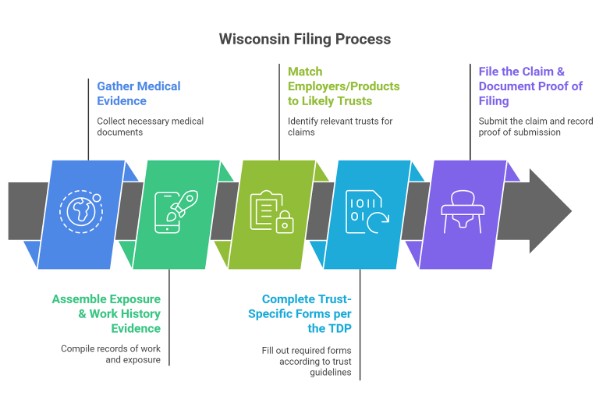
Filing an asbestos trust fund claim means you’ll need solid documentation of your medical history, work background, and exposure details. Every trust has its own forms and rules, and you’ve got to follow them closely.
Your medical documentation is the backbone of any asbestos trust fund claim. Trusts want specific proof of an asbestos-related diagnosis.
Essential Medical Records:
The medical evidence needs to show an asbestos-related disease clearly. Most trusts accept diagnoses like mesothelioma, lung cancer with asbestos exposure, and asbestosis.
Claimants should get complete files from all their doctors. Hospital records, oncology reports, and pulmonologist notes really help.
Some trusts want medical evidence from the last six months. Others accept older records if they show how the disease progressed.
You’ll need a detailed work history and proof of exposure. This ties your illness to specific companies and their asbestos products.
Key Exposure Evidence:
Work history should name job sites, dates, and duties. The more details, the stronger your claim.
Product identification helps link your exposure to certain trusts. Product brochures, safety data sheets, or company docs showing asbestos use can be surprisingly helpful.
Military veterans should grab discharge papers and service records. Navy vets, in particular, often have strong claims because of heavy asbestos use on ships.
You’ll need to connect your work history to the right asbestos trust funds. That means researching which companies went bankrupt and set up trusts.
Some big trusts, like Johns Manville Corporation, cover insulation and building materials. Others focus on automotive, industrial, or shipyard exposures.
Trust Matching Factors:
Legal databases and trusted websites list which products and companies are covered. Doing this research helps you spot all the trusts you might qualify for.
Some people qualify for multiple trust payments. Each trust acts independently, so filing with several can increase your total compensation.
Every asbestos trust fund uses its own Trust Distribution Procedures (TDP). These spell out claim form requirements, evidence standards, and payment percentages.
You have to fill out the forms accurately. Missing info or mistakes can slow things down or get your claim denied.
Common Form Requirements:
Some forms are just a page or two, while others seem to go on forever. It really depends on the trust.
Payment percentages vary widely, from 5% to 40% of the claim’s base value. It all depends on the trust’s available funds and the number of claims they’re handling.
Having a lawyer can help with the complicated stuff. Filing asbestos claims without legal help can be complex and unpredictable.
When you’re ready to file, pay close attention to how and when you submit everything. Most trusts let you file online through secure portals these days.
Filing Documentation:
Electronic filing usually gives you instant confirmation. If you mail it, use certified mail and get a return receipt to prove delivery.
Sometimes trusts ask for more info after you file. Respond quickly so your claim doesn’t get stuck in limbo.
Most asbestos trust fund claims take several months to process. The claim process generally takes several months to over a year, depending on complexity.
Many trusts have online tracking, so you can check your claim’s status. It’s a good idea to follow up now and then, just in case something goes missing.
Filing trust claims can feel overwhelming, but our team at Third Coast Lawyers helps you organize documents, verify exposures, and move forward confidently. Schedule an appointment today.
If you’re ready to get started, call us now!
Wisconsin asbestos victims face different deadlines for state lawsuits and trust fund claims. Each trust sets its own timing rules, so knowing these deadlines really matters when planning your claims strategy.
| Action | Typical deadline | Source/Note |
| File trust claim | See each trust’s TDP (some allow years after diagnosis) | Trust TDP |
| Preserve medical/pathology slides | Immediately — some trusts require originals | TDPs/filing instructions |
| Serve trust disclosure in court | 30 days before trial per WI rule (if also filing suit) | WI statute/rule. (Wisconsin Legislative Documents) |
Wisconsin gives you three years from the date you discover or get diagnosed with an asbestos-related illness to file a lawsuit in state court. This deadline is strict, and missing it usually means you lose your chance to sue.
Trust fund deadlines aren’t the same. Most asbestos trusts keep accepting claims as long as they exist, so there’s no automatic cutoff date.
Still, a few trusts do set bar dates that block new claims after a certain point. Check each trust’s rules—don’t just assume you’ve got unlimited time.
Attorneys can help identify all potential jurisdictions and trust funds, and track applicable filing deadlines. Things get complicated fast when multiple companies and exposure sites are involved.
Every trust uses a Trust Distribution Procedure (TDP) to set its own timing rules. These rules determine how long your claim will take and when you might see payment.
FIFO processing—”first in, first out”—means your claim gets reviewed in the order it arrives. If you file early, you get ahead of the line.
Most trusts offer two ways to review your claim:
Expedited reviews usually wrap up in 60-90 days. Individual reviews? Those can drag on for a year or two, especially if the trust has a big backlog.
Some trusts cut payment percentages if their funds run low. Those numbers can change as more people file claims.
Trust fund claim processing involves multiple steps with unique rules for each trust. Many people file with several trusts at once to try for the best compensation.
Trust fund claims need four main exhibit packets: medical diagnosis, work history, product exposure, and legal statements. Each one has its own formatting rules and document requirements.
The medical packet proves you have an asbestos-related disease. You’ll need official records, such as pathology reports, scans, and your doctor’s statements.
Key Medical Documents:
Order these records directly from your hospital or doctor’s office. Expect to pay $0.25 to $1.00 per page for copies.
Put everything in date order, with the latest diagnosis on top. It helps to make a simple timeline showing when your symptoms started and when doctors confirmed your illness.
Cut out duplicate pages. Highlight spots that mention your specific asbestos-related disease. Trusts usually only cover certain cancers and lung diseases.
This packet shows where and when you got exposed to asbestos at work. You’ll need detailed job info and statements from people who saw what happened.
Essential Employment Documents:
Ask the Social Security Administration for your full earnings history. It usually takes 2-4 weeks and costs nothing.
List every job you’ve had, with dates and what you did each day. Include details about asbestos exposure at different workplaces and products you used.
Try to get signed statements from coworkers who saw you working with asbestos. Their affidavits should mention specific products, dust, and the safety gear people used (if any).
This packet links your exposure to specific asbestos products from companies with trust funds. Identifying the right products decides which trusts might pay.
Start with your work history and identify the materials you used at each job. Common products? Insulation, floor tiles, gaskets, brake parts—the usual suspects.
Product Research Methods:
Some law firms have huge product databases that match brands to job sites. Industrial sites are often stuck with the same suppliers for ages.
Back up your claims with photos, ads, or technical specs that prove asbestos was in the product. Trusts want clear proof that their product caused your exposure.
Affidavits and medical causation letters need to use clear, specific language. Trusts won’t accept vague or speculative statements.
Affidavit Key Elements:
Sample affidavit: “While I worked at [Company] from [dates], I saw [claimant’s name] working with [specific product]. The work made visible dust that covered everyone and everything nearby.”
Physician Letter Requirements:
Sample causation letter: “After examining and reviewing [patient’s name]’s records, I believe [specific disease] resulted directly from occupational asbestos exposure. This matches what current medical research shows about asbestos-related diseases.”
| Exhibit | Typical content | Why trusts want it |
| Medical packet | Biopsy, imaging, doctor’s letter | Confirms diagnosis |
| Work history | Employer names, dates, job duties | Links claimant to exposure |
| Product evidence | Invoices/MSDS | Links to trust-covered products |
| Proof of identity | ID, SSN, death cert if applicable | Verifies claimant |
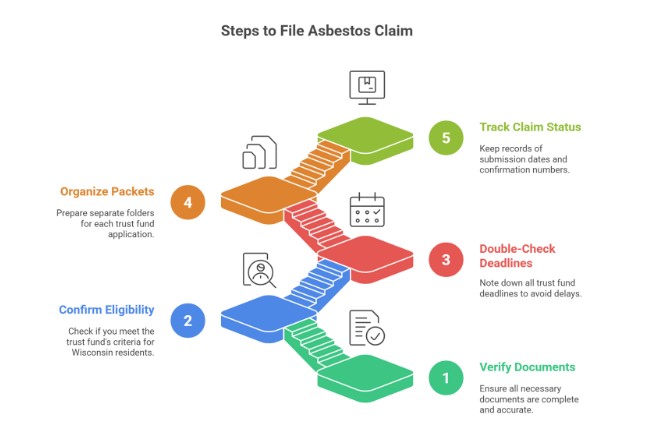
Before you send in your Wisconsin asbestos trust claim, run through this action plan. It helps ensure your documents are in order and that you don’t miss any deadlines.
Step 1: Verify Document Completeness. Check if your medical records clearly show your asbestos-related diagnosis.
Employment records should list the specific Wisconsin job sites and the dates you worked at each site.
Product identification documents need to name the exact asbestos-containing materials you came into contact with.
If you forget something, your claim could get delayed—or even denied. It’s frustrating, but it happens.
Step 2: Confirm Trust Fund Eligibility. Take a close look at each trust fund’s requirements for Wisconsin residents.
Some trusts treat mesothelioma claims differently from other asbestos diseases, which can get confusing fast.
Make sure your exposure history lines up with the trust’s list of covered products and time periods.
Step 3: Double-Check Filing Deadlines Jot down every trust fund deadline date somewhere you’ll actually see it.
Wisconsin doesn’t have a state statute of limitations for these claims, but the trusts themselves set their own deadlines.
Try to get your claims in at least 30 days before the cutoff. That way, you’ve got some wiggle room if you need to fix anything.
Step 4: Organize Submission Packets. Set up a separate folder for each trust fund application. It’s a pain, but it keeps things straight.
Slip in copies of all your supporting documents, and don’t forget original signatures if the trust asks for them.
Step 5: Track Claim Status Write down every submission date and confirmation number somewhere safe.
Reach out to the trust administrators every 60 to 90 days to check on your mesothelioma compensation claim.
Your compensation opportunities may depend on filing trusts correctly and on time. Start your evidence checklist now and get clear, tailored guidance for Wisconsin. Reach out to Third Coast Lawyers—contact us today.
How do I file an asbestos trust claim in Wisconsin?
You must submit medical records, work-history evidence, and product identification that matches a trust’s criteria, then file through the trust’s online portal or mail-in system.
What evidence do asbestos trusts require?
Most trusts require a confirmed diagnosis, pathology or imaging reports, a detailed work-history timeline, and documents linking your jobsite to the bankrupt manufacturer’s asbestos products.
Do asbestos trust claims have deadlines?
Yes. Each trust sets its own filing requirements and timing rules. These deadlines are separate from Wisconsin’s three-year statute for personal injury claims.
Can I file multiple asbestos trust claims at once?
Yes. Many Wisconsin claimants qualify for several trusts because different manufacturers’ products were used at the same jobsite or throughout their work history.
How long does it take to receive payment from an asbestos trust?
Processing times vary. Some trusts pay in weeks; others take several months, depending on the completeness of the documentation and the trust’s review queue.
Do I still need a lawsuit if I file trust claims?
Possibly. Trust claims compensate only for exposure to bankrupt companies. You may still file lawsuits in Wisconsin against solvent manufacturers or contractors.
Can I file a trust claim if I don’t remember the exact asbestos products?
Yes. Work records, invoices, blueprints, coworker statements, or industry-standard product lists can help identify which asbestos-containing materials were likely present at your jobsite.
