

Secondary asbestos exposure is exposure that occurs not at the original worksite but through contact with fibers carried home on a worker’s clothing, hair, or skin.
Spouses and children of Wisconsin paper mill workers, shipyard builders, and insulators who laundered contaminated work clothing inhaled asbestos fibers shaken loose during handling — often for decades without knowing the risk.
Wisconsin is one of seven states where women’s annualized mesothelioma death rates exceeded 6.0 per million between 1999 and 2020 (CDC MMWR, 2022). Wisconsin allows three years from the family member’s own diagnosis to file a personal injury claim under Wis. Stat. § 893.54(1m).
Families of Wisconsin workers are still receiving asbestos-related diagnoses decades after the original exposure ended. Schedule a free consultation with Third Coast Lawyers before evidence connecting the worker’s employment to the family member’s diagnosis becomes harder to assemble.
Asbestos fibers were transferred from Wisconsin paper mills, shipyards, and manufacturing plants to family homes primarily through contaminated work clothing.
A worker who spent a shift handling pipe insulation, boiler lagging, or dryer felts accumulated microscopic fibers on coveralls, work boots, hair, and exposed skin.
Those fibers entered the home and became airborne during routine activities.
NIOSH identified the primary transfer pathways in its 1995 report directed by the Workers’ Family Protection Act (Public Law 102-522):
A 2014 peer-reviewed study published in Risk Analysis quantified the take-home exposure pathway. Researchers contaminated work clothing at workplace-level fiber concentrations (1–2 fibers per cubic centimeter) and measured airborne fiber release during handling and shaking.
The study confirmed that routine clothing handling generated measurable asbestos exposure in the household environment (Sahmel et al., Risk Analysis, 2014).
Spouses of Wisconsin paper mill workers who laundered work clothing during the 1950s through 1970s inhaled asbestos fibers shaken loose during handling — exposure that occurred daily, for years, without any warning from the manufacturers whose products generated the contamination.
Any person diagnosed with an asbestos-related disease from household exposure to fibers carried home by a worker can file a personal injury claim in Wisconsin. The claimant need not have entered the worksite. The claim is based on the claimant’s own diagnosis, not the worker’s.
Secondary exposure claims in Wisconsin target the manufacturers of the asbestos-containing products used at the worker’s job site. The legal theory: manufacturers knew or should have known that asbestos fibers would be carried home and that household contacts faced a foreseeable risk of exposure.
| Claim Type | Filed By | Defendant | Wisconsin Statute |
| Personal injury — secondary exposure | Diagnosed family member | Product manufacturer(s) | Wis. Stat. § 893.54(1m) — 3 years from diagnosis |
| Wrongful death — secondary exposure | Surviving spouse, children, or personal representative | Product manufacturer(s) | Wis. Stat. § 893.54(1m)(b) — 3 years from date of death |
| Asbestos trust fund claim | Diagnosed family member or estate | Bankrupt manufacturer’s trust fund | Trust-specific deadlines (separate from state SOL) |
The employer where the worker was exposed is generally not the defendant in a secondary exposure claim. The employer owed a duty of care to the worker, not necessarily to the worker’s household contacts.
The product manufacturer, by contrast, owed a duty to all foreseeable persons exposed to its product — including family members who predictably came into contact with contaminated clothing.
If you’re ready to get started, call us now!
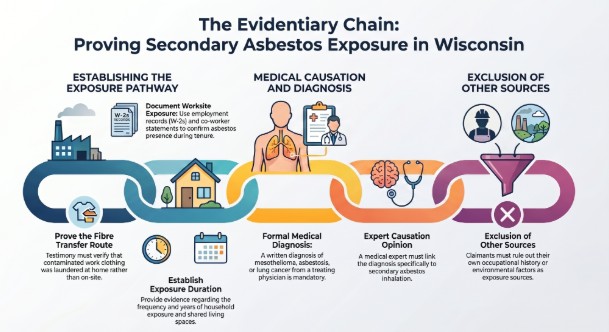
Secondary exposure claims require a longer evidentiary chain than direct occupational claims because the claimant must connect a diagnosis to fibers that traveled from a specific worksite, through a specific worker, into a specific household. Three links in the chain must be documented:
| Evidence Element | Worker’s Direct Claim | Family Member’s Secondary Claim |
| Employment records | Required — proves worker’s presence at the jobsite | Required — proves worker’s presence at the jobsite |
| Product identification | Required — links exposure to specific manufacturers | Required — same products, same manufacturers |
| Fiber transfer documentation | Not required | Required — must prove fibers reached the household |
| Household exposure testimony | Not required | Required — laundering, contact, shared living space |
| Medical diagnosis | Worker’s diagnosis | Family member’s own diagnosis |
| Causation expert | Links workers’ exposure to workers’ disease | Links secondary exposure to a family member’s disease |
The additional evidentiary burden — proving the transfer pathway — is why secondary exposure claims require detailed investigation starting as early as possible.
Employment records are discarded, co-workers become unreachable, and the worker may have already died by the time the family member receives a diagnosis.
Third Coast Lawyers secures time-sensitive evidence before it disappears — employment records, product identification, and household exposure documentation that connect the worker’s job to the family member’s diagnosis.
Secondary exposure cases name different defendants than the worker’s original claim because the legal duty at issue is different. The worker’s claim targeted parties who owed a duty to protect the worker at the jobsite.
The family member’s claim targets parties who owed a duty to warn foreseeable household contacts about the risks of take-home exposure.
The distinction plays out in three ways:
A 2023 Wisconsin jury awarded $9.7 million in a secondary exposure wrongful death case involving Sarah Krentz, who inhaled asbestos fibers as a child through her stepfather’s contaminated work clothing.
The jury found nine of eleven named product manufacturers liable, with Motor Casting Co. assigned 50 percent of responsibility.
If you’re ready to get started, call us now!
Families can file a wrongful death claim in Wisconsin when a person who was secondarily exposed to asbestos has died from an asbestos-related disease. The wrongful death statute of limitations under Wis. Stat. § 893.54(1m)(b) provides three years from the date of the secondarily exposed person’s death — not the date of the worker’s death or the date of the original exposure.
The wrongful death deadline runs from the secondarily exposed person’s date of death, not the worker’s. A spouse who laundered a paper mill worker’s contaminated clothing in the 1960s, received a mesothelioma diagnosis in 2024, and died in 2025 gives surviving family members until 2028 to file a wrongful death claim.
The worker’s death date — whether in 1990 or 2010 — does not control the family’s filing deadline.
Wisconsin wrongful death claims allow recovery for:
The $9.7 million Krentz verdict in 2023 awarded $3 million to the surviving husband and $6.7 million to the estate — confirming that Wisconsin juries assign substantial value to secondary exposure wrongful death claims when the evidence chain is documented.
Wisconsin’s discovery rule anchors the statute of limitations to the family member’s own diagnosis date — not the worker’s exposure, the worker’s diagnosis, or the worker’s death. Under Wis. Stat. § 893.54(1m), the three-year clock starts when the secondarily exposed family member discovers or reasonably should have discovered the asbestos-related disease.
The practical effect: a spouse diagnosed with mesothelioma in 2026 has until 2029 to file a personal injury claim, even if the worker’s exposure ended in the 1970s, the worker retired in the 1980s, and the worker died in the 2000s. None of those earlier dates controls the family member’s filing deadline.
The Wisconsin Supreme Court reinforced the independence of asbestos-related claims in Sopha v. Owens-Corning Fiberglas Corp. (230 Wis. 2d 212, 1999), holding that diagnosis of a non-malignant asbestos condition does not trigger the statute of limitations for a later-diagnosed malignant condition.
The same principle applies to secondary-exposure claimants: the family member’s clock begins at the family member’s own diagnosis and runs independently of any prior legal action involving the worker.
Wisconsin’s comparative negligence framework under Wis. Stat. § 895.045 also applies to secondary exposure claims.
A family member’s claim is barred only if the claimant is assigned 51 percent or more of the fault — a threshold rarely reached in secondary exposure cases where the claimant had no knowledge of the hazard and no ability to prevent the exposure.
Can a Wisconsin family member file an asbestos claim if exposed only through work clothing?
Wisconsin recognizes secondary exposure claims filed by family members who inhaled asbestos fibers carried home on a worker’s clothing. The claim targets the manufacturers of the asbestos products used at the worker’s job site, and the three-year statute of limitations runs from the family member’s own diagnosis date.
What is the statute of limitations for a secondary exposure claim in Wisconsin?
Wisconsin allows three years from the family member’s date of diagnosis to file a personal injury claim under Wis. Stat. § 893.54(1m). The discovery rule starts the clock at diagnosis, not at the date of the worker’s original exposure or the worker’s death.
Who is liable in a Wisconsin secondary asbestos exposure lawsuit?
Product manufacturers that made the asbestos-containing materials used at the workers’ job site are the primary defendants. The legal theory holds that manufacturers knew fibers would be carried home on clothing and that household contacts faced a foreseeable risk of exposure from laundering and routine contact.
Can I file a secondary exposure claim if the worker has already died?
The family member’s claim is independent of the worker’s. A spouse or child diagnosed with mesothelioma can file a personal injury claim based on the family member’s own diagnosis, regardless of whether the worker is alive, has already filed a claim, or died years before the family member’s diagnosis.
How do I prove asbestos fibers transferred from the worksite to my home?
Proof requires three documented links: employment records establishing the worker’s job site and role; product identification confirming that asbestos-containing materials were present at that facility; and household exposure testimony from the family member or other witnesses confirming that contaminated clothing was brought home and laundered.
What is the wrongful death deadline for a Wisconsin secondary exposure case?
Wisconsin provides three years from the secondarily exposed person’s date of death to file a wrongful death claim under Wis. Stat. § 893.54(1m)(b). The deadline runs from the family member’s death, not the worker’s death, and surviving spouses, children, or the estate’s personal representative may file.
Are secondary exposure claims as valuable as direct occupational claims?
Wisconsin juries have awarded substantial verdicts in secondary exposure cases. A 2023 Wisconsin jury awarded $9.7 million in a wrongful death case involving a woman who inhaled asbestos from her stepfather’s contaminated work clothing as a child, with nine of eleven named manufacturers found liable.
Does Wisconsin’s comparative negligence rule affect secondary exposure claims?
Wisconsin’s modified comparative negligence framework under Wis. Stat. § 895.045 applies, barring recovery only when the claimant is assigned 51 percent or more of fault. Secondary exposure claimants who had no knowledge of the hazard and no ability to prevent exposure rarely approach that threshold.
Can children file a secondary asbestos exposure claim in Wisconsin?
Children who inhaled asbestos fibers in the family home during childhood can file a personal injury claim upon receiving a diagnosis of an asbestos-related disease. The three-year statute of limitations begins at the date of the child’s diagnosis, and Wisconsin may toll the deadline for minors under certain circumstances.
What does it cost to hire Third Coast Lawyers for a secondary exposure claim?
Third Coast Lawyers works on a contingency fee basis. There are no upfront costs and no attorney fees unless the firm recovers compensation on the claimant’s behalf. The contingency percentage and any associated case costs are explained in full detail at the start of every engagement.
Anna Gonis O’Connor at Third Coast Lawyers has litigated more than 50 jury trials in which product identification and proof of causation determined the outcome. Schedule a free consultation at (847) 922-1178 before employment records are discarded and the evidentiary chain becomes harder to build.

About the Author
Managing Partner · Toxic Tort Trial Attorney · Licensed in Wisconsin, Illinois, and Missouri
Anna G. O'Connor is the founding member and managing partner of Third Coast Lawyers and a trial attorney licensed in Wisconsin, Illinois, and Missouri. She practices across the Midwest and has tried more than 50 jury trials during her 20-plus-year legal career. Anna represents workers and families in toxic tort matters, including asbestos and mesothelioma claims, in Wisconsin, Illinois, and Missouri state courts, federal courts, and multi-district litigation proceedings.
