

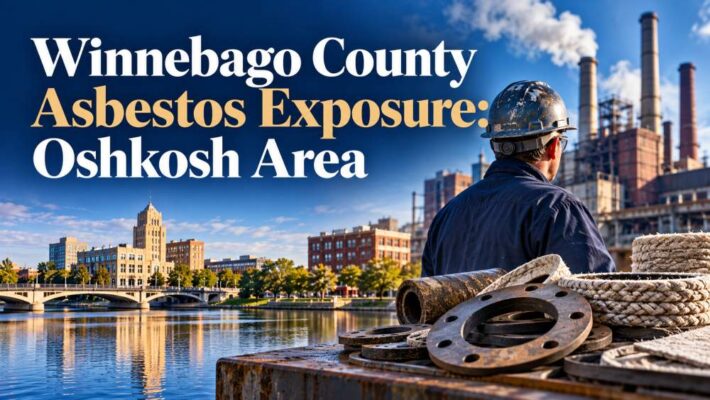
Winnebago County asbestos exposure refers to asbestos contact that workers in Oshkosh, Neenah, and Menasha may have had at paper mills, industrial plants, and maintenance jobs, mostly before the 1980s.
Whether a worker was exposed depends on the evidence, not geography, and most claims turn on records showing which products were used on a specific job.
Third Coast Lawyers handles cases in Wisconsin, Illinois, and Missouri and reviews these claims through its toxic injury practice.
Fox Valley work histories often span several plants. Third Coast Lawyers reviews them in a free consultation. No fee unless there is a recovery.
Winnebago County has a deep asbestos exposure history because its economy was built on the Fox River’s mills and factories during the decades when asbestos insulation, gaskets, and packing were widely used in industrial plants.
EWG’s Asbestos Nation analysis estimates 224 asbestos-related deaths in the county from 1999 through 2017 and reports the county’s death rate as 7.1 per 100,000 population, a figure EWG states for the 1999 to 2017 period as a whole. The count combines CDC WONDER deaths that list asbestosis or mesothelioma as a contributing cause with EWG’s own estimate of asbestos-linked lung cancer, taken from the high end of its range.
The estimate does not identify any single workplace, nor does it show that any particular worker was exposed.
The industrial base is old. The Wisconsin Historical Society records that Oshkosh’s first sawmill opened in 1847 and that the city later added furniture and equipment factories.
Neenah and Menasha anchored the county’s share of the Fox Valley paper corridor, which also runs through Outagamie and Brown counties.
Oshkosh’s documented industries moved from lumber and woodworking into furniture, equipment, and vehicle manufacturing. These plants ran boilers, steam lines, furnaces, and heavy machinery, where asbestos materials were often found.
The Wisconsin Historical Society counts 24 sawmills, 15 shingle mills, and 7 sash and door factories in Oshkosh by 1873, when the city earned the name “Sawdust City.” Later manufacturers built clothing, equipment, and specialty vehicles. Each plant type needed maintenance crews to service piping, pumps, and machinery.
The steam systems matter because of asbestos use. The EPA notes that hot water and steam pipes in older buildings may be coated with asbestos material or wrapped in asbestos blankets or tape, and that furnace door gaskets may contain asbestos insulation. Repair work that cuts or removes that material could release fibers.
Working in an Oshkosh plant does not by itself establish asbestos exposure. A claim must connect a specific asbestos-containing product to the worker’s job, usually through employment records, purchase records, and coworker testimony.
Kimberly-Clark in Neenah and Sonoco in Menasha both appear on the firm’s list of Wisconsin asbestos jobsites. Paper mills of that era ran steam-heated dryers, high-pressure steam lines, and pumps, the kind of steam equipment the EPA associates with asbestos pipe coverings and gaskets.
| Facility | Location Listed | Asbestos-Era Years Listed |
| Kimberly-Clark | Neenah and Appleton mills | 1872–1985 |
| Sonoco | Menasha | 1899–1985 |
The years are the asbestos-era ranges the firm’s jobsite list gives for each entry, and the Kimberly-Clark range is a single entry covering its Neenah and Appleton mills together rather than any one plant.
They are not facility operating dates, and they do not show when, or whether, any one worker was exposed. Product records still have to place asbestos materials at the site during the worker’s own years there.
Mill claims often focus on the companies that made the insulation, gaskets, and dryer felts rather than the mill itself, and the statewide paper mill asbestos exposure record covers other Fox Valley mills.
Maintenance and steam-system trades often worked closest to asbestos materials in mills and plants of this era, because their jobs could involve cutting, removing, and replacing insulation, gaskets, and packing.
Not every worker in these trades handled asbestos; exposure depends on the products used at each site and in each job. The boiler operator role shows how one job could involve several exposure routes at once. Family members can also develop asbestos-related disease through secondary exposure, such as dust carried home on work clothes, which may support a separate claim depending on the facts and Wisconsin law.
Mill and plant records disappear as companies close. Third Coast Lawyers rebuilds work histories before evidence disappears. No fee unless there is a recovery.
If you’re ready to get started, call us now!
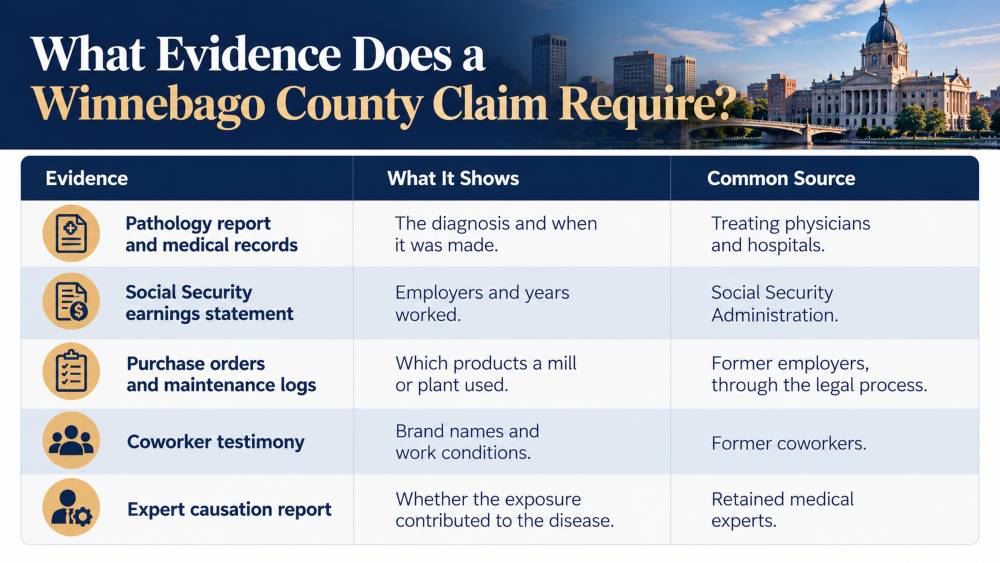
A Winnebago County asbestos claim generally rests on three elements: a physician’s diagnosis of an asbestos-related disease, proof that a specific asbestos product was present in the worker’s job, and expert testimony connecting that exposure to the disease.
The records below commonly prove those elements; no single one is legally required.
| Evidence | What It Shows | Common Source |
| Pathology report and medical records | The diagnosis and when it was made | Treating physicians and hospitals |
| Social Security earnings statement | Employers and years worked | Social Security Administration |
| Purchase orders and maintenance logs | Which products a mill or plant used | Former employers, through the legal process |
| Coworker testimony | Brand names and work conditions | Former coworkers |
| Expert causation report | Whether the exposure contributed to the disease | Retained medical experts |
For mill and plant workers, the firm’s proof work starts with Social Security earnings records, which fix the employment dates, and then uses coworker statements to corroborate which products were on site.
Third Coast Lawyers documents that exposure timeline from the first day of a case because, in the firm’s experience, timeline gaps are the most common reason claims fail at the causation stage.
When a former employer no longer holds maintenance records, product evidence may come instead from supplier and manufacturer records, equipment manuals, bankruptcy trust filings, and coworker testimony.
Whether the combined evidence is enough depends on the facts and Wisconsin law. The same sources support proving asbestos exposure at Fox Valley sites that closed or changed owners.
A first consultation with Third Coast Lawyers includes a free review of the diagnosis, work history, and deadline questions in the case.
Clients work directly with O’Connor and the firm’s team from intake through resolution, and the firm offers home and hospital appointments. A worker or family can bring the records already in their own hands:
Employer files and purchase records are requested through the legal process rather than gathered informally.
Venue in a Wisconsin civil case generally follows Wis. Stat. § 801.50(2), which allows filing where the claim arose or where a defendant resides or does substantial business.
Winnebago County’s circuit court sits in Oshkosh, the county seat, but an asbestos case may belong in another county, another state, or federal court depending on the defendants and the work history.
Filed Wisconsin circuit court cases can be looked up through Wisconsin Circuit Court Access. Deadlines are a separate question.
Wisconsin’s general limit for personal injury claims is 3 years under Wis. Stat. § 893.54(1m), but the deadline can depend on the claim type, the discovery rule, and any work in other states, so the mesothelioma filing deadline is checked against each claimant’s diagnosis date and work record.
Kimberly-Clark in Neenah and Sonoco in Menasha appear on the firm’s Wisconsin jobsite list, with asbestos-era years running to 1985. Oshkosh plants with boilers, steam lines, and heavy machinery may also have used asbestos materials, depending on the plant, the era, and the product records.
Yes. Many Fox Valley workers moved between mills and plants in Winnebago, Outagamie, and Brown counties. A claim can draw on the full work history, though each site still needs evidence of specific asbestos products, and multi-state work can raise separate deadline questions.
Asbestos claims usually target asbestos product manufacturers rather than the employer. Some of those manufacturers reorganized in bankruptcy and set up asbestos trusts that may still accept claims, subject to each trust’s eligibility rules. Employment records can be rebuilt from Social Security data.
No fixed timeline applies. A Winnebago County case with several manufacturer defendants can take longer than a single trust claim, and the court’s schedule and any settlement talks also matter. When a claimant is seriously ill, lawyers may move to preserve that testimony early.
Yes. Third Coast Lawyers offers free consultations to workers and families, including home and hospital appointments. Families can bring medical records, a Social Security earnings statement, and any notes on past jobs, mills, and coworkers, even when those records are incomplete.
No. A mill on an asbestos jobsite list can help, but a claim also needs evidence placing a specific asbestos product in the worker’s job, a diagnosed asbestos-related disease, and expert causation testimony. Whether that evidence is enough depends on the facts and Wisconsin law.
Possibly. A spouse or child who washed mill dust from work clothes and later developed an asbestos-related disease may have a separate claim, depending on the facts. After a worker’s death, eligible family members may bring a wrongful death action under Wis. Stat. § 895.04.
Not for claims against outside manufacturers. Under Wis. Stat. § 102.03(2), workers’ compensation is the exclusive remedy against the employer only. Companies that made the asbestos insulation, gaskets, or dryer felts used at a Winnebago County mill may face a lawsuit, depending on the evidence.
Winnebago County’s asbestos history runs through the Neenah and Menasha paper mills and Oshkosh’s long industrial base.
A claim combines a diagnosis, product evidence tied to the worker’s own job, and expert causation testimony.
Venue and deadlines depend on the defendants, the diagnosis, and the work history, which is why the exposure timeline is built from records first.
Coworker memories of brand names fade over time. Third Coast Lawyers handles these claims from intake to resolution. No fee unless there is a recovery.

About the Author
Managing Partner · Toxic Tort Trial Attorney · Licensed in Wisconsin, Illinois, and Missouri
Anna G. O'Connor is the founding member and managing partner of Third Coast Lawyers and a trial attorney licensed in Wisconsin, Illinois, and Missouri. She practices across the Midwest and has tried more than 50 jury trials during her 20-plus-year legal career. Anna represents workers and families in toxic tort matters, including asbestos and mesothelioma claims, in Wisconsin, Illinois, and Missouri state courts, federal courts, and multi-district litigation proceedings.
