

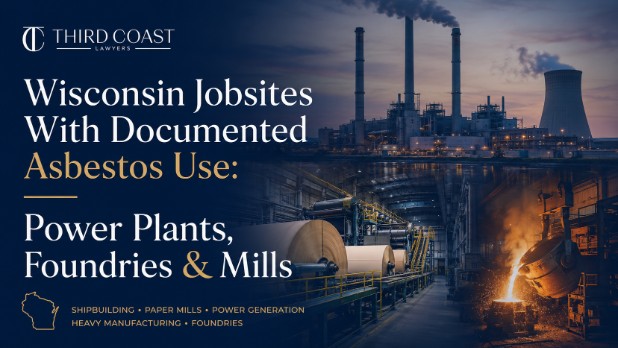
Wisconsin’s power plants, foundries, and paper mills used asbestos extensively from the 1940s through the early 1980s, resulting in documented exposure among workers across the state.
Boiler rooms, foundry pour floors, and paper-machine dryer sections concentrated friable asbestos materials in confined, high-heat environments.
Workers diagnosed today retain three-year filing rights under Wisconsin’s discovery rule, and Third Coast Lawyers connects the diagnosis to the worksite through union, employer, and Social Security records.
Wisconsin asbestos cases turn on identifying the worksite before records and witnesses disappear. Third Coast Lawyers reconstructs the proof file during a free consultation.
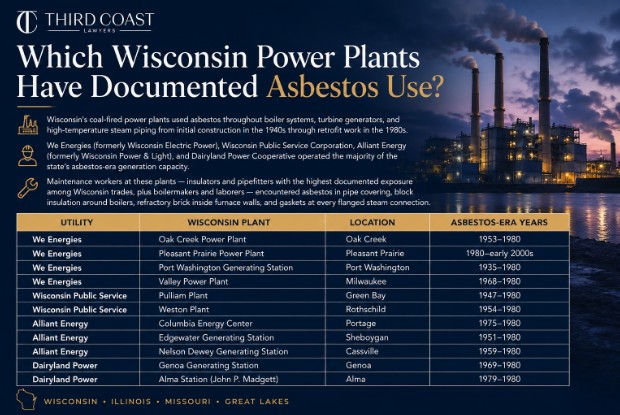
Wisconsin’s coal-fired power plants used asbestos throughout boiler systems, turbine generators, and high-temperature steam piping from initial construction in the 1940s through retrofit work in the 1980s.
We Energies (formerly Wisconsin Electric Power), Wisconsin Public Service Corporation, Alliant Energy (formerly Wisconsin Power & Light), and Dairyland Power Cooperative operated the majority of the state’s asbestos-era generation capacity.
Maintenance workers at these plants — insulators and pipefitters with the highest documented exposure among Wisconsin trades, plus boilermakers and laborers — encountered asbestos in pipe covering, block insulation around boilers, refractory brick inside furnace walls, and gaskets at every flanged steam connection.
| Utility | Wisconsin Plant | Location | Asbestos-Era Years |
| We Energies | Oak Creek Power Plant | Oak Creek | 1953–1980 |
| We Energies | Pleasant Prairie Power Plant | Pleasant Prairie | 1980–early 2000s |
| We Energies | Port Washington Generating Station | Port Washington | 1935–1980 |
| We Energies | Valley Power Plant | Milwaukee | 1968–1980 |
| Wisconsin Public Service | Pulliam Plant | Green Bay | 1947–1980 |
| Wisconsin Public Service | Weston Plant | Rothschild | 1954–1980 |
| Alliant Energy | Columbia Energy Center | Portage | 1975–1980 |
| Alliant Energy | Edgewater Generating Station | Sheboygan | 1951–1980 |
| Alliant Energy | Nelson Dewey Generating Station | Cassville | 1959–1980 |
| Dairyland Power | Genoa Generating Station | Genoa | 1969–1980 |
| Dairyland Power | Alma Station (John P. Madgett) | Alma | 1979–1980 |
Documented exposure at any of these plants supports a Wisconsin asbestos claim when paired with diagnosis records and verifiable employment history.
Active retrofit and decommissioning work at Oak Creek, Pleasant Prairie, and other listed facilities continues to disturb in-place asbestos materials today, extending exposure timelines into the 2020s for maintenance contractors.
Wisconsin foundries and heavy-equipment manufacturers used asbestos throughout pour floors, ladle linings, and furnace systems where temperatures exceeded the melting point of substitute insulation materials.
The state’s heavy-industry corridor — concentrated in Milwaukee County, Racine County, and Kenosha County — operated dozens of facilities employing asbestos products from the 1940s through the late 1970s.
Foundry workers, molders, casters, millwrights, and maintenance crews encountered asbestos in refractory brick, mold board, fire blankets, heat-resistant aprons and gloves, gasket material, and pipe insulation throughout these plants.
| Manufacturer | Wisconsin Facility | Primary Industry | Asbestos-Era Years |
| Allis-Chalmers | West Allis Works | Heavy machinery, turbines | 1900–1985 |
| A.O. Smith | Milwaukee, Kenosha | Auto frames, water heaters | 1920–1980 |
| Bucyrus-Erie | South Milwaukee | Mining shovels, draglines | 1893–1985 |
| Falk Corporation | Milwaukee | Industrial gears | 1892–1980 |
| Harnischfeger | West Milwaukee | Cranes, mining equipment | 1884–1980 |
| Modine Manufacturing | Racine | Heat-transfer products | 1916–1980 |
| Briggs & Stratton | Wauwatosa | Small engines | 1908–1980 |
| Wehr Steel | Milwaukee | Steel castings | 1899–1980 |
| Charter Steel | Saukville | Steel rod production | 1955–1980 |
| Joy Manufacturing | Franklin | Mining equipment | 1919–1980 |
Foundry and heavy-manufacturing exposure differs from power-plant exposure in product mix and fiber concentration.
Refractory materials and ladle linings released amphibole asbestos fibers — particularly amosite and crocidolite — at higher concentrations than the chrysotile-dominant products used in utility pipe insulation.
The mineralogical difference matters in causation analysis because amphibole fibers carry stronger documented links to mesothelioma than chrysotile alone.
If you’re ready to get started, call us now!
Wisconsin’s paper industry concentrated asbestos use in steam systems, paper-machine dryer sections, and recovery boilers from World War II through the early 1980s.
The Fox River Valley, Wisconsin River corridor, and Green Bay region housed the majority of asbestos-era pulp and paper operations, with mills operating continuously and requiring asbestos insulation on every high-temperature pipe and dryer cylinder.
Paper-machine tenders, maintenance workers, steam engineers, and electricians encountered asbestos in dryer felts, pipe covering, boiler insulation, gaskets, and pump packing throughout these facilities under the broad toxic exposure categories Wisconsin tort law treats as actionable.
| Operator | Wisconsin Mill | Location | Asbestos-Era Years |
| Kimberly-Clark | Neenah, Appleton Mills | Fox Valley | 1872–1985 |
| Consolidated Papers | Wisconsin Rapids | Wisconsin River | 1894–1985 |
| Mosinee Paper | Mosinee, Rhinelander | North-central WI | 1910–1985 |
| Wausau Paper | Wausau, Brokaw, Mosinee | North-central WI | 1899–1985 |
| Procter & Gamble (Charmin) | Green Bay | Green Bay | 1957–1985 |
| Georgia-Pacific | Green Bay | Green Bay | 1947–1985 |
| Sonoco | Menasha | Fox Valley | 1899–1985 |
| Domtar (formerly Nekoosa Papers) | Nekoosa, Port Edwards | Wisconsin River | 1893–1985 |
| Stora Enso / NewPage / Verso | Stevens Point, Wisconsin Rapids, Biron | Wisconsin River | 1900–1985 |
| Marathon Paper | Rothschild | North-central WI | 1909–1985 |
Paper-machine dryer felts represent the highest-concentration asbestos-exposure pathway in Wisconsin paper mills.
Dryer felts containing chrysotile asbestos required periodic replacement, with each felt change releasing airborne fibers throughout the machine room.
Steam piping serving dryer cylinders carried asbestos-block insulation that deteriorated with thermal cycling, producing friable debris during routine repair and shutdown maintenance.
Paper-mill workers diagnosed decades after retirement face evidence-preservation deadlines that compress with every year. Third Coast Lawyers opens intake within 72 hours of the call.
Asbestos was the standard high-temperature insulator across heavy industry from the 1930s through the late 1970s because no synthetic substitute matched its combination of heat resistance, tensile strength, chemical inertness, and low cost.
The International Agency for Research on Cancer classifies all six regulated asbestos mineral types — chrysotile, amosite, crocidolite, tremolite, anthophyllite, and actinolite — as Group 1 human carcinogens, but commercial classification before 1972 was driven entirely by industrial performance.
A single pound of asbestos fiber could insulate dozens of feet of high-pressure steam pipe at temperatures exceeding 1,000°F, making it economically irreplaceable for utility, foundry, and paper-mill applications.
Federal regulation of workplace asbestos exposure began with the Occupational Safety and Health Administration’s first standard in 1972, codified at 29 CFR 1910.1001. The EPA followed with the Asbestos National Emission Standards for Hazardous Air Pollutants in 1973, under 40 CFR 61 Subpart M, which restricted asbestos-containing material disturbance during demolition and renovation.
Industry-wide phase-out accelerated after 1980, but asbestos, still in place at Wisconsin power plants, foundries, and mills, continues to expose maintenance crews during demolition, retrofit, and decommissioning work in 2026.
Wisconsin’s substantial-factor causation standard from Zielinski v. A.P. Green Industries (2003 WI App 85) intersects with the asbestos application of comparative negligence at every worksite-based claim.
The standard requires plaintiffs to show exposure to a defendant’s asbestos product was a substantial contributing factor to the disease, not the sole cause — a threshold that admits claims based on documented brand-name product contact during identifiable employment periods.
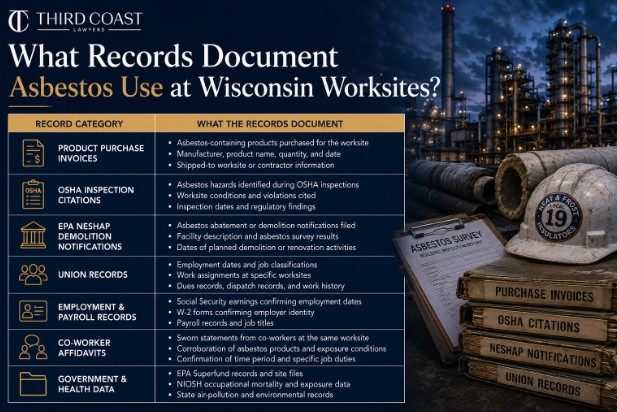
Four record categories document asbestos use at Wisconsin worksites: product purchase invoices from manufacturers including Johns-Manville, Owens Corning, and W.R. Grace; OSHA inspection citations issued during regulatory enforcement; EPA NESHAP demolition notifications filed before plant teardown; and union records from Heat and Frost Insulators, UA pipefitter locals, and steelworker locals representing workers at each facility.
Wisconsin air-pollution regulators administer asbestos demolition and renovation notifications under the federally delegated NESHAP program, requiring contractors to file asbestos surveys for commercial and industrial structures built before 1980.
For Wisconsin insulators, pipefitters, foundry workers, and paper-mill maintenance crews, the proof framework starts with Social Security earnings records confirming exact employment dates, union books confirming work classifications, and W-2 records confirming employer identity for each year of work history.
Co-worker affidavits — sworn statements from fellow tradesmen who shared the same job site during the same period — corroborate product identification when the diseased worker’s recall is incomplete after decades of latency.
EPA Superfund records and NIOSH occupational mortality data provide secondary documentation when employer files are unavailable.
Wisconsin industrial sites, including the Murphy Oil refinery in Superior, carry active CERCLA listings tied to asbestos contamination, and NIOSH mortality surveillance identifies elevated mesothelioma rates among Wisconsin insulators, pipefitters, and foundry workers across the state’s industrial corridor.
If you’re ready to get started, call us now!
Wisconsin law applies the three-year statute of limitations from Wis. Stat. § 893.54 to all asbestos-related personal injury claims, with the diagnosis clock starting under the discovery rule from Hansen v. A.H. Robins, 113 Wis. 2d 550 (1983). The Wisconsin Supreme Court extended discovery-rule principles to latent toxic-tort cases in Borello v. U.S. Oil Co., 130 Wis. 2d 397 (1986), confirming that asbestos disease accrues at diagnosis rather than at the date of exposure — even when exposure occurred at a Wisconsin worksite that ceased operations decades earlier.
For surviving family members of Wisconsin workers exposed at power plants, foundries, or mills, wrongful death actions under Wis. Stat. § 893.54(2) impose a three-year limit running from the date of death rather than the date of diagnosis.
Both timelines run independently — a worker diagnosed in 2026 can pursue personal injury claims through 2029, and if death follows during the case, the family retains separate wrongful-death filing rights for three additional years from the date of death.
Worksite-based claims combine tort actions against asbestos product manufacturers with trust claims against bankrupt former manufacturers, subject to the disclosure requirements of Wis. Stat. § 802.025, enacted as 2013 Wis. Act 154.
The statute requires plaintiffs to disclose all trust claims and exposure information during litigation, and failure to comply can result in case dismissal or sanctions under the Asbestos Bankruptcy Trust Claim Transparency Act.
Comparative negligence under Wis. Stat. § 895.045 applies to plaintiff conduct at the worksite, but the 51 percent rule bars recovery only when the plaintiff is more than 50 percent at fault — a threshold rarely met in asbestos exposure cases against product manufacturers and premises owners.
Plaintiffs found 50 percent or less at fault recover damages reduced by their proportional share, and Wisconsin juries determine fault allocation across all named defendants and the plaintiff.
Wisconsin workers who recognize their employer or worksite on the lists above should preserve evidence in three immediate steps: secure complete medical records and request pathology slides from any treating facility, request a Social Security earnings statement at ssa.gov to confirm full employment history, and contact former co-workers while their recollections remain documentable. Witness availability is the time-sensitive evidence category — tradesmen who worked Wisconsin power plants and mills in the 1960s and 1970s are now in their 70s and 80s, and sworn statements taken early in the case preserve testimony that may otherwise become unavailable.
Workers whose former employer or asbestos-product manufacturer has filed for bankruptcy still retain access to compensation through the trust claim process, which operates under separate evidentiary standards and filing deadlines from tort litigation against solvent defendants.
Approximately 60 active asbestos bankruptcy trusts administer claims for victims of companies, including Johns-Manville, Owens Corning, W.R. Grace, Babcock & Wilcox, and Combustion Engineering — manufacturers whose products were installed across every category of Wisconsin worksite listed in this guide.
A complete compensation framework for Wisconsin worksite-based asbestos claims pursues every available source: solvent defendants through state and federal courts, bankruptcy trust funds for defunct manufacturers, and VA benefits for Navy veterans whose Wisconsin shipyard or industrial work overlapped military service.
The three recovery sources operate in parallel rather than as alternatives, with trust claim amounts subject to setoff against tort recoveries under Wis. Stat. § 802.025.
Are all Wisconsin power plants on this list closed?
No. We Energies operates Oak Creek under partial retrofit, and other listed plants remain in active service. Asbestos abatement continues at Oak Creek, Pleasant Prairie, and other named Wisconsin facilities, and maintenance workers still encounter in-place asbestos during decommissioning projects. The three-year filing clock runs regardless of current operational status.
What if the company I worked for no longer exists?
Wisconsin workers retain recovery options against asbestos product manufacturers even when the original employer has closed. Bankruptcy trusts administered for Johns-Manville, Owens Corning, W.R. Grace, and other defunct manufacturers continue paying mesothelioma and lung cancer claims under standardized evidence and filing rules.
Does the discovery rule apply to all Wisconsin asbestos cases?
Yes. Wisconsin’s discovery rule from Hansen v. A.H. Robins (1983) applies to all latent-disease cases, including mesothelioma and asbestos-related lung cancer. The three-year statute of limitations under Wis. Stat. § 893.54 starts when the diagnosis is made, not when exposure occurred decades earlier.
Can I file a claim if I only worked at a Wisconsin plant for a short time?
Yes. Wisconsin asbestos causation applies the substantial-factor standard from Zielinski v. A.P. Green Industries (2003), meaning brief but documented exposure to a defendant’s asbestos product can support a claim. Total duration matters less than confirmed product contact and resulting medical diagnosis.
What is the difference between an asbestos claim against a power plant versus a foundry?
The defendants and product types differ. Power plant cases typically focus on boiler insulation, pipe lagging, and turbine gasket manufacturers. Foundry cases focus on refractory brick, ladle lining, and heat-resistant textile suppliers. Both follow the same Wisconsin statute of limitations and discovery rule framework.
Do paper mill workers face different asbestos hazards than other industrial workers?
Yes. Paper-machine dryer felts containing chrysotile asbestos released airborne fibers during routine felt changes and dryer maintenance — exposure pathways are less common in other industries. Boiler, steam pipe, and gasket exposure overlapped with power plant and foundry environments across all three Wisconsin industrial sectors.
What records prove I worked at a specific Wisconsin worksite?
Social Security earnings statements confirm employer identity and exact employment dates. Union books from Heat and Frost Insulators, UA pipefitter locals, and steelworker locals confirm work classification. W-2 forms, pay stubs, and co-worker affidavits provide additional documentation when employer records are unavailable.
Does Wisconsin allow recovery for workers who also smoked?
Yes. Wisconsin’s comparative negligence statute, Wis. Stat. § 895.045, treats smoking as a factor for the jury to weigh in lung cancer claims, not an automatic bar. Plaintiffs at 50 percent or less fault recover reduced damages. Mesothelioma claims are unaffected by smoking history.
Are Wisconsin asbestos claims subject to caps on damages?
Wisconsin places no general cap on personal injury damages in asbestos cases. Non-economic damages in medical malpractice cases face caps under Wis. Stat. § 893.55, but asbestos claims against manufacturers and premises owners proceed under standard tort principles without statutory damage limitations.
How long does a Wisconsin worksite asbestos case typically take?
Wisconsin worksite asbestos cases typically resolve in 12 to 36 months from the filing date, depending on the number of defendants, trust claim coordination, and whether the case settles or proceeds to trial. Expedited tracks are available for plaintiffs with mesothelioma diagnoses, given the median survival of under two years.
Wisconsin power plant, foundry, and mill workers retain three-year filing windows from mesothelioma diagnosis. Third Coast Lawyers handles intake, evidence, and trust claims on a contingency basis.

About the Author
Managing Partner · Toxic Tort Trial Attorney · Licensed in Wisconsin, Illinois, and Missouri
Anna G. O'Connor is the founding member and managing partner of Third Coast Lawyers and a trial attorney licensed in Wisconsin, Illinois, and Missouri. She practices across the Midwest and has tried more than 50 jury trials during her 20-plus-year legal career. Anna represents workers and families in toxic tort matters, including asbestos and mesothelioma claims, in Wisconsin, Illinois, and Missouri state courts, federal courts, and multi-district litigation proceedings.
