

Wisconsin insulators and pipefitters faced documented daily asbestos exposure across shipyards, paper mills, and power plants before the mid-1980s. Latency runs 20 to 50 years, so workers exposed at peak industrial use are receiving mesothelioma diagnoses today.
Wisconsin’s discovery rule under Wis. Stat. § 893.54 starts the three-year filing clock at diagnosis — not exposure — and Third Coast Lawyers builds the work-history and medical-causation proof file that connects the worksite to the diagnosis.
Asbestos exposure records degrade as witnesses age, and Wisconsin employers close. Third Coast Lawyers reconstructs the proof file during the free consultation.
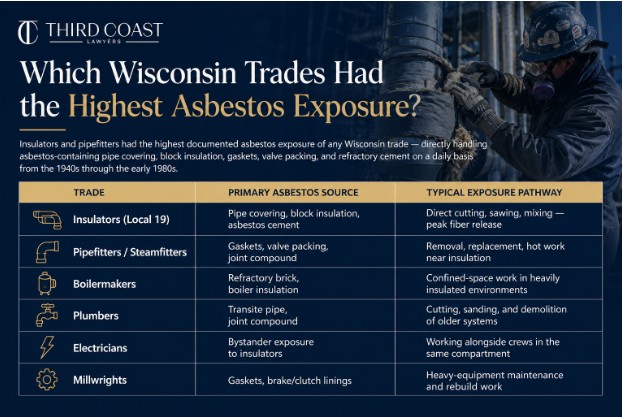
Insulators and pipefitters had the highest documented asbestos exposure of any Wisconsin trade — directly handling asbestos-containing pipe covering, block insulation, gaskets, valve packing, and refractory cement on a daily basis from the 1940s through the early 1980s.
The National Institute for Occupational Safety and Health identifies both trades through occupational mortality surveillance as among the highest-asbestos-exposure occupations in U.S. industrial history.
Bystander exposure to electricians, millwrights, and laborers working alongside insulation crews is also documented in NIOSH occupational mortality data.
The trades broke down by exposure pathway in the following ways:
| Trade | Primary Asbestos Source | Typical Exposure Pathway |
| Insulators | Pipe covering, block insulation, asbestos cement | Direct cutting, sawing, mixing — peak fiber release |
| Pipefitters / Steamfitters | Gaskets, valve packing, joint compound | Removal, replacement, hot work near insulation |
| Boilermakers | Refractory brick, boiler insulation | Confined-space work in heavily insulated environments |
| Plumbers | Transite pipe, joint compound | Cutting, sanding, and demolition of older systems |
| Electricians | Bystander exposure to insulators | Working alongside crews in the same compartment |
| Millwrights | Gaskets, brake/clutch linings | Heavy-equipment maintenance and rebuild work |
Insulators and pipefitters frequently performed asbestos work in confined spaces — ship engine rooms, boiler rooms, paper-mill pulp lines — where fiber concentrations exceeded the 5 f/cc OSHA permissible exposure limit set in 1972 under 29 CFR 1910.1001 — a limit subsequently reduced to the current 0.1 f/cc standard in 1994.
If you’re ready to get started, call us now!
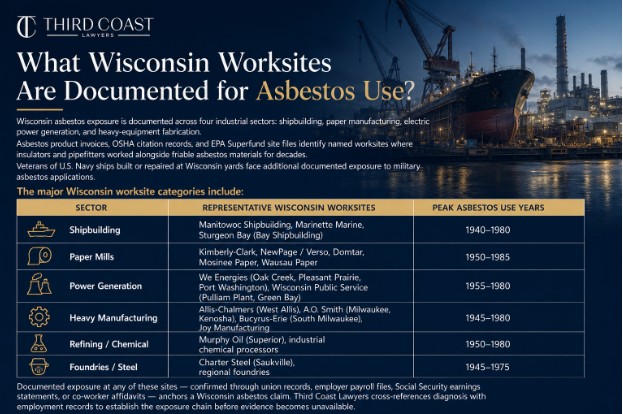
Wisconsin asbestos exposure is documented across four industrial sectors: shipbuilding, paper manufacturing, electric power generation, and heavy-equipment fabrication.
Asbestos product invoices, OSHA citation records, and EPA Superfund site files identify named worksites where insulators and pipefitters worked alongside friable asbestos materials for decades.
Veterans of U.S. Navy ships built or repaired at Wisconsin yards face additional documented exposure to military asbestos applications.
The major Wisconsin worksite categories include:
| Sector | Representative Wisconsin Worksites | Peak Asbestos Use Years |
| Shipbuilding | Manitowoc Shipbuilding, Marinette Marine, Sturgeon Bay (Bay Shipbuilding) | 1940–1980 |
| Paper Mills | Kimberly-Clark, NewPage / Verso, Domtar, Mosinee Paper, Wausau Paper | 1950–1985 |
| Power Generation | We Energies (Oak Creek, Pleasant Prairie, Port Washington), Wisconsin Public Service (Pulliam Plant, Green Bay) | 1955–1980 |
| Heavy Manufacturing | Allis-Chalmers (West Allis), A.O. Smith (Milwaukee, Kenosha), Bucyrus-Erie (South Milwaukee), Joy Manufacturing | 1945–1980 |
| Refining / Chemical | Murphy Oil (Superior), industrial chemical processors | 1950–1980 |
| Foundries / Steel | Charter Steel (Saukville), regional foundries | 1945–1975 |
Documented exposure at any of these sites — confirmed through union records, employer payroll files, Social Security earnings statements, or co-worker affidavits — anchors a Wisconsin asbestos claim. Third Coast Lawyers cross-references diagnosis with employment records to establish the exposure chain before evidence becomes unavailable.
Asbestos exposure causes four medically distinct diseases in Wisconsin trade workers: malignant mesothelioma, asbestos-related lung cancer, asbestosis, and pleural disease (plaques and thickening).
The American Cancer Society confirms that mesothelioma is caused almost exclusively by asbestos exposure, with pleural mesothelioma accounting for approximately 80 percent of diagnosed cases.
Lung cancer from asbestos has multiple causes, but the Helsinki Criteria — recognized by many U.S. courts as a medical causation framework — identify asbestos as a substantial contributing factor when occupational exposure is documented.
Disease-specific notes for insulators and pipefitters:
For Wisconsin insulators and pipefitters, the lung cancer distinction significantly affects both treatment planning and claim valuation.
Mesothelioma latency runs 20 to 50 years, leaving narrow Wisconsin filing windows after diagnosis. Third Coast Lawyers maps deadlines and trust claims at intake.
If you’re ready to get started, call us now!
Wisconsin law requires a plaintiff to prove three elements in an asbestos exposure claim: identification of a specific asbestos-containing product or worksite, documented exposure to that product, and expert medical testimony connecting the exposure to the diagnosed disease.
The Wisconsin Supreme Court has applied the substantial-factor causation standard to asbestos cases — meaning the plaintiff must show that exposure to a defendant’s product was a substantial contributing factor to the disease, not the sole cause. This standard was reaffirmed in Zielinski v. A.P. Green Industries, 2003 WI App 85.
Wisconsin’s comparative negligence statute, Wis. Stat. § 895.045, applies the 51 percent rule — a plaintiff whose own conduct is found to be more than 50 percent responsible recovers nothing.
In asbestos cases, defendants frequently raise smoking as a contributory factor in lung cancer claims, but Wisconsin courts treat smoking as a factor for the jury to weigh, not an automatic bar under the asbestos application of that rule.
Wisconsin imposes a three-year statute of limitations on personal injury claims under Wis. Stat. § 893.54, and the discovery rule starts the clock at the date the injury is discovered — not the date of exposure.
The Wisconsin Supreme Court adopted the discovery rule in Hansen v. A.H. Robins, 113 Wis. 2d 550 (1983), and extended it to latent-disease cases in Borello v. U.S. Oil Co., 130 Wis. 2d 397 (1986).
For mesothelioma and asbestos-related lung cancer, this means the filing clock typically starts at the date of diagnosis or the date a treating physician identifies asbestos as the probable cause.
Wrongful death claims arising from asbestos disease are governed by Wis. Stat. § 893.54(2) and also subject to a three-year limitation, with the clock running from the date of death rather than the date of diagnosis. Surviving family members of Wisconsin insulators and pipefitters who died from mesothelioma have separate filing rights covered in detail at the wrongful death claims post.
Where the diseased worker filed a personal injury claim during life that did not reach resolution, that claim can survive into the estate under Wis. Stat. § 895.01.
Practical implication: a Wisconsin insulator diagnosed with mesothelioma in June 2026 has until June 2029 to file a personal injury claim. If the diagnosis predates contact with a law firm by more than two years, the case requires immediate review to preserve filing rights.
Wisconsin permits asbestos plaintiffs to pursue both tort claims against solvent defendants and trust claims against bankrupt manufacturers in parallel, but Wis. Stat. § 802.025 — the Asbestos Bankruptcy Trust Claim Transparency Act — requires plaintiffs to disclose all trust claims and exposure information to defendants during litigation.
The statute was enacted as 2013 Wis. Act 154 and applies to all asbestos cases filed in Wisconsin courts. Failure to comply with disclosure obligations can result in case dismissal or sanctions.
Approximately 60 asbestos bankruptcy trusts currently administer claims for victims of companies, including Johns-Manville, Owens Corning, W.R. Grace, Babcock & Wilcox, and Combustion Engineering — manufacturers whose products were used extensively across the Wisconsin worksites listed earlier in this guide.
Trust claim amounts vary by trust and disease type, with mesothelioma typically receiving the highest payment tiers under the standardized trust claim process.
Plaintiffs do not choose between trust claims and tort litigation. A complete compensation framework pursues every available source — solvent defendants, bankruptcy trusts, and, where applicable, VA benefits for asbestos-exposed Navy veterans.
The strongest Wisconsin asbestos claims combine three evidence categories under the asbestos proof framework: a confirmed pathological diagnosis from a mesothelioma or pulmonary specialist, a detailed work history identifying specific worksites and product brands, and corroborating testimony from co-workers, union records, or employer documents.
Wisconsin’s broader toxic exposure law governs how these evidence categories translate into actionable claims against manufacturers and premises owners.
Specific evidence priorities for Wisconsin insulators and pipefitters:
Witness availability is the most time-sensitive category of evidence. Co-workers from the 1960s and 1970s are now in their 70s and 80s; sworn statements taken early in the case preserve testimony that would otherwise be lost when case-building protocols reach intake too late.
Can a Wisconsin insulator file a claim against a former employer?
Wisconsin workers’ compensation under Wis. Stat. ch. 102 provides the exclusive remedy against employers for workplace injuries. However, third-party claims against asbestos product manufacturers, premises owners, and trust funds remain available and form the recovery path in most Wisconsin insulator cases.
Does Wisconsin allow recovery if the diseased worker also smoked?
Yes. Wisconsin’s comparative negligence statute, Wis. Stat. § 895.045, treats smoking as a factor for the jury to weigh, not an automatic bar to recovery. A plaintiff found 50 percent or less responsible recovers damages reduced by proportional fault. Mesothelioma is unaffected by smoking history.
How does the discovery rule apply to mesothelioma cases in Wisconsin?
Under Hansen v. A.H. Robins and Borello v. U.S. Oil Co., Wisconsin’s three-year limitation starts when the injury is discovered or reasonably should have been discovered. For mesothelioma, the clock begins at diagnosis — meaning workers exposed decades ago retain filing rights.
What is the average asbestos settlement for a Wisconsin insulator?
Settlement amounts vary by diagnosis, exposure history, defendant solvency, and trust eligibility. Mesothelioma cases generally recover more than asbestos-related lung cancer or asbestosis claims. Third Coast Lawyers does not project dollar figures before reviewing diagnosis, work history, and trust eligibility.
Are Wisconsin Navy veterans eligible for both VA benefits and tort claims?
Yes. VA disability compensation for asbestos exposure runs parallel to tort claims against asbestos product manufacturers. VA benefits do not preclude private litigation, and trust claims against bankrupt manufacturers also remain available. All three recovery sources can be pursued together when documented exposure exists.
What if the asbestos exposure happened at a worksite that no longer exists?
Closed worksites do not bar recovery. Asbestos product manufacturers — Johns-Manville, Owens Corning, W.R. Grace, and dozens more — remain liable through bankruptcy trusts regardless of whether the original employer still operates. Work history is reconstructed through Social Security records, union books, and co-worker testimony.
Does Wisconsin require expert medical testimony in asbestos cases?
Yes. Wisconsin requires expert medical testimony to establish causation between asbestos exposure and the diagnosed disease, applying the substantial factor standard set forth in Zielinski v. A.P. Green Industries. A pulmonologist, occupational medicine specialist, or pathologist typically provides this testimony, often supported by industrial hygiene reports quantifying exposure intensity.
How does Wisconsin handle asbestos cases when multiple defendants are named?
Wisconsin applies joint and several liability under Wis. Stat. § 895.045’s modified rule — a defendant found 51 percent or more at fault is jointly liable for all economic damages. Trust claim amounts are subject to setoff against tort recoveries under Wis. Stat. § 802.025.
Can the family file a wrongful death claim if the worker dies before the case resolves?
Yes. Under Wis. Stat. § 895.01, a personal injury claim survives the decedent and continues through the estate. A separate wrongful death claim under Wis. Stat. § 895.03 is available to the surviving spouse, children, or parents, with a three-year limit from death.
Where do Wisconsin asbestos cases get filed?
Wisconsin asbestos cases are filed in the circuit court of the county where exposure occurred, where the plaintiff resides, or where the defendant maintains operations. Milwaukee County and Dane County handle the largest volume due to industrial worksite history and defendant operations.
Mesothelioma diagnoses trigger a three-year Wisconsin filing window from the diagnosis date. Third Coast Lawyers handles intake, evidence, and trust claims on a contingency basis.

About the Author
Managing Partner · Toxic Tort Trial Attorney · Licensed in Wisconsin, Illinois, and Missouri
Anna G. O'Connor is the founding member and managing partner of Third Coast Lawyers and a trial attorney licensed in Wisconsin, Illinois, and Missouri. She practices across the Midwest and has tried more than 50 jury trials during her 20-plus-year legal career. Anna represents workers and families in toxic tort matters, including asbestos and mesothelioma claims, in Wisconsin, Illinois, and Missouri state courts, federal courts, and multi-district litigation proceedings.
