


Wisconsin paper mills used asbestos-containing materials in boilers, steam lines, and dryer sections from the early 1900s into the 1980s, and the Fox River Valley held one of the country’s densest concentrations of paper manufacturing.
A toxic injury claim depends on connecting a named worker to a named mill, role, and period. Industry history establishes context; it does not establish an individual claim.
Reconstructing a mill work history depends on records that vary widely by facility and era. Third Coast Lawyers identifies what survives for a specific employer and period — free consultation.
Documentation varies in kind, and the distinction matters to a claim. A federal court decision naming a facility is a different evidentiary proposition from a company appearing on a litigation worksite list. The table below separates facilities by the type of record supporting them.
| Facility | Location | Operating Period | Documentation Type |
| Procter & Gamble Charmin paper mill | Green Bay, Brown County | Operating through the period at issue | Judicial record — Anderson v. Procter & Gamble Paper Prods. Co., 924 F. Supp. 2d 996 (E.D. Wis. 2013) |
| Fort Howard Paper Company | Green Bay, Brown County | 1919–1997, merged into Fort James Corp. | Archival holding — UW-Green Bay Area Research Center; also named on litigation worksite records |
| Thilmany Pulp & Paper | Kaukauna, Outagamie County | Largest specialty paper mill in the country by the 1950s | Litigation worksite record |
| Riverside Paper Corporation | Appleton, Outagamie County | On the Fox River since 1893 | Litigation worksite record |
Documentation types: a judicial record names the facility in a published court decision; an archival holding is company records held by a named institution; a litigation worksite record was compiled in prior asbestos litigation and is not publicly published. Facility documentation reviewed September 2026.
A second group of Wisconsin mills operated in the same corridors, during the same decades, using the same industrial steam and drying systems.
Their presence here reflects regional and industry history rather than facility-level asbestos documentation, and any claim involving them requires confirmation against employment and product records.
| Mill | Location |
| Kimberly-Clark Corporation | Fox River Valley, multiple mills |
| Consolidated Papers, Inc. | Wisconsin Rapids, Wood County; later Biron, Stevens Point, Whiting, Appleton; acquired by Stora Enso in 2000 |
| Georgia-Pacific; Green Bay Packaging Paper Mill | Green Bay, Brown County |
| International Paper Company | Green Bay and Fond du Lac |
| Bergstrom Paper; Neenah Paper Division Whiting Mill | Neenah, Winnebago County |
| Appleton Coated Paper Co.; Fox River Paper | Appleton, Outagamie County |
| St. Regis Paper Company | Rhinelander, Oneida County; later acquired by Champion International |
| Wausau Paper Corp. | Wausau, Marathon County |
| Badger Paper Mill; Marinette Paper Co. | Peshtigo and Marinette, Marinette County |
| Oconto Falls Tissue, Inc. | Oconto Falls, Oconto County |
Anderson v. Proctor & Gamble Paper Prods. Co. concerned Lloyd Anderson, who worked as a union electrician from an apprenticeship beginning around 1948 and as a journeyman and foreman from 1952 until his retirement in 1992, employed by a series of electrical contractors rather than by the mills themselves.
His worksites included the Procter & Gamble Charmin paper mill in Green Bay.
The allegations describe several exposure routes. Procter & Gamble furnished the materials for the electrical work, including asbestos-containing micarta, and Anderson worked on the company’s machinery. The complaint alleged he received no warning that pipe insulation at the facility contained asbestos. Anderson was diagnosed with lung cancer.
Two points generalize beyond that case. Anderson was not an insulator and never installed asbestos, which is why claims arise as readily from electricians, machinists, and laborers as from insulation crews.
And he was a contract worker, not a mill employee — a status that shapes which defendants a claim can reach rather than foreclosing it.
Brown County recorded 257 asbestos-related deaths between 1999 and 2017 and Outagamie County 196, on CDC WONDER mortality data compiled by EWG Asbestos Nation.
Winnebago County recorded 224 across the same period. These are county-level totals reflecting recorded asbestos-related mortality from all exposure sources.
They do not identify which facility produced any individual’s exposure, and a higher county total does not by itself establish heavier exposure at the mills within it.
Thilmany Pulp & Paper in Kaukauna operated as the country’s largest specialty paper mill by the 1950s. Riverside Paper Corporation has operated on the Fox River in Appleton since 1893. Both appear in worksite records compiled during prior asbestos litigation.
The wider corridor between Appleton, Neenah, and Green Bay held one of the densest concentrations of paper manufacturing in the United States, and mills there ran continuously from the late 1800s through the 1980s.
Several historically prominent Fox Valley paper companies have no confirmed facility-level asbestos documentation. Claimants who worked at those mills should bring employment records rather than assume an exposure history from a company’s size or location.
Consolidated Papers, Inc. operated one of the state’s largest mill complexes at Wisconsin Rapids, expanding over roughly a century into Biron, Stevens Point, Whiting, and Appleton before Stora Enso acquired it in 2000. Facilities of that scale ran industrial boilers and extensive steam systems that used asbestos insulation throughout the period.
Many of these mills have closed, changed hands, or been demolished. Materials installed in their boiler rooms and pipe systems remain the basis of claims filed decades later.
Six equipment categories account for most asbestos use in 20th-century paper manufacturing. Whether a given product was present at a given mill is a separate question answered by invoices, specifications, and coworker testimony rather than by industry practice.
Pipe covering was performed by insulation molded around steam and hot-water lines. Installation required hand cutting and fitting.
Boiler insulation consisted of blankets, blocks, and cement applied to the exteriors of industrial boilers.
Gaskets made with chrysotile asbestos sealed joints between pipes, valves, and flanges. Replacement involved scraping old material from flange faces.
Valve packing used braided asbestos compressed around valve stems; it was removed and replaced as routine maintenance.
Dryer felts carried the wet paper web over steam-heated cylinders. Replacement required handling worn material directly.
Friction materials in paper machine brake systems controlled roller and winding speed.
Johns Manville — operating in Milwaukee as the Manville Covering Company from 1886 — and Owens Corning both distributed insulation products across Wisconsin during the relevant decades. Both later entered bankruptcy, and their products fall within asbestos bankruptcy trusts that continue to accept claims subject to each trust’s eligibility rules.
Statewide distribution does not establish that a particular manufacturer’s product sat in a particular mill.
Product identification evidence establishes that connection and determines which trusts a claim can reach. A claim resting on industry-wide distribution alone is materially weaker than one resting on a purchase order or a coworker who can name the brand.
Establishing which manufacturer’s materials were installed at a specific mill is the investigative work that opens a trust claim. Third Coast Lawyers builds that record — case review.
If you’re ready to get started, call us now!
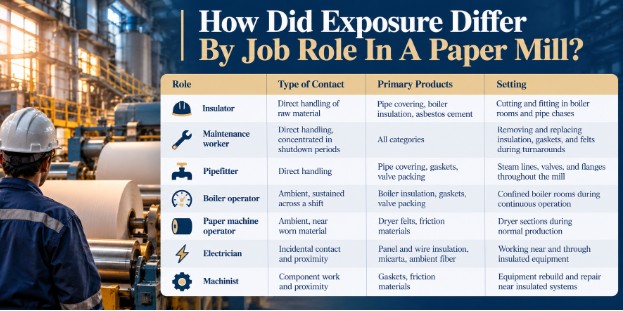
Roles differed in the type of contact they involved, the products handled, and the physical setting. The categories below describe contact type rather than ranking measured dose, which varies by facility, era, ventilation, and task.
| Role | Type of Contact | Primary Products | Setting |
| Insulator | Direct handling of raw material | Pipe covering, boiler insulation, asbestos cement | Cutting and fitting in boiler rooms and pipe chases |
| Maintenance worker | Direct handling, concentrated in shutdown periods | All categories | Removing and replacing insulation, gaskets, and felts during turnarounds |
| Pipefitter | Direct handling | Pipe covering, gaskets, valve packing | Steam lines, valves, and flanges throughout the mill |
| Boiler operator | Ambient, sustained across a shift | Boiler insulation, gaskets, valve packing | Confined boiler rooms during continuous operation |
| Paper machine operator | Ambient, near worn material | Dryer felts, friction materials | Dryer sections during normal production |
| Electrician | Incidental contact and proximity | Panel and wire insulation, micarta, ambient fiber | Working near and through insulated equipment |
| Machinist | Component work and proximity | Gaskets, friction materials | Equipment rebuild and repair near insulated systems |
Contractors brought in for turnaround work, repairs, or insulation replacement encountered the same materials as directly employed workers, frequently across several facilities over a career.
Employment through a contracting firm rather than the mill does not by itself foreclose a claim, and as set out below, Wisconsin law addresses that situation directly.
The role profile matters because it points to which products, manufacturers, and trusts are relevant to an individual case.
Turnarounds required work that routine operation did not. During a scheduled shutdown, crews stripped deteriorated pipe covering from steam lines, chipped hardened asbestos cement from boiler surfaces, removed worn dryer felts, and repacked valves with braided asbestos.
Each of those tasks involved contact with friable material — material that crumbles under hand pressure and releases fibers when disturbed. That is a different kind of contact from working near insulation that remains intact and undisturbed.
The setting compounded it. Boiler rooms were enclosed, hot, and poorly ventilated, conditions under which airborne fibers disperse slowly.
OSHA’s asbestos standard at 29 CFR 1910.1001 sets the current permissible exposure limit at 0.1 fibers per cubic centimeter as an eight-hour time-weighted average, a limit adopted long after the exposures at issue in most mill claims and one that indicates the level now considered controlling rather than what any historical mill environment measured.
Turnaround participation frequently changes the character of a work history. A defendant may characterize a machine operator or electrician as having had minimal asbestos contact; documented turnaround assignments answer that directly.
Establishing which shutdowns a worker was assigned to, and what was stripped or replaced during them, often determines whether a mill case is won or lost.
Claims commonly target the manufacturers of the asbestos-containing products installed at a mill. Those manufacturers, rather than the mill operator, supplied the product alleged to have caused the disease, and their bankruptcy trusts may continue accepting claims after a facility closes.
Premises owners are a separate and live category in Wisconsin. In Estate of Lorbiecki v. Pabst Brewing Co., 2026 WI 12, the Wisconsin Supreme Court held that the safe-place statute, Wis. Stat. § 101.11, imposes a non-delegable duty on a premises owner toward frequenters, a category that includes employees of independent contractors.
Gerald Lorbiecki worked as a subcontractor installing and repairing pipes at Pabst’s Milwaukee brewery in the 1970s and later developed mesothelioma.
The court’s reasoning turned on what the owner knew and what it controlled. The record showed Pabst knew, before Lorbiecki worked there, that many miles of pipe in the facility were insulated with asbestos and that airborne asbestos was dangerous.
Pabst argued it had not directed Lorbiecki’s work, but the court distinguished control over the work from control over the place where the work was performed. Supervision and control of the worker is not a requirement in unsafe-condition cases under the statute.
The court held that a reasonable jury could find Pabst liable for breaching the heightened duty of care, and that sufficient evidence existed to submit punitive damages to the jury. It also held the punitive award was capped at twice the compensatory damages for which Pabst was legally responsible under Wis. Stat. § 895.043(6), reducing the amount the trial jury had set.
Wisconsin appellate authority had already treated airborne asbestos as an unsafe condition under the statute.
In Viola v. Wisconsin Electric Power Co., 2014 WI App 5, the Court of Appeals addressed safe-place claims arising from asbestos released during repairs at a utility’s premises.
For a paper mill worker, the practical consequence is that the mill operator is not automatically outside the case. Which defendants are properly named depends on ownership, control of the premises, what the owner knew, and the evidence available — an assessment made case by case rather than by rule.
Take-home exposure, also called household or secondary exposure, occurs when a worker carries fibers home on clothing, footwear, hair, or skin, exposing family members who never entered the mill.
A worker who spent a turnaround shift stripping pipe covering accumulated fibers on coveralls and work boots, and those fibers transferred to vehicles, furniture, and laundry.
CDC research published in Morbidity and Mortality Weekly Report in 2022 reported that Wisconsin was among seven states where the annualized mesothelioma death rate for women exceeded 6.0 per million between 1999 and 2020.
That is a mortality finding. It describes a pattern rather than assigning a cause to any exposure pathway.
The legal position warrants precision. A household member who develops an asbestos-related disease brings a personal injury claim in that person’s own right, and the limitation period runs from that person’s own discovery — or reasonable-diligence discovery — of the disease and its cause under Wis. Stat. § 893.54(1m)(a), commonly at the confirming diagnosis.
It does not run from the worker’s exposure dates, retirement, or death. Whether a defendant owed a duty to a household member is a separate question, analyzed under foreseeability and the relationship between the parties, and courts across jurisdictions have divided on it.
Wisconsin juries have returned substantial verdicts in take-home cases. The duty analysis in any given case turns on when the exposure occurred and what the defendant knew at the time, so these claims are assessed individually rather than by category.
The evidentiary chain is heavier than a direct occupational claim because three links must be documented rather than two: which mill employed the worker, which products were present there, and how fibers reached the household. That chain is fully set out for take-home exposure claims.
Three differences affect how a case is built, though each depends on the facts of the particular employment.
The Fox River’s contamination history is a separate legal matter, and conflating the two costs claimants time.
The EPA’s Lower Fox River and Green Bay Superfund site addresses polychlorinated biphenyls discharged by paper companies producing carbonless copy paper between the 1950s and 1971.
Appvion, Inc., headquartered in Appleton, along with NCR Corporation, Georgia-Pacific, and P.H. Glatfelter, are named settling defendants under a consent decree overseen by the U.S. District Court for the Eastern District of Wisconsin.
The two differ in every material respect: a different chemical, an exposure pathway that is environmental and dietary rather than occupational inhalation, different defendants, and federal CERCLA rather than state tort law.
A worker’s asbestos claim proceeds independently of any Fox River PCB matter, even where both trace to the same employer or riverside facility.
Wisconsin sets three years for personal injury claims under Wis. Stat. § 893.54(1m)(a). Case law governs accrual separately: a claim accrues when the injury is discovered, or when it should have been discovered with reasonable diligence, whichever comes first.
Diagnosis is not a single automatic trigger. In Sopha v. Owens-Corning Fiberglas Corp., 230 Wis. 2d 212 (1999), the Wisconsin Supreme Court held that the diagnosis of a malignant asbestos condition creates a new cause of action, with its period beginning when the claimant discovers, or with reasonable diligence should discover, that malignancy.
A prior non-malignant finding does not start the clock on a later mesothelioma. Robert Sopha worked as an insulator from 1951 to 1995 and had been found to have pleural thickening before 1987; his mesothelioma was first diagnosed in December 1996.
Which diagnosis, tied to which condition, on which date, determines the applicable deadline—analyzed in full under Wisconsin’s asbestos filing deadline rules.
Latency explains why mill work from decades ago produces claims now. CDC and NIOSH research on malignant mesothelioma places the typical interval between exposure and diagnosis at 20 to 40 years.
Where a mill worker has died, surviving family members hold a claim under Wis. Stat. § 893.54(1m)(b), and a claim the worker could have brought survives into the estate under Wis. Stat. § 895.01. Those periods run on their own terms and are assessed together.
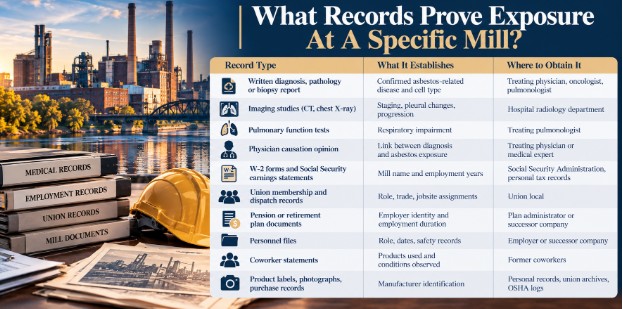
Two categories are essential — medical records establishing a confirmed diagnosis, and employment records linking the claimant to a named mill, role, and period — with supporting material filling gaps neither can close alone.
| Record Type | What It Establishes | Where to Obtain It |
| Written diagnosis, pathology or biopsy report | Confirmed asbestos-related disease and cell type | Treating physician, oncologist, pulmonologist |
| Imaging studies (CT, chest X-ray) | Staging, pleural changes, progression | Hospital radiology department |
| Pulmonary function tests | Respiratory impairment | Treating pulmonologist |
| Physician causation opinion | Link between diagnosis and asbestos exposure | Treating physician or medical expert |
| W-2 forms and Social Security earnings statements | Mill name and employment years | Social Security Administration, personal tax records |
| Union membership and dispatch records | Role, trade, jobsite assignments | Union local |
| Pension or retirement plan documents | Employer identity and employment duration | Plan administrator or successor company |
| Personnel files | Role, dates, safety records | Employer or successor company |
| Coworker statements | Products used and conditions observed | Former coworkers |
| Product labels, photographs, purchase records | Manufacturer identification | Personal records, union archives, OSHA logs |
Union dispatch and jobsite assignment records deserve particular attention in mill claims.
They often survive after a mill has closed or changed ownership even where the employer’s own personnel files were destroyed, and for tradesmen who moved between facilities they establish which site a worker was assigned to in which years — precisely the link a contractor’s employment history otherwise lacks.
A written diagnosis identifying the specific condition — mesothelioma, asbestosis, or asbestos-related lung cancer — is the one document without which the causation chain cannot be built.
Product identification does not depend on a claimant’s memory. An attorney establishes it through employment records, coworker statements, and purchase or specification documents assembled during the investigation.
Mill, dates, role, products, witnesses — a claim is built from those five, and each has its own source. Third Coast Lawyers assembles them — free case review.
Which Wisconsin paper mills have documented asbestos exposure?
Four facilities carry identifiable documentation: Procter & Gamble’s Charmin mill in Green Bay through federal litigation, Fort Howard Paper Company through archival holdings, and Thilmany Pulp & Paper and Riverside Paper Corporation through litigation worksite records.
Can a claim proceed if the mill has closed or been demolished?
Often yes. Claims commonly target manufacturers of the products installed at the mill, and their bankruptcy trusts may continue accepting claims subject to each trust’s eligibility rules. Premises-owner liability may also survive depending on ownership and control.
Did electricians and machinists face exposure, or only insulators?
Both. Anderson v. Proctor & Gamble Paper Prods. Co. involved a contract electrician exposed through materials the mill furnished and insulation he had not installed. Incidental contact reached trades whose primary work never involved asbestos.
Do contractors have claims against the mill owner?
Wisconsin law addresses this directly. In Estate of Lorbiecki v. Pabst Brewing Co., the Wisconsin Supreme Court held the safe-place statute imposes a non-delegable duty on premises owners toward frequenters, including employees of independent contractors, where the owner controlled the premises.
Why did turnaround work involve different exposure than daily operations?
Turnarounds required stripping insulation, chipping asbestos cement, removing worn dryer felts, and repacking valves — direct handling of friable material in enclosed boiler rooms, rather than working near insulation that remained intact.
Does Fox River PCB litigation affect an asbestos claim?
No. PCB contamination and occupational asbestos exposure involve different chemicals, exposure pathways, defendants, and legal frameworks. An asbestos claim tied to mill insulation or gaskets proceeds independently, even against the same employer.
What is the filing deadline for a paper mill claim?
Wisconsin sets three years under Wis. Stat. § 893.54(1m)(a), measured from accrual rather than exposure. Accrual follows the discovery rule, and Sopha v. Owens-Corning Fiberglas Corp. establishes that a later malignancy can carry its own separate period.
Can a spouse who washed work clothes bring a claim?
A household member brings a claim in their own right, with the period running from their own discovery of the disease and its cause rather than the worker’s history. Whether a defendant owed that household member a duty is a separate, fact-dependent question.
How is a mill exposure timeline reconstructed?
Through medical records confirming the diagnosis, employment records such as W-2s, Social Security earnings statements, and pension documents establishing the mill and years, and coworker statements identifying which products were present during that employment.
Do claimants need to recall the product brand?
No. Product identification comes from employment records, coworker statements, and purchase or specification documents, not memory. An attorney handles that identification during the case investigation.
Why do diagnoses appear decades after the mill work ended?
CDC and NIOSH research places the typical interval between asbestos exposure and mesothelioma diagnosis at 20 to 40 years, which is why work performed in the 1970s produces claims today.
What does it cost to bring a paper mill claim?
Third Coast Lawyers handles these claims on a contingency fee basis, with no upfront costs and no attorney fees unless the firm recovers compensation. The contingency percentage and case costs are explained fully at the start of every engagement.
County mortality figures show where recorded asbestos-related mortality was higher, not necessarily where exposure was heaviest. A claim needs a named mill, role, and period. Third Coast Lawyers assembles that record — schedule a consultation.

About the Author
Managing Partner · Toxic Tort Trial Attorney · Licensed in Wisconsin, Illinois, and Missouri
Anna G. O'Connor is the founding member and managing partner of Third Coast Lawyers and a trial attorney licensed in Wisconsin, Illinois, and Missouri. She practices across the Midwest and has tried more than 50 jury trials during her 20-plus-year legal career. Anna represents workers and families in toxic tort matters, including asbestos and mesothelioma claims, in Wisconsin, Illinois, and Missouri state courts, federal courts, and multi-district litigation proceedings.
