

Madison County and Cook County anchor the nation’s asbestos litigation because Illinois pairs a dedicated asbestos docket with a new 2025 law letting out-of-state manufacturers face suit in Illinois courts.
Madison County has held the nation’s top spot for asbestos-lawsuit filings for years, while Cook County has produced verdicts exceeding $20 million for families harmed by industrial asbestos exposure — so choosing the right venue can meaningfully change what a family recovers.
Third Coast Lawyers helps Wisconsin families evaluate available venue options for an asbestos claim, including cases with ties to Illinois industrial sites.
Madison County, located directly across the Mississippi River from St. Louis, built its reputation over three decades on a dedicated asbestos docket staffed by judges who handle little else.
The Third Judicial Circuit Court’s asbestos case management order, first entered in 1995 and revised most recently in September 2024, structures how cases move from filing to trial.
Madison County’s asbestos case management order alone draws plaintiffs’ firms from across the country, since a specialized docket resolves procedural disputes faster than a general civil calendar.
Families with confirmed mesothelioma diagnoses benefit most directly, because Madison County’s expedited-setting rules prioritize plaintiffs with limited life expectancy.
Madison County’s asbestos docket has drawn national attention for its filing volume for more than a decade.
The court’s own published case management orders govern docketing, discovery, and trial-setting procedures for every asbestos case filed there, giving attorneys and defendants a predictable procedural roadmap that few other counties offer.
If you’re ready to get started, call us now!
Cook County built its asbestos litigation reputation on a different foundation: raw industrial history rather than docket specialization. Chicago’s twentieth-century economy ran on steel mills, railyards, and shipyards along Lake Michigan, and workers in those industries encountered asbestos-containing insulation, gaskets, and fireproofing materials daily.
Cook County juries have responded with some of the largest individual verdicts in the Midwest, with recent asbestos and talc-exposure cases producing awards exceeding $20 million, including punitive damages tied to negligent exposure.
Where Madison County moves cases through a specialized docket built for volume, Cook County functions more like a traditional civil court handling asbestos claims among a broader caseload — but with a jury pool shaped by generations of direct exposure to the same industries at issue.
Cook County’s combination of a broad caseload and an exposure-shaped jury pool produces outcomes that influence settlement negotiations statewide, as defense counsel weighs Cook County jury tendencies when deciding whether to try a case or settle before trial.
Illinois Senate Bill 328 fundamentally altered which companies can be sued in Illinois courts. Governor JB Pritzker signed the bill into law on August 15, 2025, as Public Act 104-0352, amending 735 ILCS 5/2-209 and Business Corporation Act sections 805 ILCS 5/13.20 and 5/13.70.
Under the new framework, any out-of-state corporation registered to do business in Illinois — or transacting business there without registering — consents to general jurisdiction in Illinois courts for toxic substance exposure claims, including asbestos, provided at least one co-defendant is separately subject to Illinois jurisdiction.
The practical effect reaches beyond Illinois residents. A manufacturer headquartered in another state can now face an Illinois lawsuit even when the alleged exposure occurred entirely outside Illinois, so long as the company remains registered to do business there and a co-defendant has Illinois ties.
Illinois became only the second state, after Pennsylvania, to adopt this consent-by-registration approach following the U.S. Supreme Court’s Mallory decision.
For families with exposure histories spanning Wisconsin worksites and Illinois-based employers or suppliers, Senate Bill 328 broadens the places where a claim can legitimately be filed.
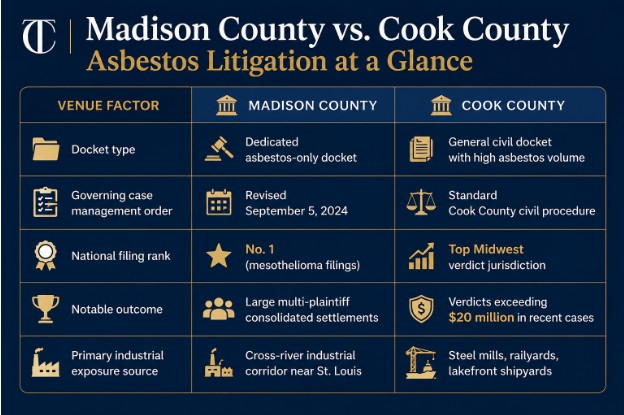
| Venue Factor | Madison County | Cook County |
| Docket type | Dedicated asbestos-only docket | General civil docket with high asbestos volume |
| Governing case management order | Revised September 5, 2024 | Standard Cook County civil procedure |
| National filing rank | No. 1 (mesothelioma filings) | Top Midwest verdict jurisdiction |
| Notable outcome | Large multi-plaintiff consolidated settlements | Verdicts exceeding $20 million in recent cases |
| Primary industrial exposure source | Cross-river industrial corridor near St. Louis | Steel mills, railyards, lakefront shipyards |
Historic verdicts function as settlement benchmarks even for cases that never reach trial. When a Cook County jury returns a verdict of tens of millions of dollars, defense counsel and insurers recalculate the expected value of every similar case still pending.
Illinois asbestos litigation has produced verdict ranges from $5 million to more than $20 million in recent years, and large consolidated settlements involving multiple Madison County plaintiffs set expectations for how multi-plaintiff cases resolve.
This dynamic matters for Wisconsin families comparing outcomes under Wisconsin’s 51% fault rule against pursuing a claim tied to an Illinois-based employer or supplier, since the venue with the strongest verdict history often produces the strongest settlement leverage before a case ever reaches a jury.
Ready to find out whether your family’s asbestos exposure history opens the door to a stronger venue? Third Coast Lawyers reviews exposure timelines at no cost and identifies every jurisdiction where your claim could be filed.
If you’re ready to get started, call us now!
Illinois imposes a two-year statute of limitations under 735 ILCS 5/13-202 that runs from the date a patient is diagnosed with an asbestos-related disease, not from the date exposure occurred decades earlier.
Illinois’ discovery rule applies regardless of where the patient currently lives, so a Wisconsin resident diagnosed after working at an Illinois industrial site retains the same two-year window as an Illinois resident.
Wisconsin claimants pursuing a wrongful death claim tied to asbestos exposure should confirm which state’s statute of limitations governs before assuming Wisconsin’s own deadline controls.
Filing in the wrong jurisdiction, or missing a shorter applicable deadline, can eliminate a valid claim entirely.
Choosing a venue requires matching the facts of an exposure history to the jurisdiction that best supports them. A worker who spent decades at a Wisconsin paper mill or shipyard has a straightforward filing in Wisconsin.
A worker whose exposure crossed state lines — time at an Illinois refinery, followed by years at a Wisconsin manufacturing facility — may have a genuine choice between venues, and that choice can affect both the speed of resolution and the range of likely compensation.
An experienced attorney reviews the full occupational history, identifies every named defendant’s ties to each potential jurisdiction, and files in the jurisdictions where the evidence and procedural rules favor the client most.
Third Coast Lawyers builds that occupational timeline before recommending a filing strategy, rather than defaulting to whichever state the client happens to live in.
Don’t let a preventable filing mistake cost your family the compensation this evidence supports. Third Coast Lawyers offers a confidential case review today.
Why is Madison County, Illinois, considered the top venue for asbestos lawsuits?
Madison County built a dedicated asbestos-only docket decades ago, staffed by judges experienced exclusively in asbestos procedure. That specialization, combined with expedited trial settings for mesothelioma patients, has kept Madison County ranked the nation’s top jurisdiction for mesothelioma filings for over a decade.
What is Illinois Senate Bill 328, and why does it matter for asbestos cases?
SB 328, signed into law on August 15, 2025, allows Illinois courts to exercise general jurisdiction over out-of-state corporations registered to do business in Illinois. The law lets manufacturers face Illinois asbestos lawsuits even when the underlying exposure occurred entirely outside Illinois.
Can a Wisconsin resident file an asbestos lawsuit in Illinois?
Yes, if the exposure occurred in Illinois or a defendant has sufficient Illinois business ties under the state’s expanded jurisdiction rules following Senate Bill 328. An experienced attorney should confirm the applicable statute of limitations and venue requirements before any filing decision.
How much have asbestos verdicts in Cook County reached?
Cook County juries have returned verdicts exceeding $20 million in recent asbestos and talc-exposure cases, including punitive damages awarded against corporate defendants found to have negligently exposed workers.
What is Illinois’ statute of limitations for mesothelioma claims?
Illinois allows two years from the date of diagnosis under 735 ILCS 5/13-202, not from the date of original exposure, under the state’s discovery rule. This deadline applies to residents and non-residents filing Illinois claims alike.
Why do defense attorneys treat Madison and Cook County verdicts as benchmarks?
Large verdicts in these counties shape how insurers and defense counsel value similar pending cases, since a jury’s willingness to award significant damages signals the expected outcome if a comparable case proceeds to trial.
Does filing in Madison County guarantee a faster resolution?
Not automatically, but Madison County’s expedited-setting rules let mesothelioma patients and older claimants request accelerated trial dates, which can shorten the time between filing and resolution compared to a standard civil docket.
What industries in Cook County produced the most asbestos exposure?
Chicago’s steel mills, railyards, and Lake Michigan shipyards exposed generations of workers to asbestos-containing insulation, gaskets, and fireproofing material throughout the twentieth century.
Can Illinois’ new jurisdiction law be challenged in court?
Yes. Legal commentators and business groups have raised constitutional concerns about SB 328’s consent-by-registration framework, and litigation testing its limits is expected to develop as Illinois courts apply the law.
Should someone with Wisconsin and Illinois work history consult an attorney before choosing a venue?
Yes. Venue selection affects applicable deadlines, available defendants, and likely settlement value, so a full occupational history review should precede any filing decision.

About the Author
Managing Partner · Toxic Tort Trial Attorney · Licensed in Wisconsin, Illinois, and Missouri
Anna G. O'Connor is the founding member and managing partner of Third Coast Lawyers and a trial attorney licensed in Wisconsin, Illinois, and Missouri. She practices across the Midwest and has tried more than 50 jury trials during her 20-plus-year legal career. Anna represents workers and families in toxic tort matters, including asbestos and mesothelioma claims, in Wisconsin, Illinois, and Missouri state courts, federal courts, and multi-district litigation proceedings.
