

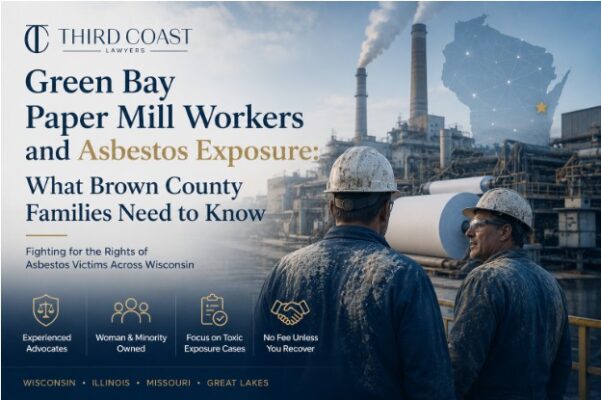
Green Bay paper mills insulated boilers, dryers, and steam lines with asbestos from the early 1900s into the 1980s. Brown County recorded 257 documented asbestos-related deaths between 1999 and 2017, according to EWG Asbestos Nation’s analysis of CDC WONDER mortality data.
A federal court case confirms asbestos exposure at a Procter & Gamble paper facility in Green Bay. Fort Howard Paper Company is independently documented as a Green Bay asbestos worksite.
A free case review with Third Coast Lawyers identifies which mill, employer, and products apply to a specific Brown County work history.
By the time an asbestos-related diagnosis appears, employment records and former coworkers are often already harder to find, since decades typically separate exposure from diagnosis. Schedule a free consultation with Third Coast Lawyers to identify what documentation still exists for a specific Green Bay mill and work history.
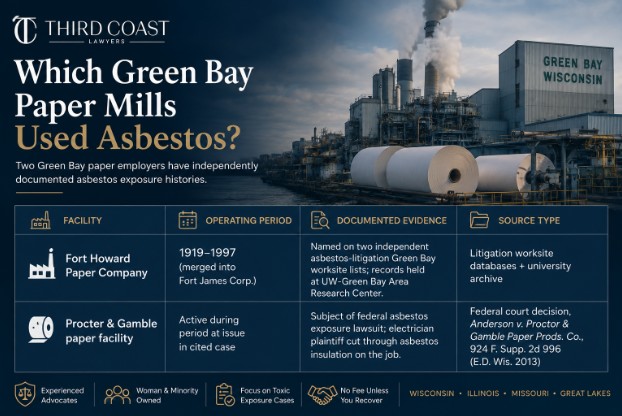
Two Green Bay paper employers have independently documented asbestos exposure histories:
| Facility | Operating Period | Documented Evidence | Source Type |
| Fort Howard Paper Company | 1919–1997 (merged into Fort James Corp.) | Named on two independent asbestos-litigation Green Bay worksite lists; records held at UW-Green Bay Area Research Center | Litigation worksite databases + university archive |
| Procter & Gamble paper facility | Active during period at issue in cited case | Subject of federal asbestos exposure lawsuit; electrician plaintiff cut through asbestos insulation on the job | Federal court decision, Anderson v. Proctor & Gamble Paper Prods. Co., 924 F. Supp. 2d 996 (E.D. Wis. 2013) |
Green Bay’s broader paper-mill corridor — part of the Fox River Valley documented on Third Coast Lawyers’ statewide paper mill page — supported many other pulp and paper producers through the 20th century.
Naming a former employer as an asbestos worksite requires documentary confirmation, not general industry history.
Claimants who worked at other Green Bay mills should bring employment records to a free case review rather than assume a company’s asbestos history from its name alone.
If you’re ready to get started, call us now!
A Green Bay-era paper mill used asbestos-containing materials in five main areas, per the client’s statewide paper mill exposure page:
Confined, poorly ventilated spaces — boiler rooms and pipe chases in particular — allow airborne fibers to accumulate rather than disperse, a pattern documented across enclosed industrial settings generally.
In the P&G federal case, the plaintiff worked as an electrician. His job required cutting through asbestos insulation and working in close proximity to it.
This pattern — exposure through proximity and incidental contact, not just direct installation — repeats across trades that never handled asbestos as their primary job.
Exposure intensity varied by role. Based on the exposure patterns documented across Third Coast Lawyers’ own paper mill and shipyard claims, the firm generally observes the following pattern:
Maintenance contractors carried the same exposure risk as directly employed mill workers. Contractors often worked at multiple Green Bay facilities over a career, not just one mill.
Asbestos-related diseases have a long latency period. CDC/NIOSH research on malignant mesothelioma mortality places the typical gap between exposure and clinical diagnosis at 20 to 40 years.
A Green Bay mill worker who last handled asbestos insulation in the 1970s or 1980s may only now be receiving a mesothelioma or asbestosis diagnosis.
This latency is why Wisconsin’s filing clock works differently than most injury claims:
Those manufacturers’ bankruptcy trusts may continue accepting claims after a mill closes, though individual trust rules and eligibility requirements vary by fund.
Reconstructing a mill exposure timeline generally relies on three categories of documentation:
Based on the firm’s own case experience, union dispatch and jobsite assignment records are often especially useful for Green Bay mill claims, since they can survive after a mill has closed even when the employer’s own personnel files were discarded.
Third Coast Lawyers assembles this documentation directly, coordinating with claimants to identify what still exists for a specific Green Bay facility and employment period.
If you’re ready to get started, call us now!
A Brown County mill worker or family can generally pursue compensation through two channels that can operate independently:
A worker exposed to products from multiple suppliers over a career at Green Bay mills may qualify to pursue several trust claims, subject to each trust’s own eligibility rules. Recovery can include:
A spouse who laundered contaminated work clothes may separately have grounds to pursue a claim, depending on the specific exposure pathway and other case-specific facts.
Case value depends on the specific diagnosis, the strength of product identification at the named mill, and the number of viable defendants or trusts a claim can reach — factors Anna Gonis O’Connor and the Third Coast Lawyers team evaluate during a free, no-obligation case review.
The firm works on a contingency fee basis, with no upfront costs.
Which Green Bay employers used asbestos insulation? Fort Howard Paper Company (1919–1997) and a Procter & Gamble Green Bay paper facility are independently documented Green Bay asbestos worksites, the latter through a federal court case. Other former Green Bay mill employers should be confirmed against employment records rather than assumed from general industry history.
Can a claim proceed if the mill has closed? Generally yes. Asbestos claims typically target the manufacturers whose products caused the exposure rather than the mill operator or employer. If a documented manufacturer’s product was present at the mill, the corresponding trust fund may continue accepting claims, though eligibility depends on that trust’s specific rules.
Do maintenance contractors have claims too? Yes. Contractors brought in for turnaround work, equipment repair, or insulation replacement generally faced the same direct exposure as employed mill workers, often across multiple Green Bay facilities. Employment through a contracting firm rather than the mill itself does not eliminate a potential claim.
How is a mill exposure timeline reconstructed? An attorney combines medical records, employment records such as W-2s and union files, and co-worker statements to establish which mill, which role, and which asbestos products applied to a specific work history. Union dispatch records are often especially useful once a mill’s own personnel files no longer exist.
Do claimants need to remember the name of the asbestos product? No. Product identification is typically established through employment records, co-worker statements, and known product-distribution history at a specific mill, not from the claimant’s own memory. An attorney handles this identification as part of the case investigation.
What is the deadline for a Brown County claim? Wisconsin generally requires personal injury claims within three years under Wis. Stat. § 893.54(1m), with the clock typically starting at diagnosis rather than the original mill exposure. The exact accrual date depends on case-specific facts an attorney should confirm before any filing decision.
Diagnosis often comes 20 to 40 years after the original exposure, which means the records proving a specific work history are already aging by the time a claim becomes possible. Contact Third Coast Lawyers at (847) 922-1178 for a free review of a Green Bay work history and the deadline that applies to it.

About the Author
Managing Partner · Toxic Tort Trial Attorney · Licensed in Wisconsin, Illinois, and Missouri
Anna G. O'Connor is the founding member and managing partner of Third Coast Lawyers and a trial attorney licensed in Wisconsin, Illinois, and Missouri. She practices across the Midwest and has tried more than 50 jury trials during her 20-plus-year legal career. Anna represents workers and families in toxic tort matters, including asbestos and mesothelioma claims, in Wisconsin, Illinois, and Missouri state courts, federal courts, and multi-district litigation proceedings.
