

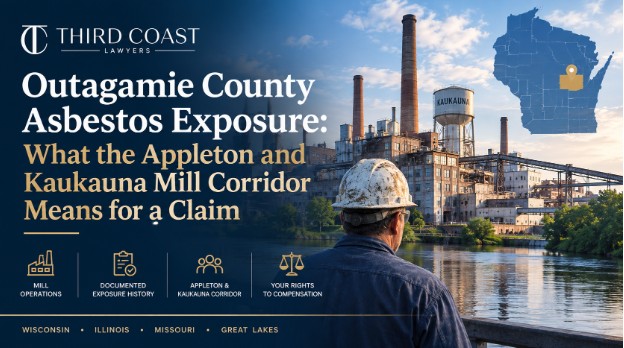
Outagamie County, home to Appleton and Kaukauna, sits inside the Fox River Valley — described on Third Coast Lawyers’ statewide paper mill page as historically containing the largest concentration of paper mills in the United States.
The county recorded 196 documented asbestos-related deaths between 1999 and 2017, per CDC WONDER mortality data as compiled by EWG Asbestos Nation.
That countywide mortality figure reflects historical exposure across the county broadly—it doesn’t, by itself, establish which specific mill any individual worker was exposed at.
A free case review with Third Coast Lawyers connects a documented diagnosis to a specific Outagamie County mill and work history.
Historical mill records get harder to reconstruct with each passing year. Schedule a free consultation to find out what still exists for a specific Appleton or Kaukauna work history.
Outagamie County’s asbestos exposure history traces directly to its position in the Fox River Valley — the largest concentration of paper mills in the United States, per Third Coast Lawyers’ statewide paper mill page.
Appleton and Kaukauna sit at the center of that corridor, and mills there ran continuously from the late 1800s through the 1980s, insulating boilers, steam lines, and dryer sections with asbestos-containing materials throughout.
The county’s 196 documented asbestos-related deaths between 1999 and 2017 place it among the client’s highest-priority Wisconsin counties, alongside Brown County (Green Bay) and Winnebago County — all three anchored by the same Fox River paper-mill corridor.
That county-wide total reflects the area’s cumulative industrial history; it isn’t a substitute for facility-specific evidence in an individual claim, which still requires connecting a specific worker to a specific mill, role, and time period.
If you’re ready to get started, call us now!
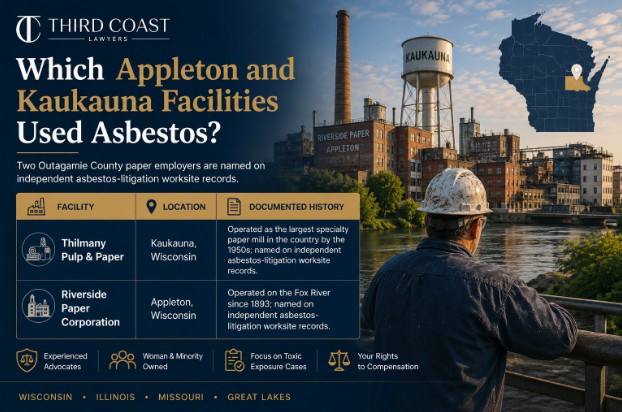
Two Outagamie County paper employers are named on independent asbestos-litigation worksite records:
| Facility | Location | Documented History |
| Thilmany Pulp & Paper | Kaukauna | Operated as the largest specialty paper mill in the country by the 1950s; named on independent asbestos-litigation worksite records |
| Riverside Paper Corporation | Appleton | Operated on the Fox River since 1893; named on independent asbestos-litigation worksite records |
Third Coast Lawyers doesn’t link directly to the sources documenting these worksites because they’re published by competing law firms, and the firm’s standing policy prohibits linking to other legal practices.
Kimberly-Clark’s Fox Valley mills, including facilities in the Appleton area, are documented on Third Coast Lawyers’ statewide paper mill page.
Naming a specific former Outagamie County employer as an asbestos worksite requires documentary confirmation, not general industry history — several other historically prominent Fox Valley paper companies do not currently have that documentation confirmed.
Claimants who worked at other Outagamie County mills should bring their employment records to a free case review rather than assume a company’s asbestos history from its name or location alone.
Exposure intensity in the Fox Valley mill corridor followed the same pattern documented on Third Coast Lawyers’ statewide paper mill page.
Insulators and pipefitters cut, fitted, and applied asbestos pipe covering and boiler insulation by hand throughout Fox Valley mills, while boiler operators worked full shifts inside boiler rooms insulated with asbestos block and refractory material.
Maintenance workers faced episodic but intense exposure during scheduled shutdowns, stripping and replacing insulation and gaskets, while machinists and paper machine operators were exposed near dryer sections, where the statewide page documents that asbestos-containing felts shed fibers as they wore from heat and friction during normal operation.
Electricians were exposed by proximity, working near insulated equipment rather than handling asbestos material directly.
Maintenance contractors carried the same exposure risk as directly employed mill workers, often across multiple Fox Valley facilities over a career rather than a single mill.
If you’re ready to get started, call us now!
The Fox River’s contamination history involves a legally separate issue from asbestos exposure, and the two shouldn’t be confused.
The EPA’s Lower Fox River and Green Bay Superfund site addresses polychlorinated biphenyls (PCBs) — not asbestos — discharged into the river by paper companies producing carbonless copy paper from the 1950s through 1971.
Appvion, Inc. (headquartered in Appleton) and NCR Corporation are named settling defendants in that cleanup, alongside Georgia-Pacific and P.H. Glatfelter, under a consent decree overseen by the U.S. District Court for the Eastern District of Wisconsin.
That PCB litigation is a distinct legal matter: different chemical, different exposure pathway (environmental and dietary, primarily through contaminated fish, rather than occupational inhalation), different defendants, and a different legal framework (federal CERCLA Superfund law rather than state personal injury tort law).
A worker’s occupational asbestos exposure inside an Outagamie County mill — from insulation, gaskets, or dryer felts — is a separate claim from any Fox River PCB exposure, even when both trace back to the same employer or the same riverside facility. An attorney evaluates each independently.
Reconstructing an Outagamie County mill exposure timeline generally relies on the same evidence framework used across Third Coast Lawyers’ Wisconsin claims: a written diagnosis identifying the specific asbestos-related disease, supported by pathology and imaging reports; employment records such as W-2 forms, Social Security earnings statements, union membership files, and pension documents establishing which mill, which role, and which years; and co-worker statements or product documentation identifying which specific asbestos products were present at a given facility during the claimant’s employment.
Union dispatch and jobsite assignment records are especially useful for Fox Valley mill claims generally, since they can survive after a mill has closed or changed ownership even when the employer’s own personnel files were discarded — a pattern already documented on Third Coast Lawyers’ shipyard exposure page for other Wisconsin industrial claims.
Wisconsin’s general venue statute, Wis. Stat. § 801.50, governs where a civil claim, including an asbestos personal injury claim, may properly be filed — generally the county where the defendant resides or does business, or, for certain claims, the county where the claim arose.
This is a jurisdictional and procedural determination, not a rule of thumb, and courts evaluate it for each defendant named in a specific case rather than assuming it based on the location of exposure alone.
You can search case filings and records through Wisconsin Circuit Court Access, the state’s public case-lookup system.
Wisconsin’s statute sets a three-year period for personal injury claims under Wis. Stat. § 893.54(1m).
Wisconsin case law, not the statute itself, determines when that clock actually starts under the discovery rule — and for asbestos disease specifically, the Wisconsin Supreme Court held in Sopha v. Owens-Corning Fiberglas Corp., 230 Wis. 2d 212 (1999), that a later, medically distinct malignant asbestos condition can create a new, separate cause of action, with its own filing clock.
“Diagnosis starts the clock” is not a single automatic trigger — which diagnosis, on which date, tied to which condition, determines the applicable deadline, and an attorney should confirm it against the specific facts.
A closed or sold mill does not automatically end a claim’s viability. Asbestos claims often target the manufacturers of the products installed at a mill rather than the mill operator, though which parties are properly named as defendants is case-specific and depends on the facts and evidence available.
Those manufacturers’ bankruptcy trusts may continue accepting claims after a mill closes, subject to each trust’s own eligibility rules.
Which Outagamie employers are linked to asbestos use?
Thilmany Pulp & Paper (Kaukauna) and Riverside Paper Corporation (Appleton) are named on independent asbestos-litigation worksite records. Kimberly-Clark’s Fox Valley mills are documented on the client’s statewide paper mill page. Confirm other former employers against employment records first.
Can a claim be filed if the work was in another county?
Generally yes. Wisconsin’s venue rules under Wis. Stat. § 801.50 typically look to where a defendant resides or does business, or in some cases where the claim arose, so work history spanning Outagamie and neighboring counties doesn’t prevent a claim. An attorney evaluates the specific defendants involved.
Does Fox River PCB litigation affect an asbestos claim?
No. Fox River PCB contamination and occupational asbestos exposure are separate legal matters involving different chemicals, different exposure pathways, and different legal frameworks. An asbestos claim tied to mill insulation or gaskets proceeds independently of any Fox River PCB litigation, even against the same employer.
How long does an Outagamie County claim take?
Timelines vary by case complexity, number of defendants, and whether the claim resolves through negotiation, trust fund claims, or litigation. Trust fund claims often resolve faster than lawsuits, while cases involving multiple manufacturers can take longer.
What if the worker has died?
Wisconsin’s Wrongful Death Act, referenced in Wis. Stat. § 893.54(2), addresses filing rights for surviving family members separately from the deceased’s own personal injury deadline. The specific window and how it interacts with the deceased’s diagnosis history depend on the facts, and an attorney should confirm the applicable deadline before assuming a claim is time-barred.
What if the employer or mill has closed?
A closed or sold mill doesn’t end a claim. Asbestos claims often target the manufacturers of the products installed there rather than the mill operator, and those manufacturers’ bankruptcy trusts may continue accepting claims regardless of the mill’s current status.
Do family members of Outagamie County mill workers face exposure risk too?
Possibly. A spouse who laundered a mill worker’s contaminated work clothes may have grounds to pursue a secondary exposure claim, depending on the specific exposure pathway and other case-specific facts an attorney evaluates individually.
What does it cost to bring an Outagamie County claim?
Third Coast Lawyers handles these claims on a contingency fee basis — no upfront costs and no attorney fees unless the firm recovers compensation. The contingency percentage and any case costs are explained fully at the start of every engagement.
Contact Third Coast Lawyers at (847) 922-1178 for a free review of an Outagamie County work history and which deadline applies to it.

About the Author
Managing Partner · Toxic Tort Trial Attorney · Licensed in Wisconsin, Illinois, and Missouri
Anna G. O'Connor is the founding member and managing partner of Third Coast Lawyers and a trial attorney licensed in Wisconsin, Illinois, and Missouri. She practices across the Midwest and has tried more than 50 jury trials during her 20-plus-year legal career. Anna represents workers and families in toxic tort matters, including asbestos and mesothelioma claims, in Wisconsin, Illinois, and Missouri state courts, federal courts, and multi-district litigation proceedings.
