

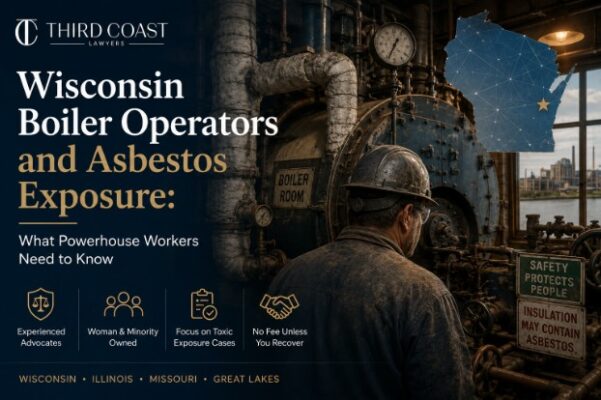
Wisconsin boiler operators worked inside the source of asbestos exposure, not near it. They tended boilers insulated with asbestos block, packed with asbestos gaskets, and lined with asbestos refractory material as part of their day-to-day work.
A free case review with Third Coast Lawyers connects a documented diagnosis to a specific Wisconsin plant, boiler room, and employment history.
Boiler room exposure histories can be dense, and documenting them gets harder with each passing year. Schedule a free consultation with Third Coast Lawyers to identify what still exists for a specific Wisconsin plant and work history.
A boiler operator’s job kept them in the boiler room for a full shift, unlike other trades that came in only for occasional repairs. That continuous presence created a different exposure profile than a trade that visited the same room only when something needed fixing:
| Exposure Factor | Boiler Operator | Visiting Maintenance Trade |
| Time in boiler room | Full shift, daily | Limited to the repair or inspection window |
| Proximity to insulated equipment | Constant, working beside boilers and steam lines throughout the shift | Intermittent, only while performing the specific task |
| Routine tasks involving asbestos material | Adjusting valve packing and monitoring insulated equipment were common duties at many plants | Direct handling only during the repair itself |
| Exposure source | Own routine tasks plus any work performed by other trades in the same room | Primarily own repair work, with some ambient exposure from others present |
This table describes a general exposure pattern, not a measured comparison of total dose between trades or a claim that every boiler operator performed every listed task.
Specific duties varied by plant, employer, and era — an attorney evaluates each individual’s actual role and exposure based on the specific facility and work history, not this table alone.
Third Coast Lawyers’ review of the boiler room asbestos claims it has handled has observed a recurring pattern: the room itself was enclosed and poorly ventilated, so fibers released by any activity — an operator’s own work or another trade’s repairs — stayed in the air the operator breathed for the length of the shift.
A 1982 field survey by Mount Sinai researchers William J. Nicholson, George Perkel, and Irving J. Selikoff, published as Occupational Exposure to Asbestos: Population at Risk and Projected Mortality 1980–2030 in the American Journal of Industrial Medicine (Vol. 3, pp. 259–311), documented asbestos-related chest X-ray findings among stationary engineers surveyed in the New York metropolitan area.
If you’re ready to get started, call us now!
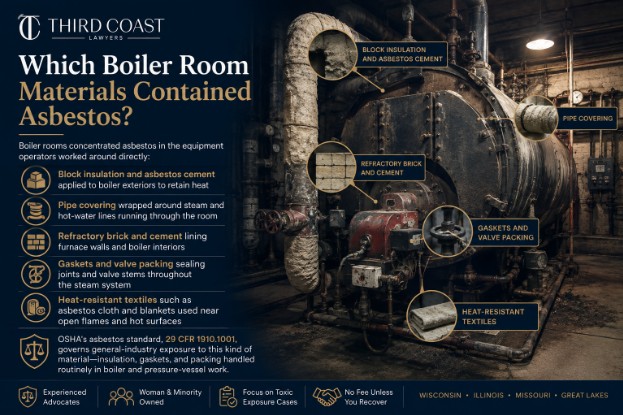
Boiler rooms concentrated asbestos in the equipment operators worked around directly:
OSHA’s asbestos standard, 29 CFR 1910.1001, governs general-industry exposure to this kind of material—insulation, gaskets, and packing handled routinely in boiler and pressure-vessel work.
Boiler operators worked wherever a facility needed industrial-scale steam or heat. Third Coast Lawyers’ statewide jobsite page documents four Wisconsin sectors with named facilities:
A specific facility, plant name, and employment period are what connect a diagnosis to a viable claim.
Anna Gonis O’Connor and the Third Coast Lawyers team match that history to the manufacturers and trust funds it points to.
Boiler room asbestos exposure wasn’t limited to the operator alone. Fibers released in a confined space affect everyone working in it:
A boiler operator’s own claim and a family member’s secondary exposure claim can sometimes trace back to the same boiler room — one from direct occupational exposure, the other from fibers carried home on the operator’s clothing.
Reconstructing a boiler operator’s Wisconsin work history generally draws on:
Third Coast Lawyers coordinates directly with claimants to determine which of these records still exist for a specific Wisconsin plant and employment period, applying the same evidence framework used across the firm’s Wisconsin asbestos claims, including whether a local permit record applies.
If you’re ready to get started, call us now!
Wisconsin’s statute sets a three-year period for personal injury claims under Wis. Stat. § 893.54(1m). Wisconsin case law, not the statute itself, determines when that three-year clock starts under the discovery rule—and for asbestos disease specifically, that determination has its own complications.
The Wisconsin Supreme Court held in Sopha v. Owens-Corning Fiberglas Corp., 230 Wis. 2d 212 (1999), that a later, medically distinct malignant asbestos condition — mesothelioma diagnosed after an earlier, non-malignant asbestos finding — can create a new, separate cause of action, with its own filing clock starting when that later condition is discovered or reasonably should have been discovered.
What that means in practice: “diagnosis starts the clock” is not a single automatic trigger that applies the same way to every boiler operator’s history.
Which diagnosis, on which date, tied to which condition, determines the applicable deadline — and mesothelioma’s latency period commonly runs 20 to 40 years from exposure to diagnosis, per CDC/NIOSH research, meaning an operator who last worked a Wisconsin boiler room in the 1970s or 1980s may only now be facing a relevant diagnosis.
An attorney should confirm the applicable deadline against the specific diagnosis history rather than applying a single formula.
A closed plant or a former employer that no longer exists does not automatically end a claim’s viability, since asbestos claims typically target the manufacturers of the products installed at the plant rather than the plant operator — though how that distinction applies depends on the specific facts and defendants involved. Those manufacturers’ bankruptcy trusts may continue accepting claims after a plant closes, subject to each trust’s own eligibility rules.
Did boiler operators face higher exposure than other trades?
Boiler operators worked inside boiler rooms continuously, unlike trades that entered only for repairs. Whether that means higher exposure than a specific trade depends on the facility and role — an attorney evaluates each work history individually.
Does licensing history help prove a work timeline?
It can, but only where it exists. Wisconsin has no statewide boiler operator license, so licensing evidence would come from local city or county permit records, not a state database. Employment and Social Security records remain primary.
Can one claim cover several employers?
Generally yes. A boiler operator who worked at multiple Wisconsin plants over a career can typically pursue a claim covering exposure at each documented facility, provided the work history and product identification support it at each site.
What if exposure happened at more than one plant?
Exposure across multiple plants doesn’t prevent a claim. An attorney evaluates the full work history rather than a single facility, and multi-site exposure may expand which manufacturers and trust funds are relevant to the case.
Are retired operators still within the deadline?
Possibly, but there’s no single automatic trigger. Wisconsin’s discovery rule ties the deadline to when the relevant diagnosis was made and reasonably discovered, not to retirement or the original exposure, and the specific diagnosis and condition determine which clock applies. An attorney should confirm the applicable deadline against the individual’s diagnosis history.
What if the plant where exposure occurred has closed?
A closed plant doesn’t end a claim. Asbestos claims typically target the manufacturers of the products installed there, and those manufacturers’ bankruptcy trusts may continue accepting claims after the plant itself is gone, subject to each trust’s rules.
Do family members of boiler operators face exposure risk too?
Possibly. A spouse who laundered a boiler operator’s work clothes may have grounds to pursue a secondary exposure claim, depending on the exposure pathway and other case-specific facts an attorney evaluates individually.
What does it cost to bring a boiler operator’s claim?
Third Coast Lawyers handles these claims on a contingency fee basis — no upfront costs and no attorney fees unless the firm recovers compensation. The contingency percentage and any case costs are explained fully at the start of every engagement.
Contact Third Coast Lawyers at (847) 922-1178 for a free review of a Wisconsin boiler room work history and the deadline that applies to it.

About the Author
Managing Partner · Toxic Tort Trial Attorney · Licensed in Wisconsin, Illinois, and Missouri
Anna G. O'Connor is the founding member and managing partner of Third Coast Lawyers and a trial attorney licensed in Wisconsin, Illinois, and Missouri. She practices across the Midwest and has tried more than 50 jury trials during her 20-plus-year legal career. Anna represents workers and families in toxic tort matters, including asbestos and mesothelioma claims, in Wisconsin, Illinois, and Missouri state courts, federal courts, and multi-district litigation proceedings.
