

A Wisconsin asbestos exposure lawyer identifies the employer, industry, and specific asbestos products behind a claimant’s exposure, then builds the medical and employment record needed to evaluate a claim against Wisconsin’s filing deadline.
Third Coast Lawyers handles claims tied to paper mills, foundries, shipyards, and power plants across Brown, Winnebago, Milwaukee, and Outagamie counties — among the counties with the state’s highest documented asbestos-related death totals.
A free case review identifies which deadline, trust funds, and legal options apply to a specific work history.
Wisconsin’s filing deadline is fact-specific and starts ticking before many claimants realize it. Schedule a free consultation with Third Coast Lawyers to confirm which deadline applies before employment records and witnesses become harder to locate.
A Wisconsin asbestos exposure lawyer connects a documented medical diagnosis to a specific work history, identifies the manufacturers whose products caused the exposure, and evaluates whether to pursue a lawsuit, one or more trust fund claims, or both.
The role centers on three tasks: matching the claimant’s employer and trade to known asbestos products, coordinating expert medical causation review, and managing parallel filings against multiple manufacturers’ trust funds alongside any viable lawsuit.
Product identification drives the case. A pipefitter at a Fox Valley paper mill and an insulator at a Manitowoc shipyard handled different materials from different manufacturers. Hence, each worker’s toxic injury claim depends on the specific pipe covering, gaskets, or boiler insulation documented at their jobsite.
Anna Gonis O’Connor, founding member and managing partner at Third Coast Lawyers, has litigated more than 50 jury trials across state, federal, and multidistrict proceedings, including toxic tort matters where product identification and medical causation determine the outcome.
When a claimant’s own employment file is missing or incomplete — common when a mill or shipyard closed decades ago — the firm reconstructs work history from secondary sources:
Social Security earnings statements confirming employer and years worked, union membership and dispatch records showing jobsite assignments, pension or retirement plan documents, and co-worker statements identifying the specific products present at a given site during the claimant’s employment.
This reconstruction process is often what determines whether product identification is possible at all.
The distinction between mesothelioma, asbestosis, and asbestos-related lung cancer also shapes a claim’s timeline, since each condition carries its own diagnosis date and Wisconsin courts have addressed how a prior non-malignant diagnosis affects a later malignant one.
Third Coast Lawyers evaluates which asbestos-related disease applies and confirms the applicable deadline before recommending a filing strategy, then assembles the documentation needed to prove the exposure history against the correct defendants.
Consulting an attorney does not require knowing which product or company caused the exposure in advance — identifying the responsible manufacturer is part of the investigation an attorney performs, though naming a specific defendant becomes necessary once a claim is filed and pursued through litigation or a trust.
If you’re ready to get started, call us now!
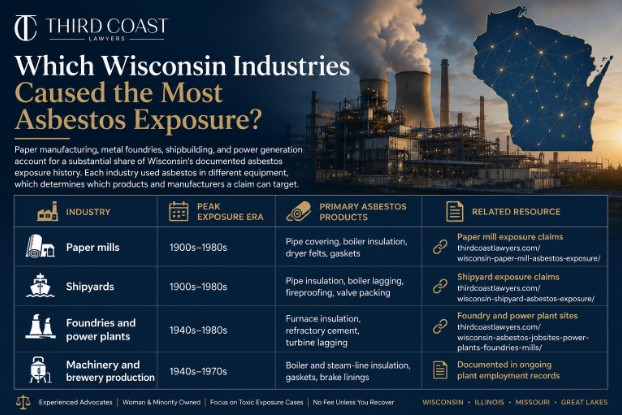
Paper manufacturing, metal foundries, shipbuilding, and power generation account for a substantial share of Wisconsin’s documented asbestos exposure history. Each industry used asbestos in different equipment, which determines which products and manufacturers a claim can target.
| Industry | Peak Exposure Era | Primary Asbestos Products | Related Resource |
| Paper mills | 1900s–1980s | Pipe covering, boiler insulation, dryer felts, gaskets | Paper mill exposure claims |
| Shipyards | 1900s–1980s | Pipe insulation, boiler lagging, fireproofing, valve packing | Shipyard exposure claims |
| Foundries and power plants | 1940s–1980s | Furnace insulation, refractory cement, turbine lagging | Foundry and power plant sites |
| Machinery and brewery production | 1940s–1970s | Boiler and steam-line insulation, gaskets, brake linings | Documented in ongoing plant employment records |
The Fox River Valley’s concentration of paper mills made paper manufacturing a historically dominant source of Wisconsin asbestos exposure, a pattern reflected in the client’s own paper mill exposure page. Great Lakes shipyards in Manitowoc, Sturgeon Bay, and Superior separately produced some of the most intensive below-deck exposure documented in the state.
Milwaukee, Brown, Winnebago, and Outagamie counties recorded the highest combined totals of asbestos-related deaths among Third Coast Lawyers’ priority counties, a pattern that tracks to the state’s industrial history rather than population size alone.
| County | Estimated Asbestos-Related Deaths (1999–2017) | Dominant Historical Industry |
| Milwaukee County | 851 | Manufacturing, shipping, industrial trades |
| Brown County | 257 | Paper mills (Green Bay) |
| Winnebago County | 224 | Paper mills (Fox Valley) |
| Outagamie County | 196 | Paper mills (Appleton) |
Figures reflect combined asbestosis, mesothelioma, and estimated asbestos-linked lung cancer deaths for 1999–2017, compiled by EWG Asbestos Nation from CDC WONDER mortality data—the same dataset and date range cited on the client’s existing paper mill exposure page, with no discrepancy found between the two.
These figures describe historical mortality, not confirmed claim volume, and are presented here as context for where documented exposure has been heaviest.
Product identification, exposure duration, and available witnesses vary by county, and each factor shapes which trust funds and defendants a claim can reach.
Missing employment records don’t have to end a claim before it starts. Contact Third Coast Lawyers to identify which documentation still exists for a specific mill, foundry, or shipyard.
Insulators, pipefitters, boiler operators, and maintenance workers who handled raw asbestos materials directly are generally documented as facing the most intensive exposure across Wisconsin’s paper mills, foundries, and shipyards.
Insulators and pipefitters cut, shaped, and applied asbestos pipe covering and boiler insulation by hand, often in confined boiler rooms and pipe chases with limited ventilation.
Family members of these workers also face exposure risk.
A spouse who laundered contaminated work clothes may have grounds to pursue a secondary asbestos exposure claim without ever setting foot in the mill, foundry, or shipyard, though whether a specific case supports liability depends on the exposure pathway, the defendant, and other case-specific facts an attorney evaluates individually.
If you’re ready to get started, call us now!
Wisconsin generally requires personal injury claims to be filed within three years under Wis. Stat. § 893.54(1m), with the discovery rule typically starting the clock at diagnosis rather than at the original exposure.
The exact accrual date can depend on the specific disease, when the connection between the disease and asbestos exposure was reasonably discoverable, and other case-specific facts — Third Coast Lawyers confirms the applicable deadline for each claimant’s circumstances during a free case review rather than applying a single formula to every case.
Wisconsin courts have addressed how a diagnosis of a non-malignant asbestos condition, such as asbestosis, relates to the filing clock for a later-diagnosed malignant condition like mesothelioma; an attorney should confirm how that precedent applies to a specific diagnosis history.
A family member pursuing a wrongful death claim after an asbestos-related death generally has a separate window from the deceased’s own personal injury deadline, and the interaction between the two depends on the status of any claim the deceased could have brought.
Trust fund deadlines are set individually by each trust’s own distribution procedures rather than a single statewide rule.
Some trusts currently impose no outside filing deadline, while others apply their own timing or documentation requirements, so trust-specific rules should be checked for each fund a claim may reach — a step Third Coast Lawyers performs as part of trust identification.
Third Coast Lawyers handles Wisconsin asbestos claims on a contingency fee basis, meaning claimants pay no upfront costs and owe no attorney fees unless the firm recovers compensation.
The contingency percentage and any associated case costs are explained in full at the start of every engagement.
Compensation in a Wisconsin asbestos claim can come from two sources, and a single claimant often qualifies for both at the same time: a lawsuit against a solvent manufacturer still operating today, and a claim filed against one or more of the dozens of active asbestos trust funds established when manufacturers such as Johns Manville and Owens Corning filed for bankruptcy.
A worker exposed to products from several manufacturers over a career — common in paper mill and shipyard work, where multiple suppliers served the same site — can pursue trust claims against every bankrupt manufacturer identified while separately pursuing litigation against any manufacturer that remains solvent; the two paths do not offset one another.
Wisconsin’s comparative negligence rules under Wis. Stat. § 895.045 can affect recovery in cases involving more than one defendant; how fault is allocated among multiple asbestos product manufacturers is more case-specific than a single fault-percentage threshold can capture, and an attorney evaluates each defendant’s relative contribution individually.
Case value depends on the specific diagnosis, the strength of product identification evidence, and the number of viable defendants or trusts a claim can reach, all factors Third Coast Lawyers evaluates during the free case review.
Anna Gonis O’Connor and the Third Coast Lawyers team manage each claim directly from intake through resolution, coordinating medical causation review, trust fund identification, and litigation when negotiation doesn’t reach a fair resolution.
Is there a deadline to file a Wisconsin asbestos claim?
Wisconsin generally requires personal injury claims within three years under Wis. Stat. § 893.54(1m), typically starting at diagnosis. The exact accrual date depends on case-specific facts, so an attorney should confirm the deadline before making any filing decision.
Can a family file after the worker has died?
Generally yes. Wisconsin’s Wrongful Death Act gives surviving family members a separate window from the deceased’s own personal injury deadline. How that window applies depends on whether the deceased could still have brought a claim before death, which an attorney should verify on a case-by-case basis.
What if the employer no longer exists?
Asbestos claims typically target the manufacturers of the products that caused exposure, not the employer or mill operator. If a specific manufacturer’s product caused the exposure, the corresponding trust fund may continue accepting claims even if the employer no longer operates.
Does a workers’ compensation claim block an asbestos lawsuit?
Under Wisconsin law, workers’ compensation is generally the exclusive remedy against an employer, per the Wisconsin Department of Workforce Development. It does not automatically block claims against third-party product manufacturers, though how that distinction applies to a specific case depends on the facts.
What records are needed to start a claim?
A written diagnosis from a treating physician, employment records showing the employer and years worked, and any co-worker contacts or product documentation. Union membership records and Social Security earnings statements often help establish work history at closed or restructured facilities.
What compensation might a Wisconsin asbestos claim recover?
Recovery depends on the diagnosis, the strength of product identification, and the number of viable defendants or trust funds. Compensation can include medical expenses, lost income, pain and suffering, and, in wrongful death claims, loss of financial support for surviving family members.
Can someone file a Wisconsin claim after moving out of state?
Moving does not automatically eliminate a Wisconsin-based claim, but the governing deadline, venue, and applicable law depend on where the exposure occurred, where the diagnosis occurred, and other jurisdictional facts. An attorney should evaluate these facts before assuming any single state’s rule applies.
How long does a Wisconsin asbestos case take to resolve?
Timelines vary by case complexity, number of defendants, and whether the claim resolves through negotiation or litigation. Trust fund claims often resolve faster than lawsuits, while multidistrict litigation involving multiple manufacturers can extend the timeline significantly.
Do claimants need to know which product caused their exposure to consult an attorney?
No. During the investigation phase, an attorney identifies the responsible manufacturer using employment records, co-worker statements, and product distribution history. Product identification typically becomes necessary only once a claim is filed and pursued.
Wisconsin’s asbestos filing deadline generally runs three years from diagnosis under Wis. Stat. § 893.54(1m), though the exact accrual date depends on case-specific facts an attorney should confirm.
Paper mills, foundries, shipyards, and power plants across Brown, Winnebago, Milwaukee, and Outagamie counties account for a large share of the state’s documented exposure history.
Dozens of trust funds remain active even when the original employer or manufacturer no longer operates, and case value depends on product identification, diagnosis, and how many defendants are reachable.
Evidence and witnesses become harder to locate every year a work history goes undocumented. Contact Third Coast Lawyers at (847) 922-1178 for a free, confidential review of a specific work history and the deadlines that apply to it.

About the Author
Managing Partner · Toxic Tort Trial Attorney · Licensed in Wisconsin, Illinois, and Missouri
Anna G. O'Connor is the founding member and managing partner of Third Coast Lawyers and a trial attorney licensed in Wisconsin, Illinois, and Missouri. She practices across the Midwest and has tried more than 50 jury trials during her 20-plus-year legal career. Anna represents workers and families in toxic tort matters, including asbestos and mesothelioma claims, in Wisconsin, Illinois, and Missouri state courts, federal courts, and multi-district litigation proceedings.
